

On 28 November 1967, a young researcher at Cambridge recorded a signal that repeated with clockwork precision. Initially, astronomers did not even rule out the possibility that it was being transmitted by extraterrestrials. In reality, its source was a star whose existence had previously been predicted only through theoretical calculations. Seven years later, the postgraduate student’s supervisor received the Nobel Prize for the discovery, but she herself was not among the laureates.
A mysterious mark on the chart recorder paper
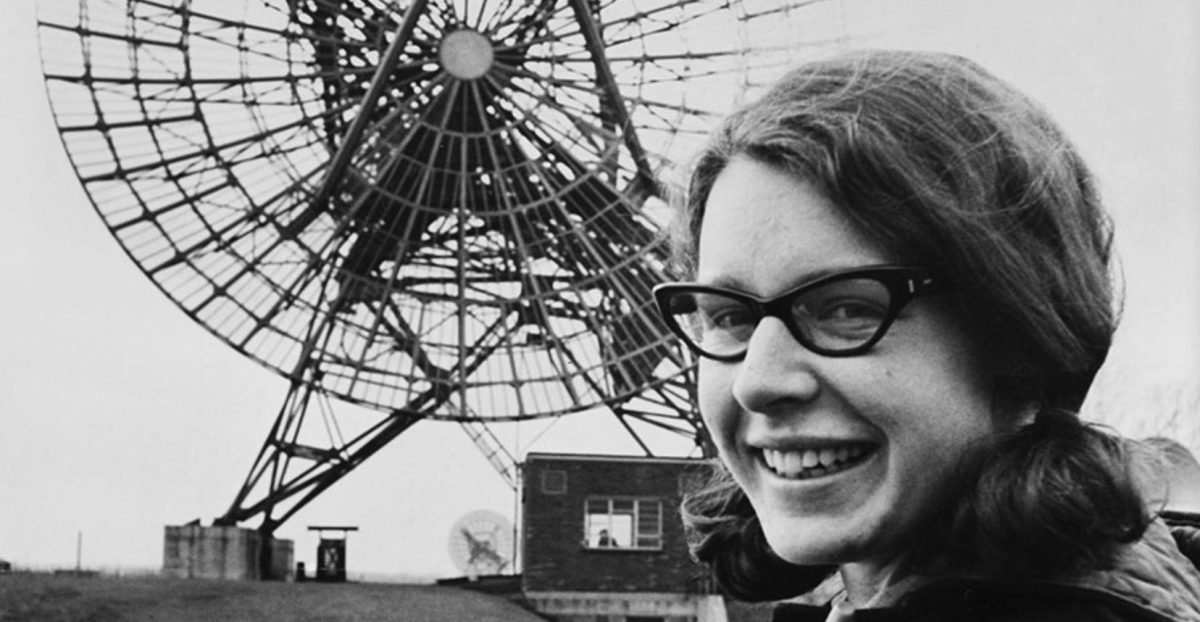
Every day, nearly 30 metres of paper emerged from the chart recorder of a radio telescope near Cambridge. A pen traced a wavy line across the paper, rising higher as stronger radio signals arrived from the sky. It was the responsibility of postgraduate student Jocelyn Bell to examine these recordings by hand. The telescope had been built to search for quasars – extremely bright nuclei of distant galaxies. Radio emissions from quasars scintillate as they pass through a stream of particles from the Sun, and it was this scintillation that Jocelyn Bell was looking for in the recordings.
In early August 1967, a brief fluctuation of an unfamiliar shape appeared among hundreds of metres of recordings. It resembled neither a quasar signal nor interference from terrestrial equipment. The telescope’s antennas were stationary, and as the Earth rotated, a strip of sky gradually passed above them. A similar signal subsequently appeared several more times, always originating from the same region of the sky. How had such a tiny detail been noticed at all, when kilometres of paper had accumulated over several months of observations?
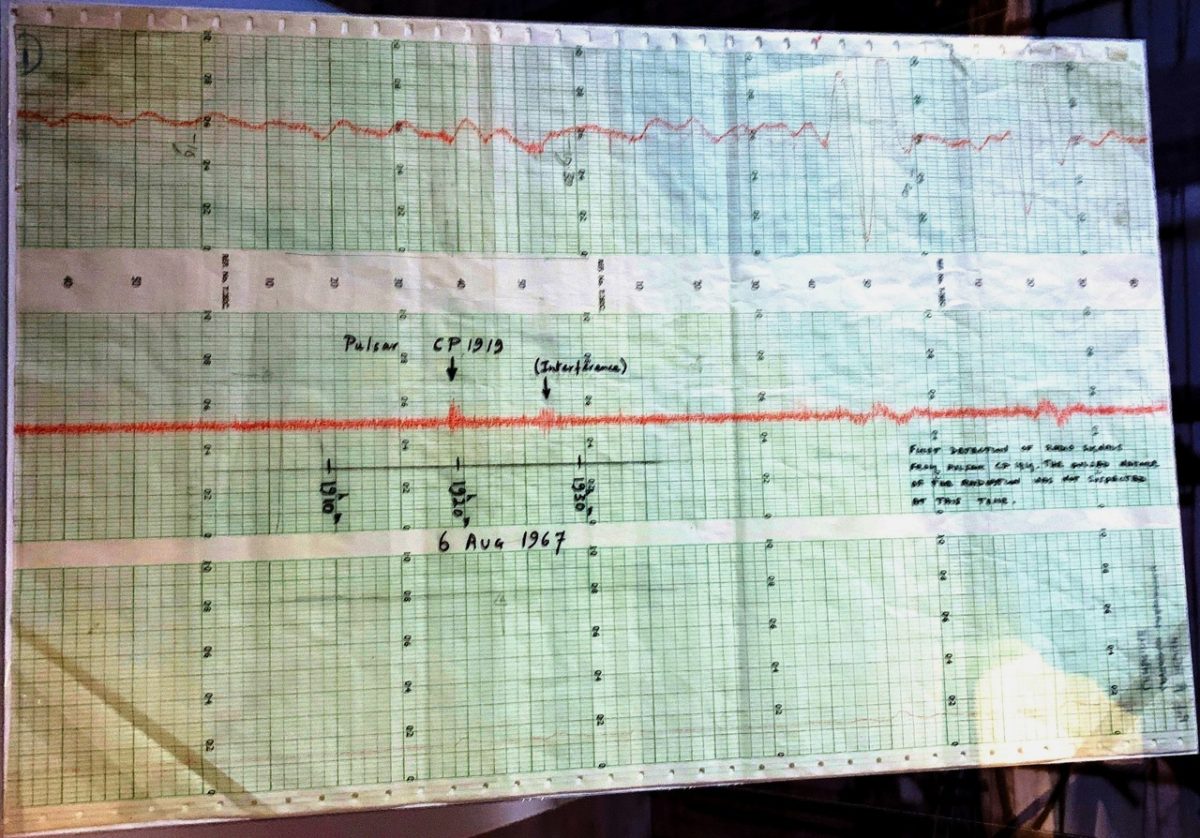
To examine the signal in greater detail, a faster chart recorder was connected to the telescope in early November. For almost a month, it recorded nothing unusual. However, on 28 November, the signal reappeared, and the high-speed recording revealed that the mark consisted of individual short pulses. They arrived at regular intervals of 1.337 seconds, slightly slower than the heartbeat of a person at rest.
Examining every mark on the paper
Jocelyn Bell knew the Cambridge radio telescope’s recordings better than anyone else, having spent two years helping to build it. Together with her colleagues, she installed antennas using a soldering iron and a sledgehammer. Eventually, the antenna array occupied a field equivalent in size to 57 tennis courts.

Source: University of Glasgow
The antennas picked up not only signals from the sky but also radio interference from terrestrial equipment, such as welding machines, sparking thermostats, and cars without radio interference suppression. Jocelyn Bell had learnt to recognize these sources by the shape of the line on the paper, so she knew exactly what ordinary interference looked like.
There was another reason why she examined the recordings so meticulously. In 1965, the young woman from Northern Ireland arrived at Cambridge after graduating from the University of Glasgow. She was convinced that she had been admitted by mistake because she was not intelligent enough to belong there. Today, this experience is known as impostor syndrome – the feeling that you do not belong somewhere and are about to be exposed.
According to Bell, the term did not exist at the time, so she simply decided to work as hard as possible to ensure that she had done everything she could. ‘Having people with impostor syndrome among us is not such a bad thing,’ Jocelyn Bell joked about her own experience half a century later. In 1967, however, it was precisely the meticulousness born of her self-doubt that prevented her from dismissing the unusual fluctuation as interference.
‘Little green men’ in the margins of a logbook
The pulses arrived at intervals of 1.337 seconds with such regularity that astronomers knew of no natural object capable of producing such a signal. In the margin of her logbook, Jocelyn Bell wrote ‘LGM-1: Little Green Men?’, a humorous reference to extraterrestrials. She later admitted that she somewhat regretted the joke. Nevertheless, the hypothesis was investigated.

The researchers first looked for a terrestrial explanation. The day after the recording of 28 November, Antony Hewish, Jocelyn Bell’s supervisor, contacted neighbouring observatories to enquire about possible artificial interference. However, terrestrial equipment rotates with the Earth, whereas the source consistently appeared at the same point among the stars and moved across the sky with them. It therefore had to be located far beyond our planet. The signal was also detected by another telescope in Cambridge, ruling out an instrument malfunction.
To estimate the distance to the source, astronomers took advantage of a property of radio waves. In the tenuous gas between stars, waves of different frequencies travel at different speeds, meaning that lower-frequency waves arrive slightly later than higher-frequency ones. From this delay, the researchers calculated that the source was approximately 200 light-years away, far beyond the Solar System but within our Galaxy.
The possibility of an artificial signal from a distant source remained. If it were being transmitted by inhabitants of another planet, that planet would be orbiting its star. As a result of this motion, the interval between pulses would alternately shorten and lengthen slightly – a phenomenon known as the Doppler effect. A similar shift was present in the signal, but it was fully consistent with the Earth’s own orbital motion around the Sun. No additional shift indicating the motion of a distant planet was detected.
In December, Jocelyn Bell noticed a second similar signal in the recordings, this time originating from a different region of the sky, and at Christmas she discovered two more. She later explained that it was unlikely that two groups of little green men in different parts of the sky would simultaneously decide to transmit signals. Following these discoveries, the extraterrestrial hypothesis was abandoned. A natural source with such a precise rhythm meant that the Galaxy contained objects unlike anything astronomers had ever observed.
A neutron star’s beam resembles that of a lighthouse
The remaining question was what produced such regular pulses. As it later turned out, the answer would determine whether astronomers could detect, for the first time, an object that had previously existed only in theoretical calculations. In late January 1968, the team submitted a paper describing the discovery to the journal Nature, and it was published in February. Astronomers around the world then began searching for similar sources and attempting to explain their nature.
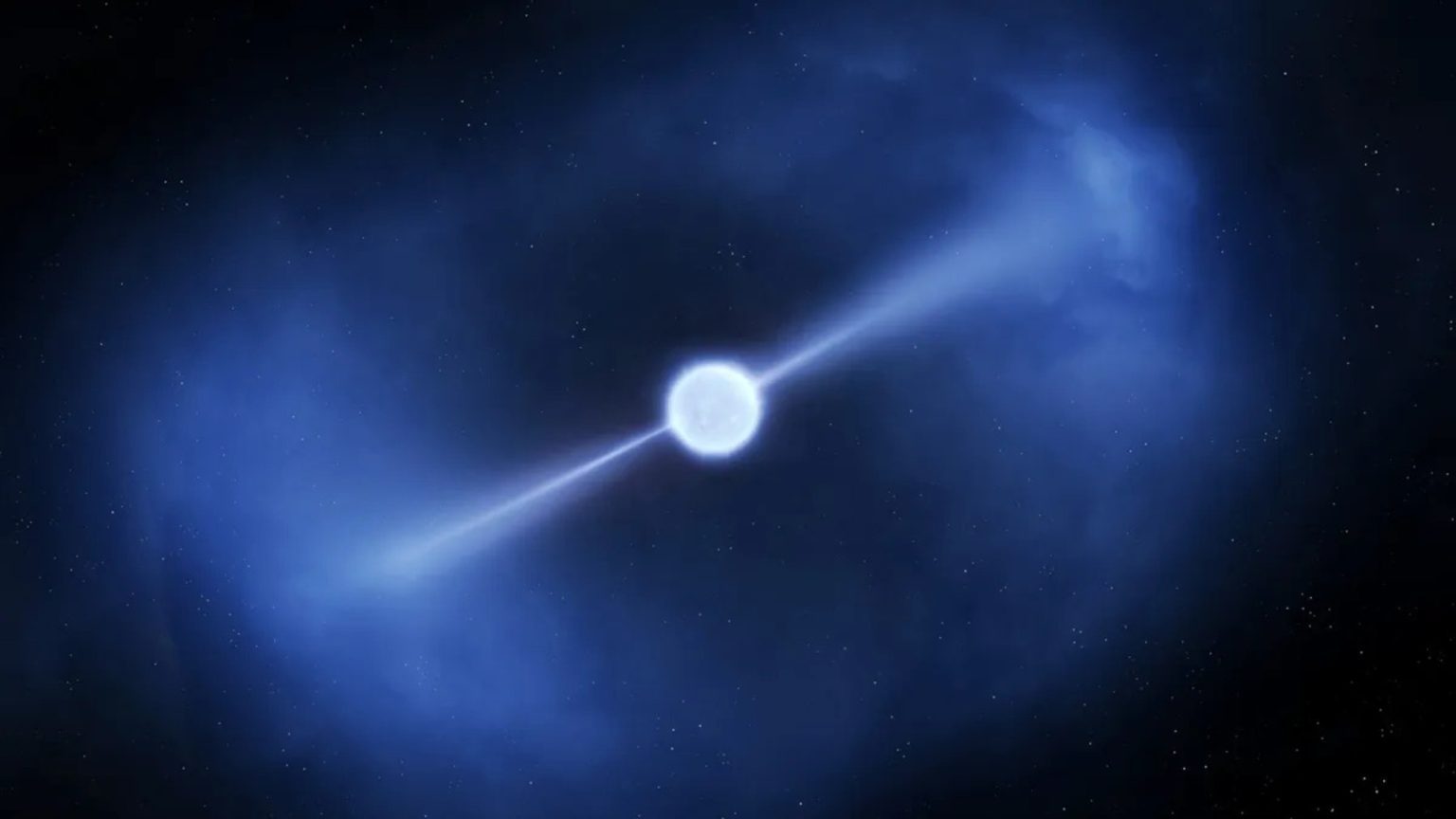
The new class of objects was named pulsars, derived from the term pulsating radio source. Antony Hewish initially believed that the pulses were indeed caused by internal oscillations of a star. The explanation that remains broadly accepted today was proposed in May 1968 by astrophysicist Thomas Gold. He suggested that a pulsar was a neutron star.
A neutron star forms when a massive star explodes as a supernova. Its matter is compressed so densely that a thimbleful of it would weigh approximately as much as the entire human population. The star itself is about 20 kilometres across, making it smaller than Kyiv.
Such a star rotates rapidly, and its powerful magnetic field produces narrow beams of radio emission. The beams sweep around as the star rotates, much like the beam of a lighthouse. Each time a beam sweeps across the Earth, a telescope detects a pulse. A pulsar therefore does not actually pulsate but rotates, and the first pulsar ever discovered completes one rotation every 1.337 seconds.
The existence of neutron stars had been predicted by theorists as early as 1933, but none had been observed before the discovery of pulsars. The regular sequence of marks on the Cambridge chart recorder paper became the first recording of a signal from a neutron star. Today, more than 3,000 pulsars are known.

The Nobel Prize went to the supervisor
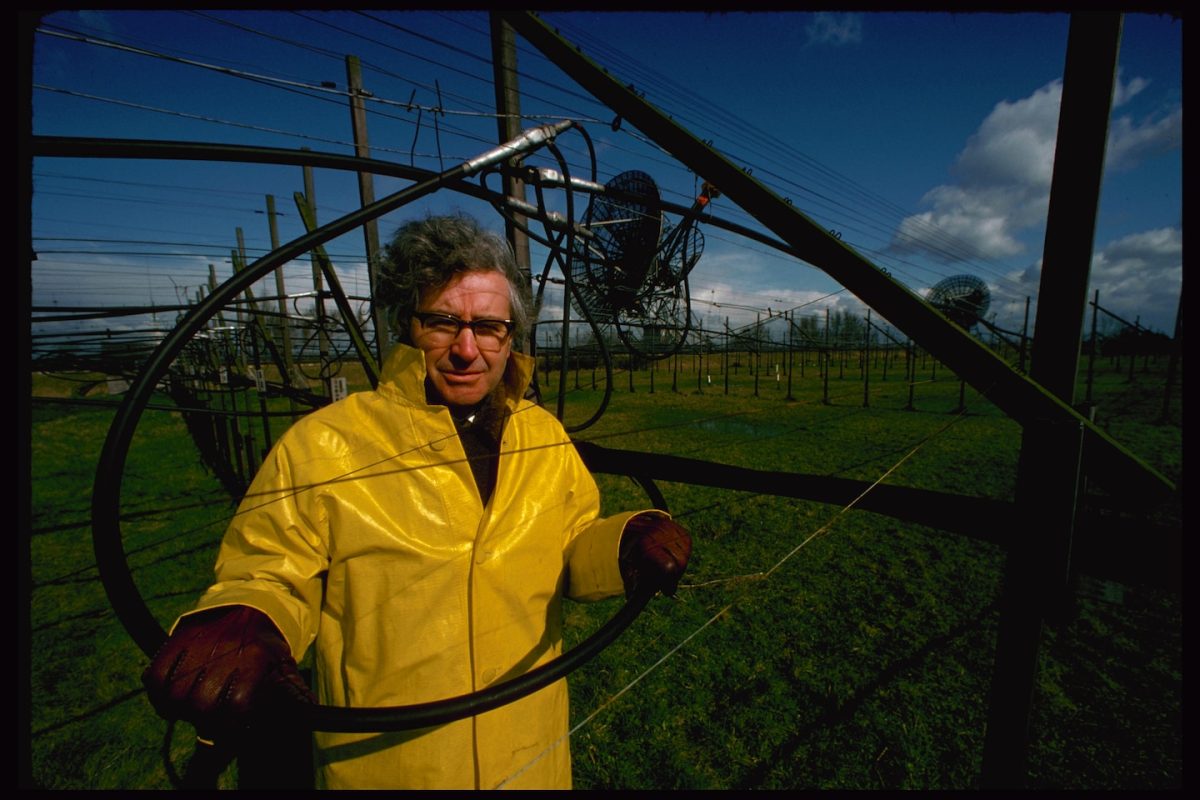
In 1974, the Nobel Prize in Physics was awarded for work in astronomy for the first time. The laureates were two Cambridge radio astronomers. Martin Ryle was recognized for a technique in which signals from several small antennas are combined to achieve the resolution of a single large telescope, while Antony Hewish was honoured for his decisive role in the discovery of pulsars.
Jocelyn Bell was not among the laureates, although she was listed as the second of five authors of the discovery paper, immediately after Antony Hewish. The decision was criticized by many prominent astronomers, including the British astrophysicist Fred Hoyle.
Source: Corbis / Getty Images
Over time, the story came to be retold as an example of a woman being denied an award because of her gender. Gender bias was indeed present. Following the discovery, Jocelyn Bell was asked not about pulsars but whether she was taller than Princess Margaret.
Bell herself, however, explained the committee’s decision differently. In 1977, Jocelyn Bell said that awarding the prize to postgraduate students would diminish its value, except in very exceptional circumstances, and that her case was not one of them. Many years later, she added that the Nobel Committee rarely recognized students at the time and that the prize was often regarded as an award for the senior man on the team. The pulsar had been discovered by a postgraduate student who meticulously examined every metre of paper, but the Nobel Prize at the time was awarded to those who supervised the work.
Three million dollars for others
Jocelyn Bell received her largest financial award for the discovery of pulsars 51 years later. In 2018, she was awarded the Special Breakthrough Prize in Fundamental Physics, established by Yuri Milner together with other philanthropists. Unlike the annual prize, the special prize can also be awarded for a discovery made many years earlier. It was worth $3 million. The 1974 Nobel Prize, which Antony Hewish shared with Martin Ryle, would have been worth approximately $620,000 in 2018 prices, making the new award nearly five times larger.

Jocelyn Bell donated the entire sum to fund postgraduate scholarships for women, members of ethnic minorities, and refugees wishing to pursue research in physics. The fund is administered by the UK’s Institute of Physics. According to Bell, unconscious bias continues to influence recruitment for scientific positions, and the scholarships are intended to counteract it. The researcher who was once overlooked by the Nobel Committee directed her prize money towards those who remain the least likely to be recognized in science.
