

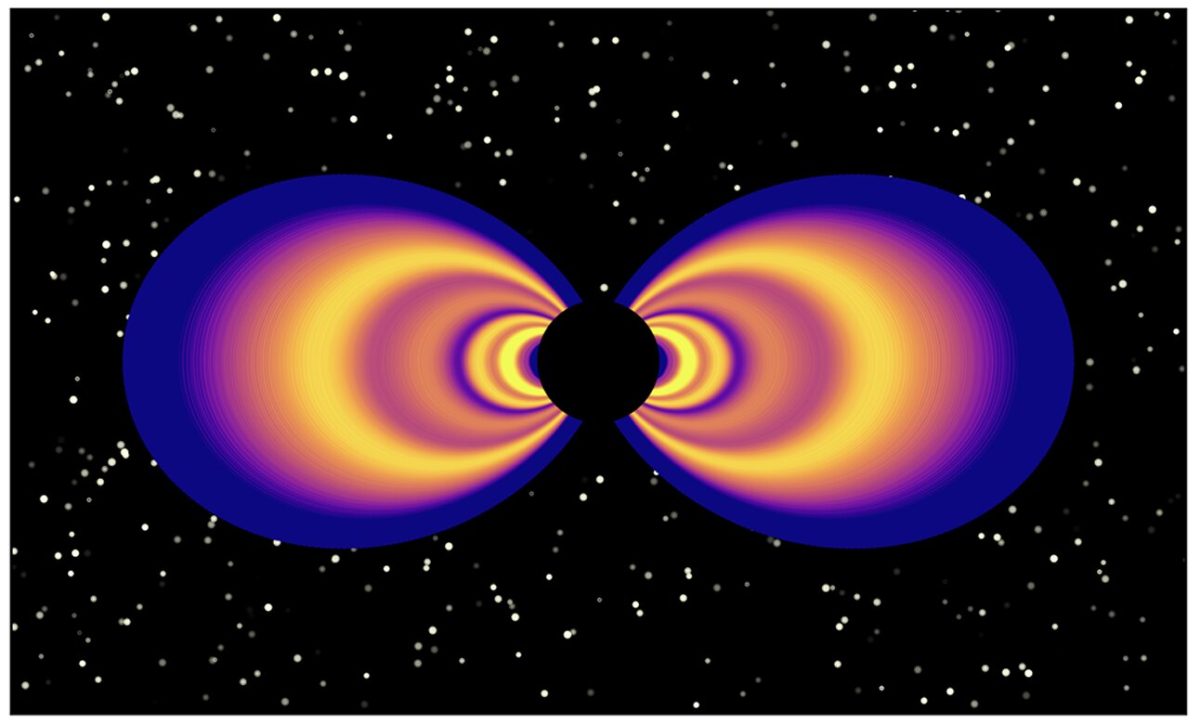
As part of a new study published in the journal Space Exploration, a team led by Vivian Pierrard from the Royal Belgian Institute for Space Aeronomy has, for the first time, directly detected four separate electron radiation belts that formed after an intense solar storm in 2024 and became visible the following month.
Formation of Temporary Belts
In Earth’s magnetic field, energetic particles are trapped in two ring-shaped regions known as the Van Allen radiation belts, which are usually separated by a gap where particles are particularly scarce. This structure can change dramatically during solar storms, but until now, astronomers have had little clear understanding of exactly how this happens. The website phys.org reports on the study.
In 2012, NASA’s Van Allen probes detected a temporary third belt following a solar storm, which persisted for about four weeks. Analyzing this structure, astronomers suggested that it might have formed when the storm pushed electrons into the normally sparsely populated regions between the belts, while electromagnetic waves drove them out of other areas. However, when solar activity reached its peak in 2014–2015, the same three-belt configuration did not reappear.
Then, in May 2024, Earth was hit by a powerful geomagnetic storm known as the “Mother’s Day Storm.” This storm, the strongest in the previous 20 years, provided researchers with the best opportunity in many years to study how the Van Allen belts respond to extreme conditions.
Visualizing the Shape of the Radiation Belts
To do this, Pierrard’s team analyzed data on energetic electrons collected by a particle-measuring telescope installed aboard the European Space Agency’s (ESA) PROBA-V satellite, which orbits at an altitude of approximately 820 km above Earth. This allowed them to track how particle concentrations changed over time. By plotting these measurements along Earth’s magnetic field lines, they were able to visualize the overall shape of the belts. To avoid misleading results caused by short-term fluctuations within the belts, they counted a belt or a gap only if it persisted for more than five days.
Their results revealed four distinct radiation belts that formed in June 2024 and persisted for more than four weeks, after which the usual two-belt configuration returned in August. Later, following several additional storms between 2024 and 2026, three-belt structures appeared again, indicating that additional belts can form repeatedly.
The Influence of Electromagnetic Waves on Belt Structure
Pierrard’s team found that electrons displaced by the storm entered the usual gap, while new depleted regions formed elsewhere, dividing the radiation environment into additional belts. The structure also depended on electron energy: four belts appeared in several of the measured energy ranges, but not at the highest energies.
The researchers suggest that the new gaps most likely formed because electromagnetic waves knocked electrons out of the belts and into the atmosphere, but the exact causes of this phenomenon remain unclear.
Toward Understanding Earth’s Radiation Environment
Building on these findings, the team now hopes to solve this mystery through simulations and modeling. Further observations may help them distinguish between the roles of natural electromagnetic waves and human-generated radio signals, such as those from powerful transmitters used to communicate with submarines.
Ultimately, this further research could lead to a deeper understanding of Earth’s rapidly changing radiation environment. In turn, this could help improve satellite designs and assess radiation exposure for astronauts, as well as help the satellite systems we depend on better prepare for solar storms.
