

Researchers from the University of Queensland have demonstrated an unusual method of wireless communication, transmitting a text message straight through a brick wall without using any radio waves or electromagnetic signals. All they needed was gravity, an old university elevator, and an ultrasensitive detector. The team published the results of its work in the journal Science Advances.
The experiment was conducted in the Parnell Building on the university campus. The physicists operated a 1950s elevator between two floors, making its massive 1.8-ton counterweight move between two fixed positions. Each position of the weight corresponded to a binary code — a zero or a one. On the other side of a solid brick wall, in an adjacent restroom, the scientists installed a gravimeter — an instrument capable of detecting the tiniest changes in gravitational force.
By decoding the recorded fluctuations in the gravitational field, the researchers successfully read the transmitted word: Gravity.
Why Gravity Works Where Wi-Fi Fails
The main intrigue of the experiment lies in gravity’s unique ability to penetrate materials. The wireless signals we are familiar with — mobile communications, Wi-Fi, and radio waves — can easily weaken or be completely blocked by concrete floors, large amounts of water, or solid rock. By contrast, the gravitational field passes through any ordinary materials without obstruction.
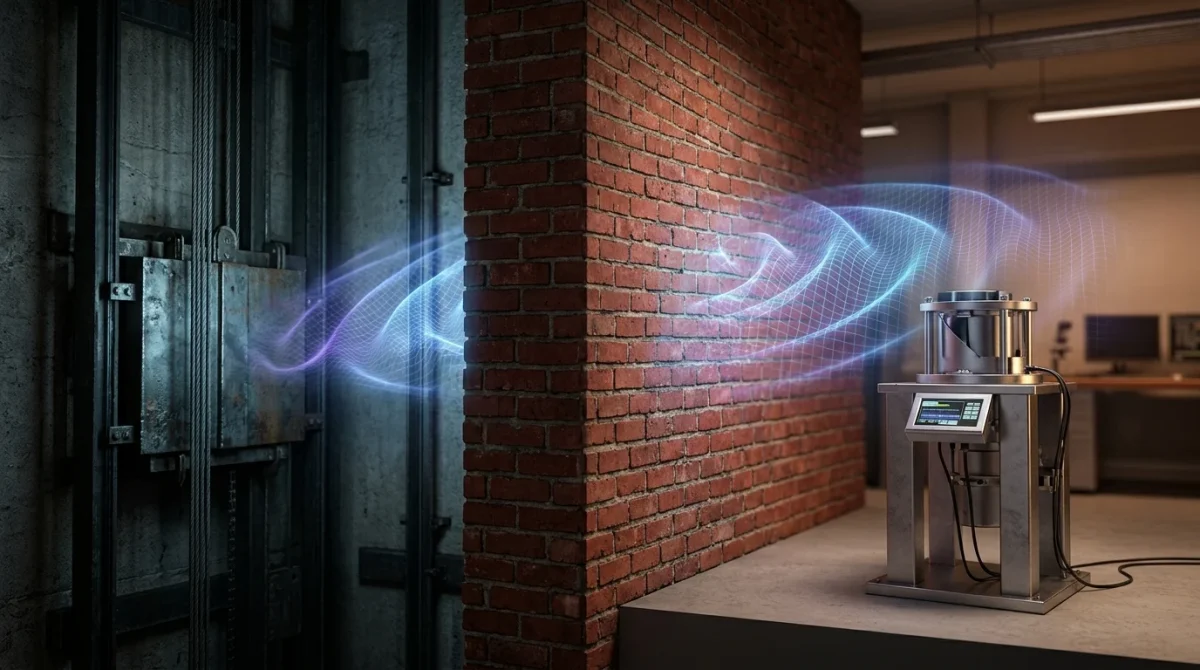
As Dr. Charles Woffinden from the School of Mathematics and Physics at the University of Queensland explains, a gravitational signal cannot simply be shielded by placing a physical barrier in its path. Anyone who has ever lost a connection in a tunnel or struggled with a weak router signal through a solid wall can easily understand the appeal of this approach. The principle itself is quite simple: any object with mass creates a gravitational field around itself, and moving that object changes the configuration of the field. These fluctuations are completely imperceptible to humans, but modern instruments are capable of detecting them.
Interestingly, the idea of a “gravitational telegraph” emerged accidentally from another project. According to Dr. Andrew Grothe, the team initially worked on contactless scales designed to determine the mass of trucks through their tiny gravitational attraction, without requiring them to drive onto a weighing platform. Once the physicists confirmed that the detector could reliably pick up the influence of large masses, they realized that by deliberately controlling the movement of a heavy object, these changes could be converted into digital zeros and ones.
At a Snail’s Pace
Despite the successful demonstration, the technology has an obvious weak point — a catastrophically low data transmission speed. Professor Andrew White admits that, because of the elevator’s considerable age, the system transmitted only 1 bit of information per minute. As a result, sending a single word took the scientists an entire hour, whereas modern networks transmit billions of bits per second.
The speed of this type of communication directly depends on three factors: the object’s mass, its speed of movement, and the sensitivity of the receiver. However, Professor White points out that more than a hundred years passed between the first telegraph and the advent of the mobile phone, so today’s experiment is only the first step.
The scientists associate the next stage in the development of this technology with quantum sensors, which use the laws of quantum physics to perform ultra-precise measurements. According to preliminary calculations by Professor Matthew Davis, replacing a conventional gravimeter with a quantum one — albeit under fairly ambitious assumptions — would make it possible to transmit signals over a distance of about 500 meters at speeds of up to 15 bits per minute. Even at these rates, gravitational communication will not replace home internet, but in the future it could become indispensable in places that neither light nor radio waves can penetrate — for example, underground or deep underwater.
Previously, we explained how scientists detected gravitational waves and what we know about them today.
Based on material from science.org
