

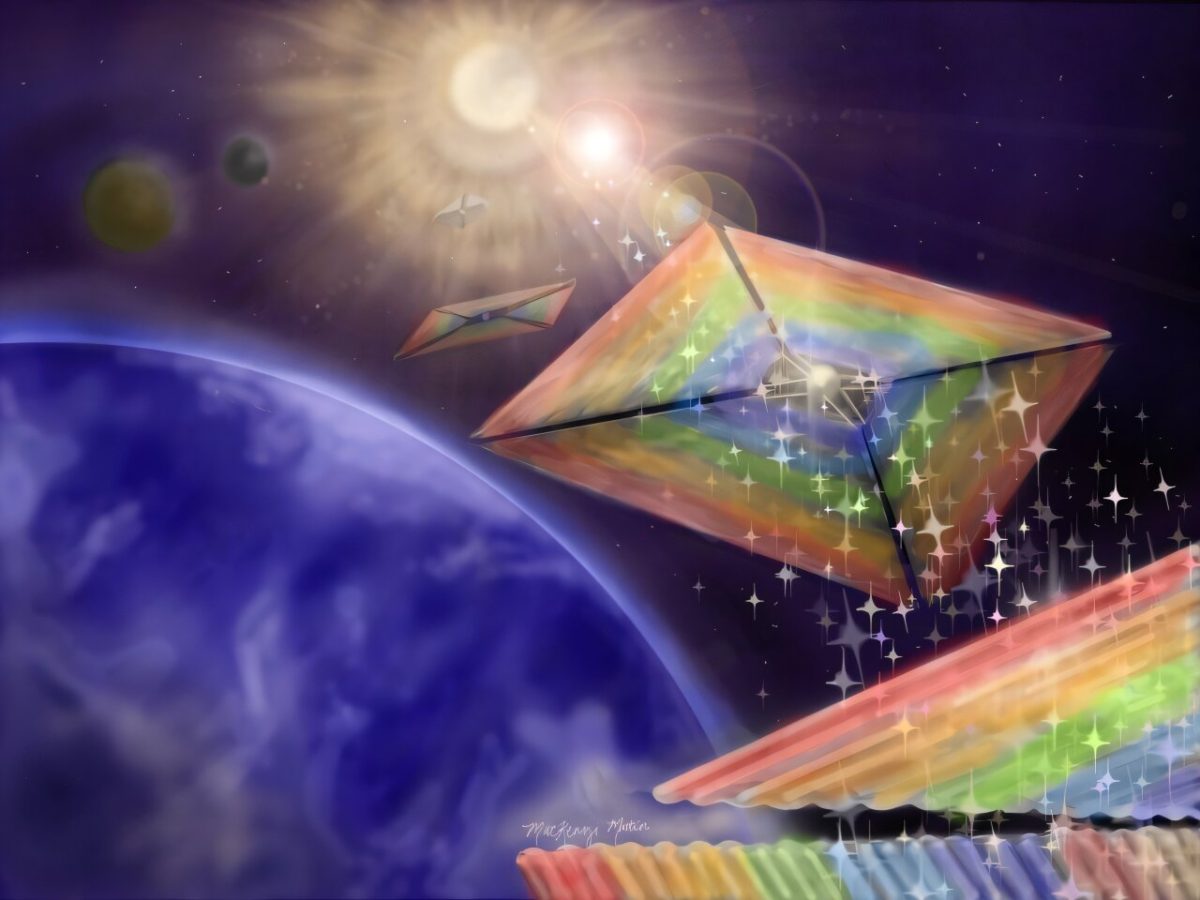
The idea of solar sails is not new. They have even been tested during spaceflights. However, they are now being proposed for manufacture using liquid crystals that diffract light. This will make these enormous surfaces appear rainbow-colored.
Movement Using the Diffraction of Sunlight
In a new paper, scientists from the Rochester Institute of Technology (RIT) described a method that will allow enormous solar sails to change their direction of motion sideways using a technology usually associated with flat screens — liquid crystals. This is reported by the website phys.org.
For many years, space enthusiasts with vivid imaginations have dreamed of traveling through the boundless expanses of space on beams of sunlight. Photons — the massless particles that make up these sunbeams — nevertheless carry momentum and can therefore provide a gentle push when they bounce off a surface. This very force underlies the concept of a “solar sail”, which has gained some popularity over the past decade, as several experimental flights have demonstrated that it is indeed possible.
Liquid crystal technology, most commonly used in liquid crystal displays (LCDs), could change how we think about controlling solar sails. RIT researchers have described a sail that, instead of acting like a giant mirror and tilting to turn relative to the Sun, uses diffraction to deflect sunlight at a steep angle, allowing the spacecraft to move sideways while remaining pointed directly at the Sun.
This solution has several advantages over traditional solar sails. To understand what they are, imagine holding an umbrella in a strong gust of wind. If you hold the umbrella directly facing the wind, it will push you straight backward — quite simple. But if you want to “turn” relative to the direction of the wind, you will have to tilt the umbrella. In doing so, you not only reduce the overall force of the wind acting on the umbrella but also make it much harder to control.
LCD Technology for a Solar Sail
Traditional solar sails face the same problem, only in space rather than in the atmosphere, and with sunlight instead of wind. Almost ten years ago, Grover Swartzlander Jr., one of the paper’s authors and an RIT professor, realized that microscopic optical patterns that reflect light sideways could replace the mechanical tilting of solar sails. To prove his point, he laid the foundations for what later became diffractive solar sails.
When light strikes a diffraction grating — the technical term for microscopic patterns embedded in the sail, similar to those etched onto a compact disc — it is deflected at steep, predictable angles even when the surface is pointed directly at the Sun. Deflecting light in one direction gives the sail an equal and opposite momentum in another direction, steering the spacecraft using only a simple roll maneuver.
Although much of the early research into diffractive sail prototypes focused on patterns etched into metal-coated films, these prototypes were difficult to scale up and fit inside a rocket fairing. This is why researchers turned to liquid crystals. In the new study, the RIT team drew on technical guidance from engineers at BEAM and researchers working on diffractive sails at the Johns Hopkins University Applied Physics Laboratory.
These flexible plastics contain rod-shaped molecules that naturally twist into microscopic spirals, forming layers with different refractive indices that deflect light through a phenomenon known as the Pancharatnam phase. This is a way of deflecting or slowing down light by changing the direction of oscillation of its waves (their “polarization”).
Sails made from this material have an additional advantage: they are lightweight, flexible, and easy to mass-produce, while also being able to fit inside a compact spacecraft.
A Three-Layer “Sandwich Structure” for a Sunshade
There is just one problem: an individual liquid crystal layer interacts only with light of a very specific wavelength, allowing the rest of the light to pass through unhindered while retaining all its ability to exert pressure. To find out how to solve this problem, the researchers turned to computer simulations and eventually used an optimization algorithm to develop a three-layer “sandwich structure” made of liquid crystals.
The top layer absorbs blue and visible light, the middle layer absorbs infrared light, and the bottom layer interacts only with longer-wavelength infrared rays. Despite the presence of these three separate layers, the total thickness of the film is only 5.5 micrometers, equivalent to one-tenth the thickness of a human hair.
Such a design would offer a significant advantage in one potential application of an enormous solar sail — as a “planetary sunshade.” Scientists have long proposed placing a giant sheet in orbit at the L1 Lagrange point between the Sun and Earth to reflect a small portion of the sunlight reaching our planet, with the aim of deliberately cooling it.
A “Diffractive Umbrella”
When using traditional materials, such an umbrella would have to tilt to maintain its position, which would consequently reduce the size of its shadow. By contrast, an umbrella made of diffractive material could maintain its position without reducing its dimensions.
Moreover, thanks to the new chiral liquid crystal design, even if the middle layer is removed, near-infrared wavelengths, which solar panels use to generate electricity, would still pass through. Alternatively, the layers could be configured to allow the red light needed for plant photosynthesis to pass through, while the rest of the sunlight would continue to exert pressure on the sail.
However, this concept is still at a very early stage. Not even a prototype of the three-layer system has been created yet, let alone one capable of withstanding the harsh conditions of launch or the constant impact of the solar wind. Nevertheless, this paper represents a step toward potentially solving one of the most fundamental problems in solar sail design — and given the significant advantages of solar sails as a propulsion system, it is only a matter of time before someone tests this new idea in the vacuum of space.
