

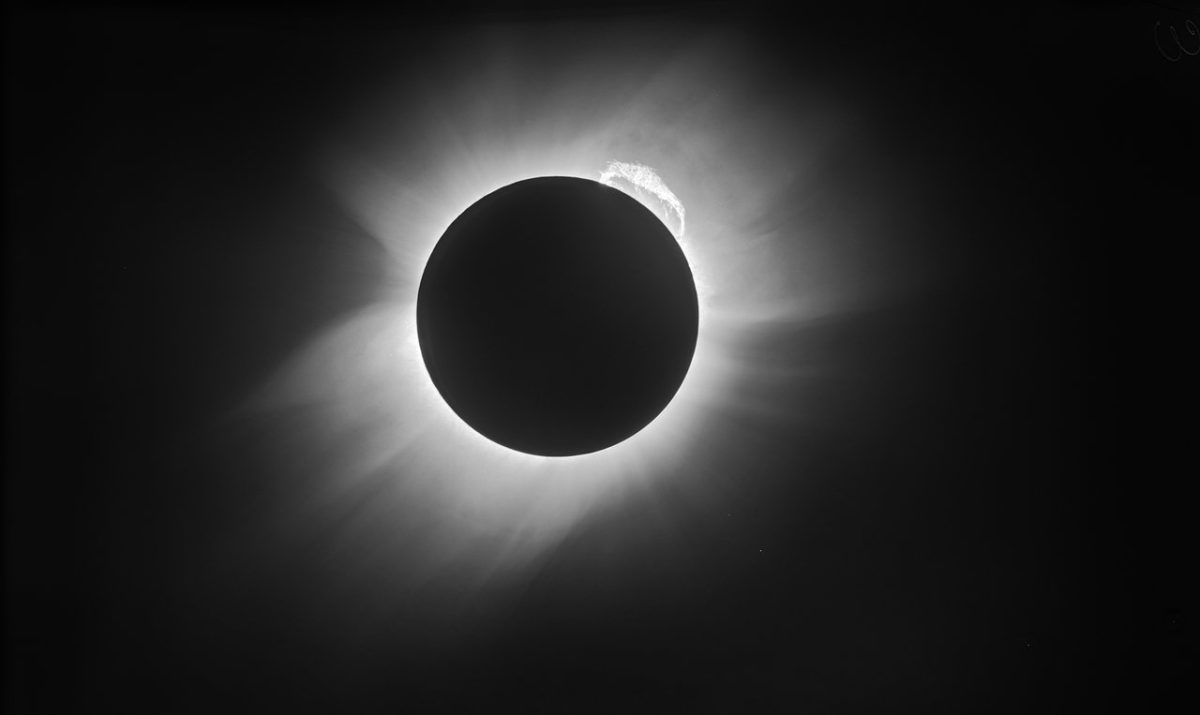
Astronomers already had a name for the hypothetical planet between Mercury and the Sun – Vulcan. All that was missing was the planet itself. Its gravity was supposed to explain Mercury’s unusual behaviour, which had been observed for decades. On 25 November 1915, Albert Einstein presented his final gravitational field equations which formed the basis of the general theory of relativity to the Prussian Academy of Sciences in Berlin. They implied that astronomers had observed something more interesting than a new planet. What had they actually measured?
Why astronomers searched for Vulcan
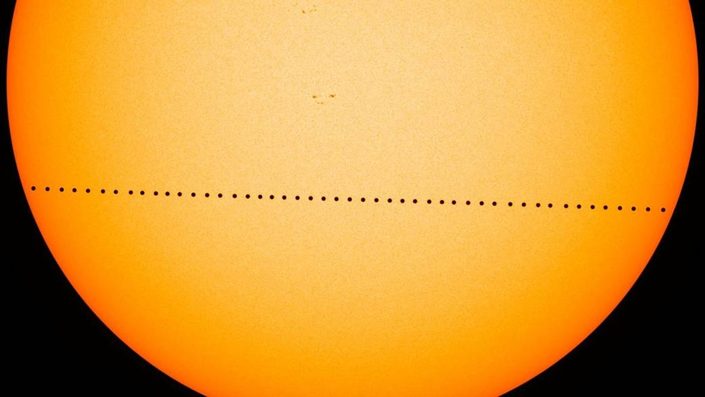
Vulcan was supposed to explain one peculiar feature of Mercury’s orbit. With each revolution of the planet around the Sun, the position of perihelion—the point in its orbit closest to the Sun—shifts slightly. Astronomers have taken into account how the gravity of neighboring planets causes Mercury’s orbit to gradually rotate. Yet over the centuries, perihelion has shifted by an additional 43 arcseconds more than predicted by calculations based on Newtonian gravity. This is approximately the angle subtended by a small coin viewed from 100 m (328 ft) away.
Urbain Le Verrier had already solved a similar mystery. From deviations in Uranus’s motion, the French astronomer calculated where to look for an unknown planet, and that was precisely where astronomers found Neptune. Could Mercury’s motion likewise betray the presence of an unseen neighbour? The hypothetical planet was named Vulcan. Astronomers searched for it between Mercury and the Sun for decades, but no observation reliably confirmed its existence.
The solution came in 1915. Einstein calculated how Mercury moves through spacetime curved by the Sun’s mass and obtained precisely the additional rotation measured by astronomers. Vulcan was no longer needed. This new picture of gravity began with a thought experiment for which Einstein did not even need a telescope.
Four Thursdays in Berlin
In 1907, Einstein imagined a person falling from a roof. If they released a set of keys, the keys would remain beside them for a moment. Without air resistance and under the same initial conditions, both the person and the keys fall with the same acceleration. An astronaut sees the same thing when releasing a pencil aboard a space station. Earth attracts the station, the pencil, and the astronaut, so all three are continuously in a state of free fall, moving around the planet.
Now imagine two balls released from the same height, some horizontal distance from each other. Both fall towards the center of the Earth, so their paths barely converge. It is in such changes in the relative motion of freely falling bodies that the curvature of space-time manifests itself. In the general theory of relativity, mass and energy change the geometry of space and time, and a body in free fall moves along the straightest possible path – a geodesic line.
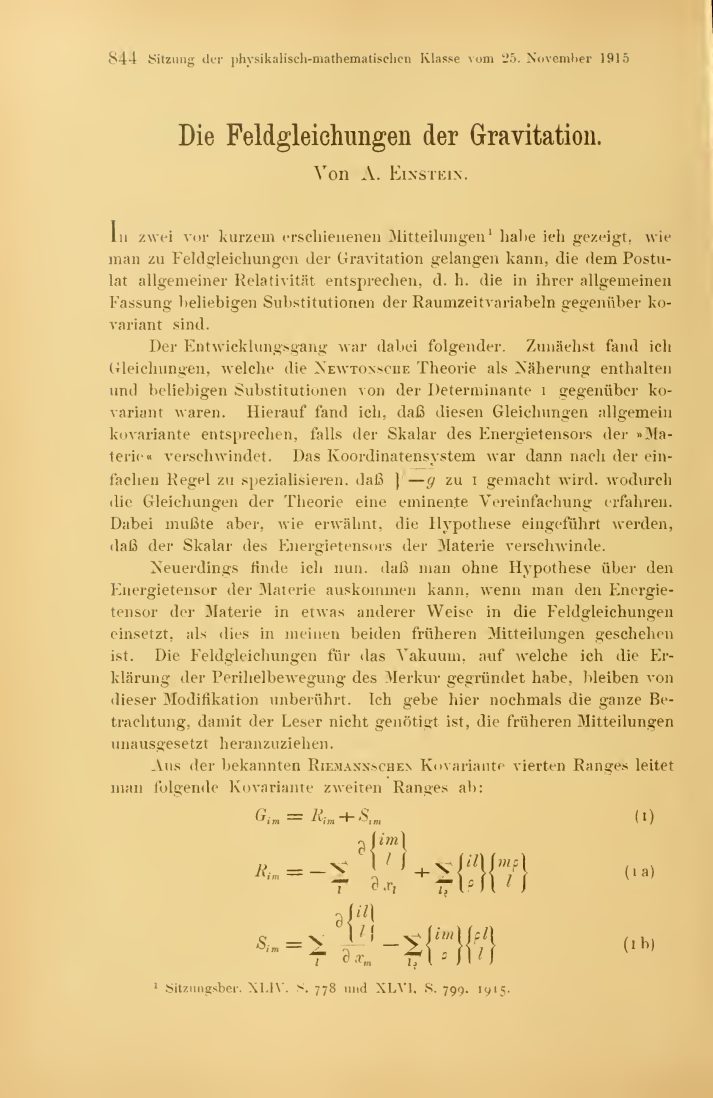
In November 1915, Einstein submitted a paper to the academy on four consecutive Thursdays. On 18 November, he showed that his calculations yielded precisely the orbital rotation that astronomers had been unable to account for. A week later, he set out the final equations in four printed pages. They could now be tested on something that passes the Sun far faster than any planet – light.
Stars in broad daylight
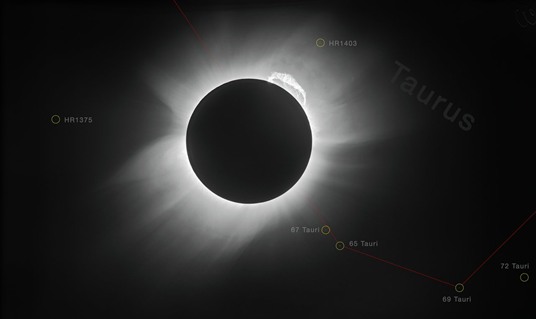
A ray of light from a distant star passing close to the Sun is deflected slightly towards it. We see a star in the direction from which its light is coming to us. Therefore, its apparent position in the sky shifts slightly further from the solar disk than it would in the absence of this gravitational effect. For a ray passing just along the Sun’s edge, the theory predicts a deflection of around 1.75 arcseconds – approximately one thousandth of the Moon’s apparent diameter.
How could such a tiny shift be detected when stars are not normally visible during the day? On 29 May 1919, the Moon obscured the Sun for several minutes. Arthur Eddington observed the eclipse from the island of Príncipe off the coast of Africa, while another expedition observed it from Sobral in Brazil. The positions of the stars were compared with night-time photographs of the same region of the sky. Adjusted to the solar limb, the two most reliable sets of measurements yielded 1.61 and 1.98 arcseconds. Einstein’s predicted value lay between them.
A galaxy acting as a lens
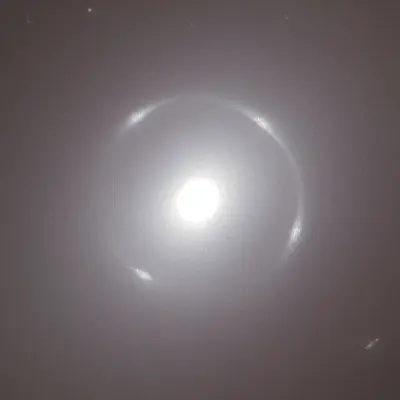
What if an entire galaxy gets in the way of the light? Its gravitational field distorts the paths of light rays from a more distant galaxy. The rays can travel from different sides of the closer galaxy and eventually end up in the same telescope. If the observer and both galaxies are located almost on the same line, the image of the distant galaxy can be distorted, stretched into arcs, and under favorable conditions, even closed into a complete Einstein ring.
In September 2023, astronomer Bruno Altieri noticed signs of such a ring around the nucleus of galaxy NGC 6505 in test images from the Euclid space telescope. The galaxy itself had been discovered back in 1884. Generations of astronomers had looked in its direction, yet the ring had only now been spotted. In 2025, the team released the image. The size of the ring and the distances to both galaxies can be used to estimate how much mass is concentrated within its outline. Even dark matter is included in this ‘weighing’ process.
What a black hole merger sounds like
A ring can be photographed because gravity deflects light. But what happens when two massive bodies orbit each other rapidly? In 1916, Einstein predicted the existence of gravitational waves—perturbations in the geometry of space-time that propagate at the speed of light. As they travel through a region of space, they subtly alter the distances between free bodies.
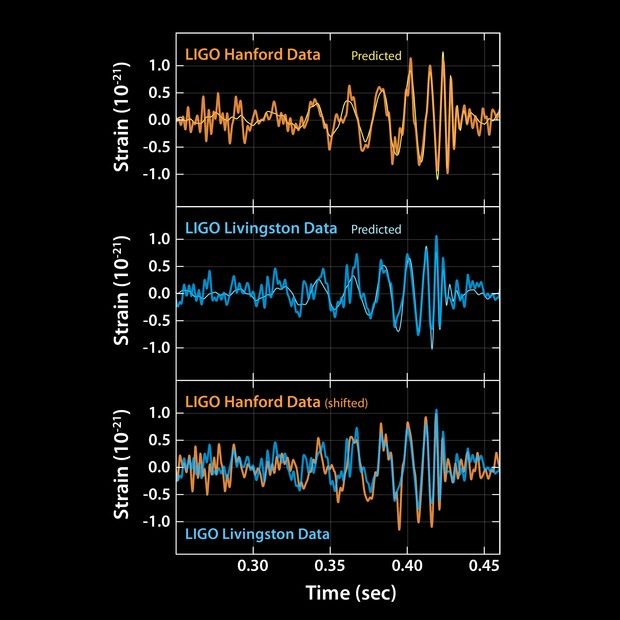
On 14 September 2015, two detectors of the US Laser Interferometer Gravitational-Wave Observatory (LIGO) directly detected gravitational waves for the first time. In each detector, a laser beam was split in two and directed towards mirrors along perpendicular paths, each 4 km (2.5 miles) long. After reflecting from the mirrors, the rays recombined. Changes in the interference pattern made it possible to detect extremely small changes in the relative lengths of the detector arms caused by the passage of the gravitational wave.
The most prominent part of the signal lasted around 0.2 seconds – blink and you could miss it. The frequency and amplitude of the oscillations increased as the two black holes approached each other. If you convert the recorded signal into sound, you can hear something like a short bird chirp. By analyzing the waveform, physicists determined that during the merger of the black holes, energy equivalent to about three solar masses was emitted in the form of gravitational waves.
How Einstein’s theory works in your phone
LIGO’s lasers use light to detect changes in distance. Your phone also uses signals to measure distances when you open a navigation app. To determine its position, a GPS receiver calculates how long radio signals from several satellites have taken to reach it. To do this, it needs to know the exact time shown by the satellite clocks when the signals were transmitted.
Gravity also affects the passage of time itself. At the higher altitude of a GPS orbit, a satellite clock gains around 45 microseconds per day relative to a clock on Earth’s surface. According to special relativity, the satellite’s high speed reduces this gain by around seven microseconds. Without corrections, the satellite clock would run ahead of its counterpart on Earth by approximately 38 microseconds per day. In this brief interval, a radio signal can travel around 11.4 km (7.1 miles) – roughly the distance between two urban districts. Engineers account for this difference in the operation of the system.
There is an irony in the search for Vulcan. Astronomers saw the very cause of Mercury’s orbit rotating slightly faster than expected every day: the Sun itself. Its gravity had long been included in their calculations, and Newton’s laws yielded excellent results for most purposes. Yet with every revolution of Mercury, a tiny discrepancy accumulated. Einstein showed that this discrepancy revealed how the mass of our star curves spacetime.
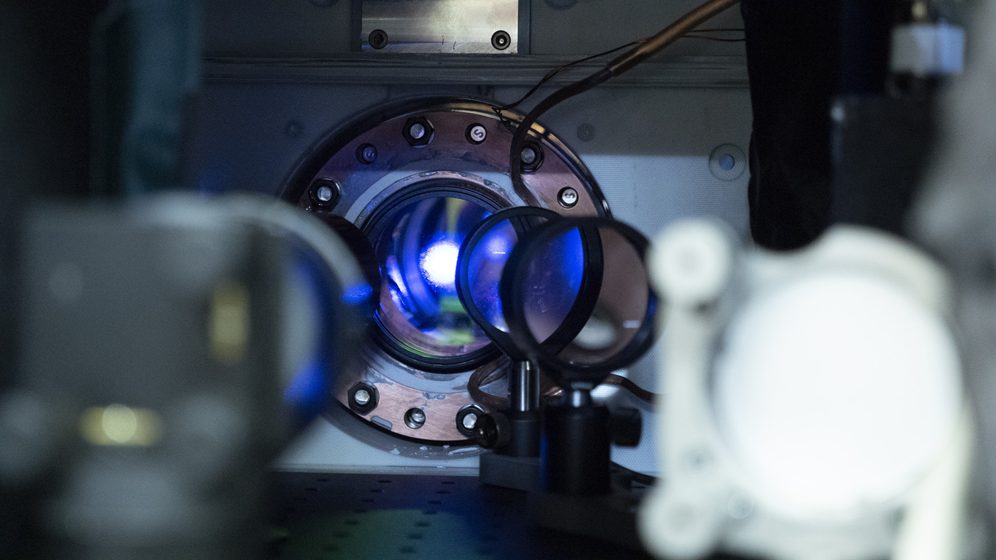
Another consequence of the same theory can be imagined without even leaving the room. Synchronize two identical clocks and leave one on a table and the other on a shelf above it. Over the course of a day, slightly more time will elapse on the shelf. In 2022, physicists at JILA measured such a difference within a single cloud of strontium atoms. The frequency of atomic transitions, by which time was measured, was slightly higher in the upper part of the cloud than in the lower part, although the difference in height was only 1 mm (0.04 inches) – roughly the thickness of a bank card. Even over such a small distance, the question ‘How much time has elapsed?’ has two slightly different answers.
How much time would pass for two twins if one remained on Earth while the other travelled to Alpha Centauri and returned home? To learn about this imaginary journey and why Einstein needed two theories of relativity, read our article ‘Relativity for beginners: everything you need to know about Einstein’s most famous work’.
