

One of the most difficult problems in mathematics, the Riemann hypothesis, has been solved. This was accomplished by Anthropic mathematician Levent Alpöge using the Claude chatbot. The correctness of the proof has already been confirmed using specialized computer programs. However, no one, not even the author himself, can yet explain why it works.
A Proof Written in a Programming Language
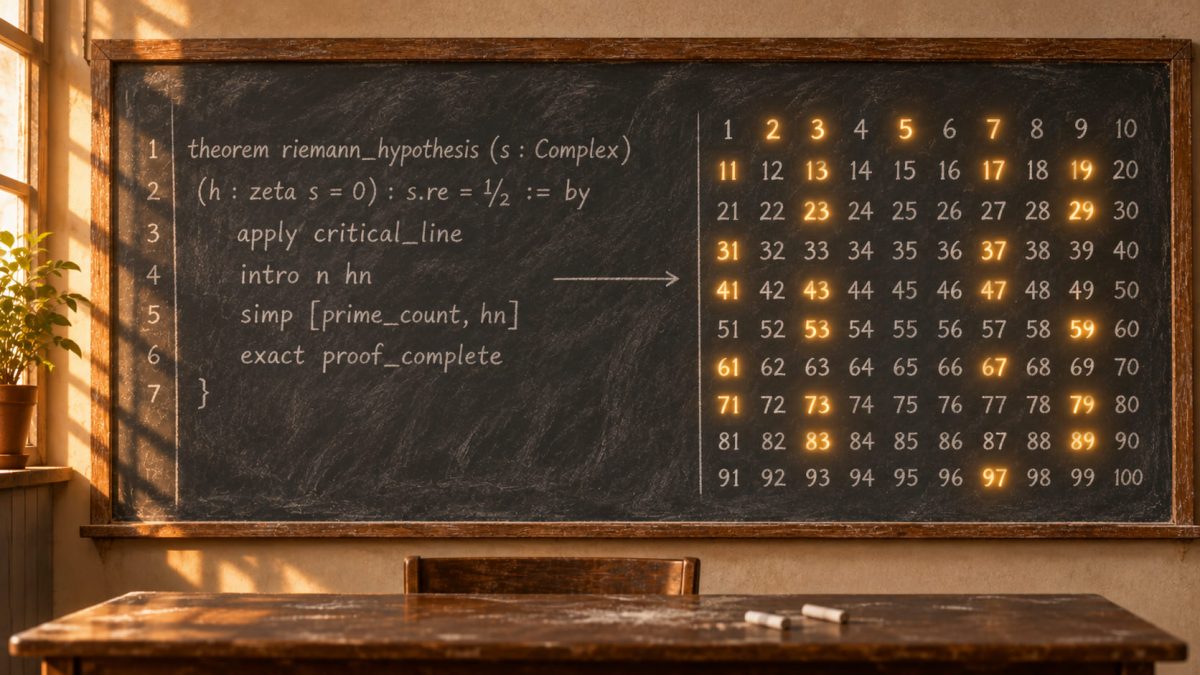
On November 20, 2026, Levent Alpöge announced the result in a note on his website. The proof would have taken more than 250,000 pages in ordinary text, an amount that no human could physically read. Therefore, the mathematician published it in the Lean programming language, in which every step of reasoning is checked automatically. Errors or unnecessary assumptions are impossible in such code, and the code itself consists of 17 million lines.
The following day, the developers of the Lean language and its mathematical library published a joint statement from Lean FRO and the Mathlib Initiative. It stated that the code proved the Riemann hypothesis itself, rather than a similar-looking statement. The code was also checked using several independent programs, and no errors were found.
Levent Alpöge had planned to tackle this problem while still a student, and the key steps of the proof emerged during six weeks of work with Claude, from early October to mid-November. At the final stage, according to him, the decisive ideas came primarily from artificial intelligence, while he himself determined the direction of the work. New York University mathematician Nestor Guillén believes that in such collaboration, AI functions as a tool, rather than a “machine god.”
The Essence of the Riemann Hypothesis
The Riemann hypothesis concerns prime numbers, which are divisible only by one and themselves, such as 2, 3, 5, and 7. Among other numbers, they appear to occur randomly. In 1859, German mathematician Bernhard Riemann discovered that the distribution of prime numbers is connected to special points of a particular mathematical function. These points can be plotted on a plane, just as on a graph.
Bernhard Riemann proposed that all the points relevant to prime numbers lie on a single straight line. If this is true, prime numbers are distributed as evenly as possible. Trillions of such points have already been checked by computers, but there are infinitely many of them. Meanwhile, thousands of theorems have been built on the assumption that the Riemann hypothesis is correct. Brian Conrey, an expert on the Riemann hypothesis, said in a comment to AFP that he considers this event the biggest thing that has ever happened in mathematics.
Verified, but Not Understood
Levent Alpöge admits that he has not yet mastered a substantial portion of the mathematics behind the proof. He promises to write a full account of it.
The previous solved Millennium Prize Problem, the Poincaré conjecture, took mathematicians about three years to verify after Grigori Perelman’s publications. This time, the order has been reversed. The correctness was confirmed within a day, while understanding it will take years.
A human proof also appeared on the same day. American Mathematical Society President Ravi Vakil published work by Stanford University postdoctoral researcher Alessandro Mazzullo, who, according to TechCrunch, spent 12 years proving the generalized Riemann hypothesis without AI. Levent Alpöge claims that his method is also applicable to the generalized hypothesis. However, Alessandro Mazzullo’s work has not been formalized in Lean, so its correctness remains to be established.
The Stock Market and the Clay Prize
The proof was announced the day after Anthropic shares made their stock market debut, which AFP described as a record-breaking one. Because of this coincidence, the announcement could easily be perceived as a calculated move by the company. Levent Alpöge himself acknowledged that the timing was unfortunate and explained that he had consulted Anthropic CEO Dario Amodei before publishing. The mathematician denies that the announcement was deliberately timed to coincide with the stock market debut. According to him, the Riemann hypothesis had been his goal since childhood, and he could not keep the result secret any longer.
The Clay Mathematics Institute is offering a $1 million prize for a solution. To qualify, the proof must be published in a peer-reviewed journal and withstand two years of rigorous scrutiny. So far, neither Levent Alpöge nor Alessandro Mazzullo has published such a paper.
