

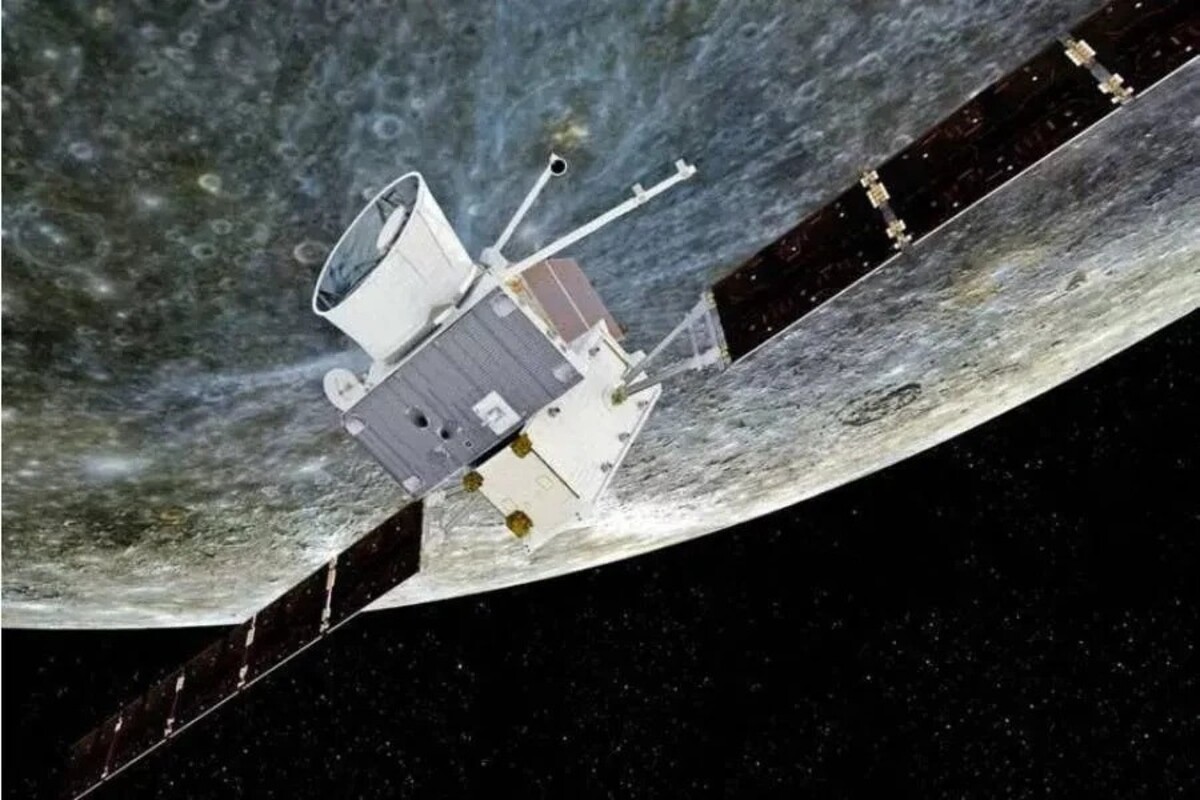
A pair of spacecraft entered orbit around Mercury on Saturday after an eight-year journey through the inner Solar System, aiming to unravel a host of mysteries surrounding our smallest planet.
Two Spacecraft at Once
The website phys.org reports that the BepiColombo spacecraft has successfully entered orbit around Mercury. In fact, it consists of two interconnected robotic explorers — one European and one Japanese — which will separate from each other next month to map and study the hot little planet from different altitudes.
The European Space Agency announced BepiColombo’s arrival through social media. A series of engine burns slowed the spacecraft enough for the planet’s weak gravity to capture it. However, several tense hours passed before flight controllers in Germany — 152 million kilometers (94 million miles) away — were able to confirm that BepiColombo had entered orbit. Teams carefully reviewed the incoming data; additional information was not immediately available.
An Eight-Year Journey Through the Solar System
BepiColombo is only the third spacecraft to visit Mercury — the planet closest to the Sun, which is only slightly larger than our Moon — and the first in more than a decade.
NASA’s Mariner 10 spacecraft flew past Mercury three times in the mid-1970s. Its team included Italian mathematician Giuseppe “Bepi” Colombo, who died in 1984 and after whom this latest mission was named. NASA’s Messenger spacecraft entered orbit around Mercury in 2011 and crashed into the planet in 2015 after running out of fuel.
Launched in 2018, BepiColombo took a slower, more fuel-intensive route to Mercury, flying past Earth once, Venus twice, and Mercury six times to gain gravitational acceleration. All these intricate loops added more than 6 billion miles (10 billion kilometers) to its odometer. The connected spacecraft separated from their carrier section in September for the final stage of the journey.
Mission Objectives
The project’s chief scientist, Geraint Jones, said that he and others cannot wait for all the new data to begin arriving in the spring. The mission will make it possible to compare “unprecedented measurements made by two spacecraft at the planet simultaneously,” he noted.
Once they enter their separate orbits, the European Space Agency orbiter and the smaller spacecraft from the Japan Aerospace Exploration Agency will study Mercury’s dense inner and outer magnetic fields, as well as everything in between: impact craters, volcanic plains, mountain ranges, and peaks rising up to 3 miles (4.5 kilometers).
Temperatures on Mercury can exceed 800 degrees (427 degrees Celsius), placing additional stress on its electronic and engineering systems. Space agency officials hope the mission will last at least one Earth year — or four Mercury years.
Despite its relative proximity to Earth, Mercury remains one of the least explored planets in the Solar System. Only the outer planets Uranus and Neptune have had fewer visitors — just one Voyager spacecraft in the 1980s.
