

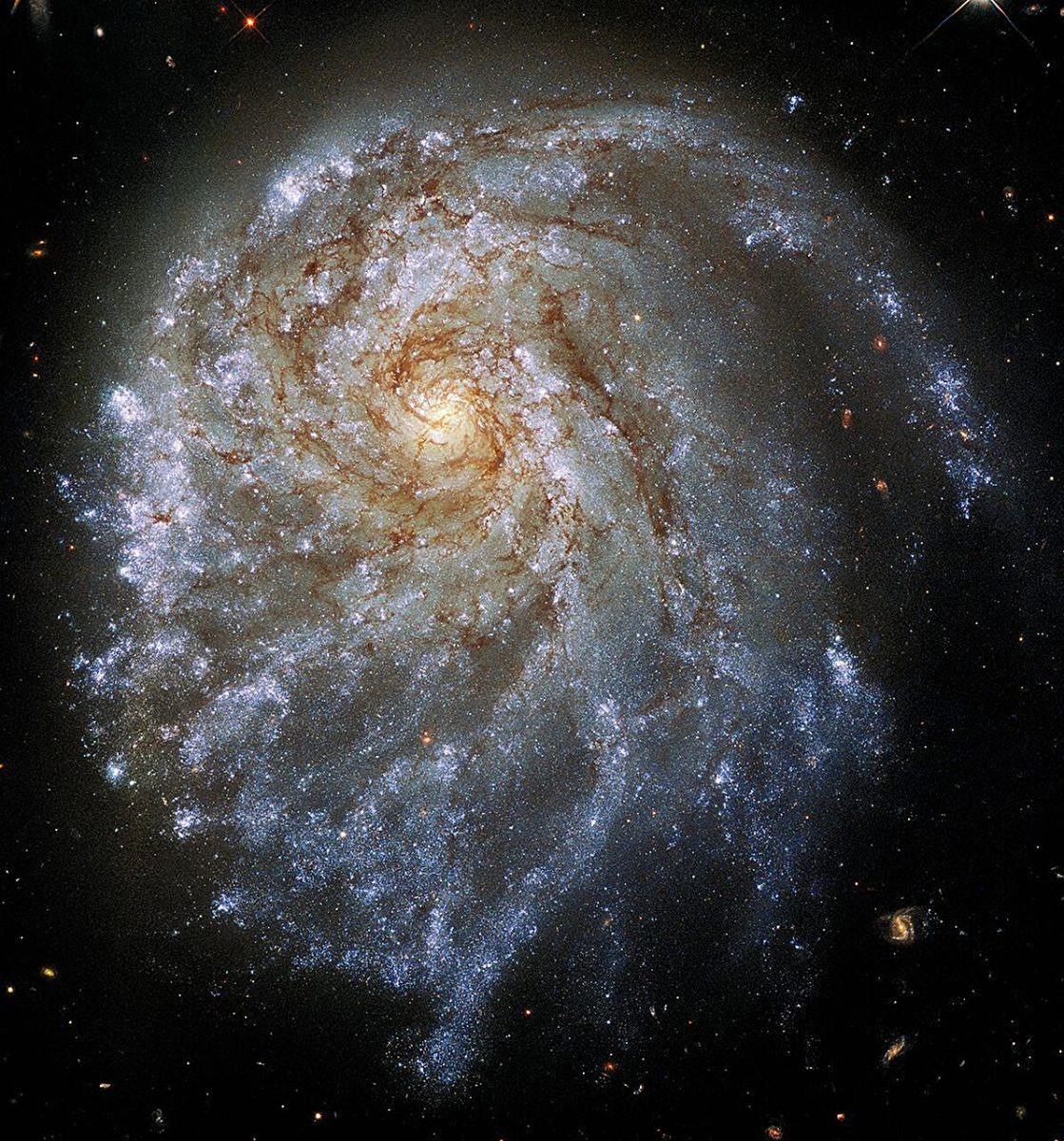
The more massive a galactic disk is and the faster it rotates, the less lopsided it is. Astronomers reached this conclusion by comparing measurements from several dozen studies. Based on this relationship, the authors conclude that the shape of a disk is governed primarily by the galaxy’s internal dynamics, rather than by collisions and the influence of neighboring galaxies alone.
More Massive Disks Are More Symmetrical
In at least one-third of spiral galaxies, one half of the disk is noticeably brighter than the other. Astronomers have been debating the origin of this asymmetry for several decades, because the answer determines what shapes a galaxy more strongly: its own structure or its environment.
A team led by Abbos Omonov from Mirzo Ulugbek National University of Uzbekistan combined measurements of 606 galaxies from 37 studies. For each galaxy, they traced the disk’s brightness around a circle centered on the galaxy and estimated how much brighter one side was than the opposite side. In systems with a stellar mass of about 2 billion solar masses, the brightness varies from the average by nearly 30% in either direction. In the most massive systems, with masses exceeding 50 billion solar masses—roughly the mass of the Milky Way—the deviation is only 7%, making massive disks four times more symmetrical.
The study has been posted on the preprint server arXiv and has not yet undergone peer review. The data were taken from a catalog that some of the authors had previously compiled from published measurements.
Brightness Waves
As phys.org explains, these estimates use a method commonly applied in signal analysis. Brightness is recorded along a circle centered on the galactic nucleus, and the uneven profile is broken down into simple waves. A wave with one bright side and one dim side corresponds to lopsidedness, while its height, or amplitude, is used to estimate the strength of the asymmetry.
The amplitude is related not only to mass. Lopsidedness also decreases in galaxies whose gas rotates faster. Where the gas moves at more than 150 km/s, the typical amplitude is 6%, while in disks rotating more slowly than 60 km/s, it reaches 19%.
Why Not Collisions?
If asymmetry were caused primarily by collisions and tidal effects, the relationship should be the opposite. Massive galaxies are more often found in groups and clusters, where such interactions occur regularly.
The authors suggest two explanations. According to the first, in massive disks with deeper gravitational wells, different regions move around the center at different angular velocities. As a result, a one-sided concentration is stretched along the orbits and quickly smeared out. According to the second, low-mass disks retain traces of ancient disturbances for longer.

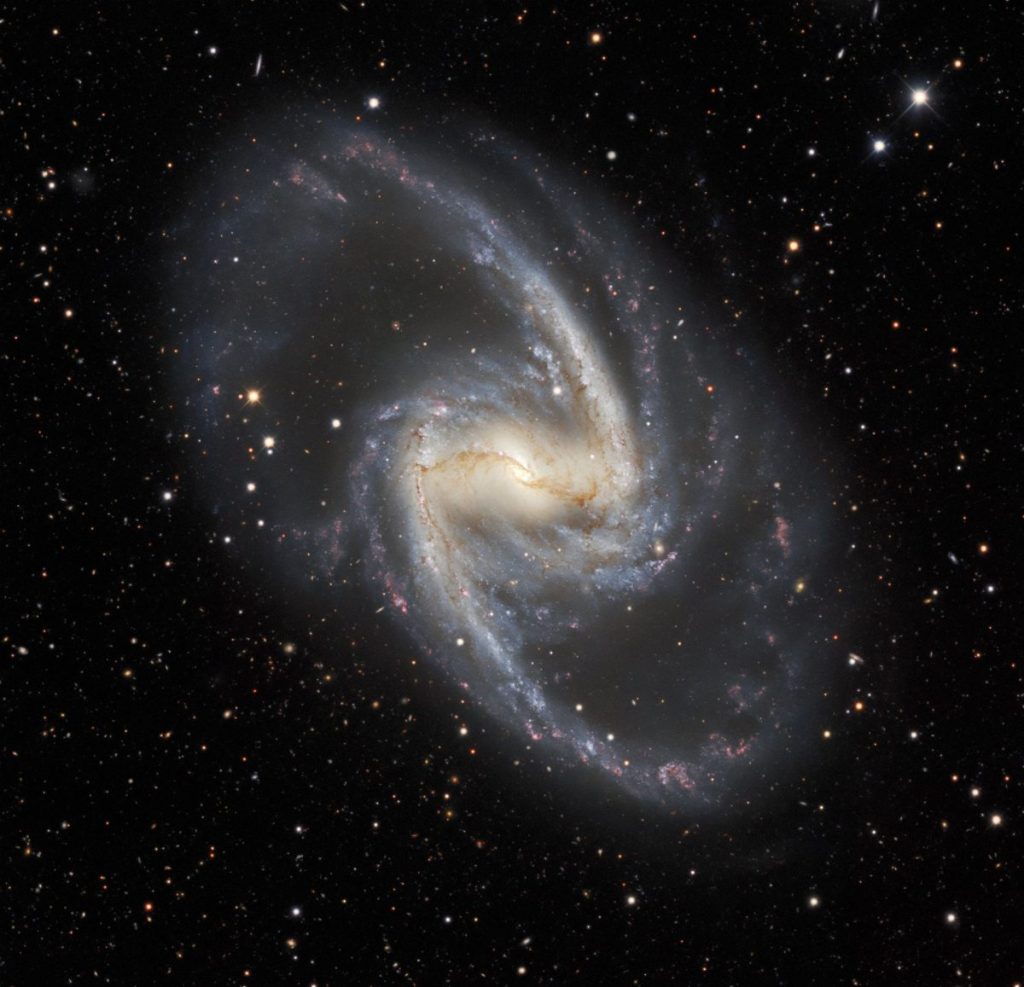
At the same time, the authors do not rule out the possibility that external influences play a greater role in individual galaxies. The Large Magellanic Cloud, one of the best-known examples of a lopsided galaxy, has a bar that is noticeably offset from the center of its disk. This asymmetry is often linked to its interaction with the Small Magellanic Cloud.
Testing with Simulations
The observational data were compared with TNG50, a computer simulation that models the evolution of galaxies across a large region of the Universe. In the simulation, the relationship between lopsidedness and mass turned out to be almost the same as in the observations. However, the typical lopsidedness in the simulated disks is about 10%, while in the compiled sample it is approximately 1.4 times greater.
The authors attribute this discrepancy to the composition of the sample. Some studies deliberately selected galaxies already known to be lopsided, and the asymmetry was measured at slightly different distances from the center. To definitively distinguish internal causes from external ones, data on the environment of each galaxy are needed, but these are not yet available in the catalog.
