

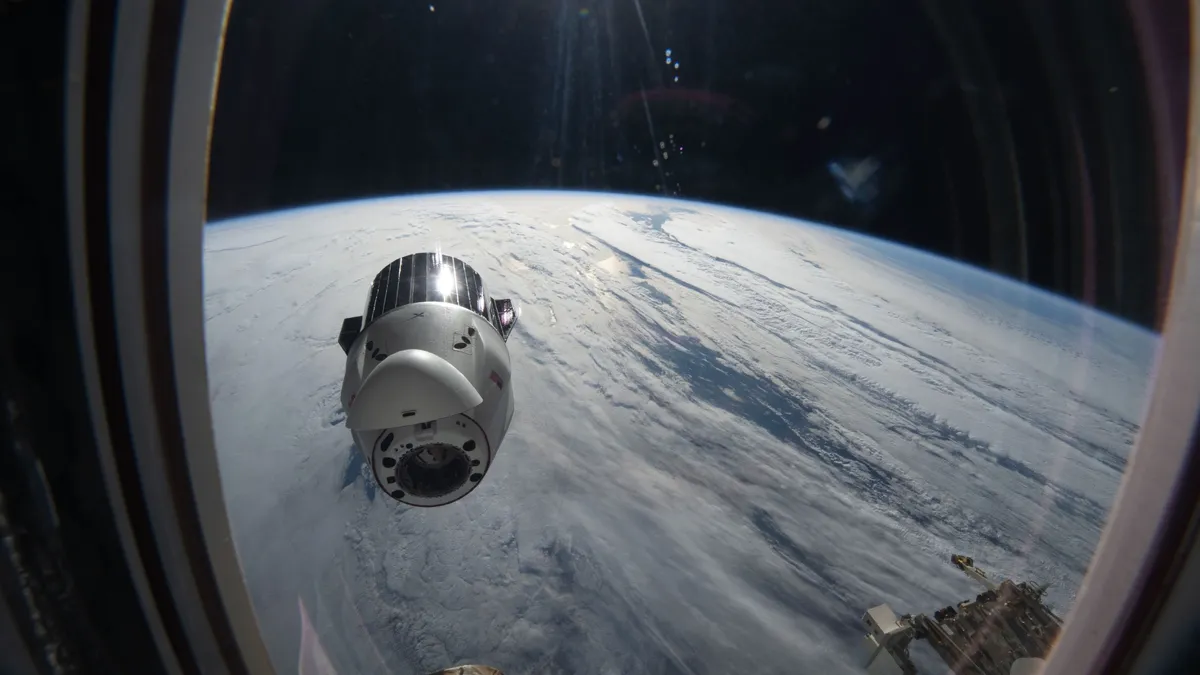
The Dragon cargo spacecraft will undock from the International Space Station tonight and bring the results of scientific experiments back to Earth. These include bioprinted blood vessels, miniature tumor models, and antibiotic-resistant bacteria. They will be studied in laboratories on the ground. At present, only Dragon can return such samples because all other cargo spacecraft burn up in the atmosphere.
Return schedule
The capsule will undock from the space-facing port of the Harmony module at 12:05 p.m. EST. The command will be issued by SpaceX flight controllers in Hawthorne, California. NASA’s live coverage will begin at 11:45 a.m. EST (1645 GMT) and can be watched here.
NASA’s live broadcast of the undocking of the CRS-35 Dragon cargo spacecraft from the International Space Station. Source: NASA.
Splashdown in the Pacific Ocean off the coast of California is scheduled for November 22, and will not be broadcast.
The departure was initially scheduled for November 18, but NASA and SpaceX canceled that attempt because of poor weather conditions in the splashdown area. The capsule lands on the water, so calm seas are required. If the waves are too high, Dragon will remain docked at the station until conditions improve, reports Space.com.
What the capsule is carrying
Most of the scientific cargo is related to medicine. According to NASA, a bioprinted blood vessel structure is returning to Earth. It was used to study vascular aging and cardiovascular diseases. Tumor organoids, or miniature clusters of cells that reproduce the structure of a tumor, were processed directly aboard the station. They will now be studied in a frozen state to identify new approaches to cancer treatment.
Frozen microbial samples will help researchers determine how antibiotic-resistant bacteria survive and evolve in space. The longest-running experiment aboard the station was a lighting system, which remained there for more than three years. It was tested to determine whether such lighting helps astronauts sleep better during long-duration missions.
The cargo was packed by the crew members, according to the NASA ISS blog. Canadian Space Agency astronaut Joshua Kutryk prepared protein crystals for pharmaceutical research conducted by the Japan Aerospace Exploration Agency (JAXA). Crystals make it possible to determine the structure of proteins, which is important for drug development. A spacesuit sent for repairs and a malfunctioning wrist joint from the Canadarm2 robotic arm are also returning to Earth for analysis.
The only spacecraft capable of returning cargo
The Cygnus, Progress, and HTV-X cargo spacecraft are disposable and burn up in the atmosphere after departure. Therefore, frozen samples from the ISS can reach laboratories only aboard a SpaceX capsule. This is the company’s 35th cargo mission under NASA’s Commercial Resupply Services contract. SpaceX completed its first delivery under the contract in 2012. NASA does not disclose the cost of an individual flight. The current capsule launched on October 13 aboard a Falcon 9 rocket and delivered more than 2,860 kilograms of cargo to the station.
The Dragon design will also be useful in bringing the station’s own history to an end. In 2024, NASA awarded SpaceX a contract worth up to $843 million for a spacecraft designed to deorbit the ISS and sink it into the ocean around 2030. SpaceX is building the deorbit vehicle as a reinforced version of Dragon, although approximately half of its structure is being developed from scratch.
