

Scientists suggest that slower dark matter particles may produce signals too weak for detectors to register, but at the same time, they are easier for planets and stars to capture. As these particles accumulate inside such bodies, they may produce effects that existing instruments can detect. A team of scientists investigated this scenario by combining theoretical calculations with observations.
How can a dark matter particle be detected?
As reported by Phys.org, a study published in the Journal of Cosmology and Astroparticle Physics found no evidence of dark matter, but it ruled out certain combinations of its possible properties, helping scientists direct future searches.
Although dark matter accounts for about 85% of all matter in the Universe, it reveals itself mainly through gravitational effects. This creates a vicious circle: if we cannot see it, we do not know what it is, and without at least some idea of what to look for, finding it becomes a difficult task. Therefore, experiments test various hypotheses about the nature of dark matter, but so far, it has not been detected directly.
One possibility is that, in addition to gravity, dark matter may have electrical or magnetic interactions that are so weak that they have not yet been detected. Its particles, for example, may carry a tiny electric charge or behave like miniature magnets. These properties would allow them to interact with ordinary matter.
This is where their speed becomes important. During a collision with material inside a detector, a slow-moving particle may transfer too little energy to produce a measurable signal. However, there is another side to this: as it passes through a celestial body, it needs to lose only a small amount of energy through collisions to become unable to escape that body’s gravity.
Over billions of years, captured particles could accumulate in the central regions. Within a small volume, they encounter one another more frequently, which under certain conditions can lead to annihilation — a process in which they are converted into other particles. The products of these reactions may either escape the celestial body or transfer their energy to it, heating it from within.
Possible signs of dark matter in celestial bodies
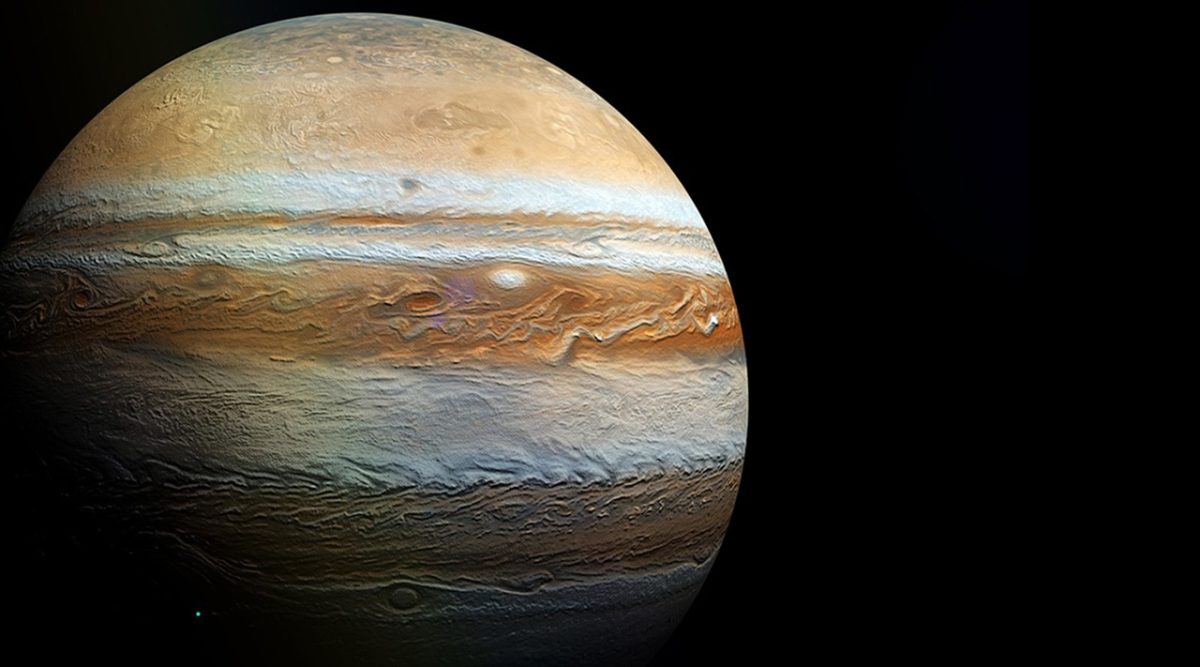
“In this study, we considered four celestial bodies: Earth, the Sun, Jupiter, and white dwarfs,” explains Gaurav Tomar, a researcher at the Center for Quantum Spacetime at Sogang University in South Korea and the corresponding author of the study. “There are specialized experiments, such as IceCube at the South Pole, that search for neutrinos from the Sun and Earth. For Jupiter and white dwarfs, we considered the possibility of heating.”
For Earth and the Sun, the researchers used the results of searches for neutrinos produced by possible dark matter annihilations. Because these neutrinos can travel through large volumes of matter, they could reach detectors and provide clues about what is happening inside a celestial body.
For Jupiter and white dwarfs, they instead examined heating. Unlike the Sun, these objects are not powered by nuclear fusion and can therefore provide more favorable conditions for detecting an additional heat source. The authors calculated how much heat dark matter would produce and compared it with the energy radiated by each body. If dark matter were producing more heat than the body actually emits, that particular dark matter scenario could be ruled out.
New constraints and the accuracy of calculations
The comparison ruled out certain combinations of particle masses and properties that other experiments had left unconstrained. Earth proved particularly useful for testing the possibility of a tiny electric charge, while white dwarfs can place constraints on other electromagnetic properties.
However, the results depend on the assumptions used in the calculations, particularly how much dark matter surrounds the stars. The more dark matter there is nearby, the more particles a star could capture over time.
“We do not know the dark matter density there. We used approximate values, so if these values change, our constraints could become weaker or stronger,” Tomar notes, referring to the M4 cluster, which contains the white dwarfs considered in the study. Its dark matter density has not been measured directly and is instead estimated using models.
For future searches, Tomar points to even cooler white dwarfs in regions with higher dark matter densities, where any additional heating would be easier to detect, as well as exoplanets, which could serve as potential dark matter traps beyond our Solar System.
