

Using the European Hera spacecraft, the binary asteroid system of Didymos and Dimorphos has been photographed in several different wavelength ranges, including infrared, which is invisible to the human eye. The shades of reflected radiation can reveal the composition of the rocks, while surface temperatures show where solid rock is located and where the material is loose. These data are needed to determine why the impact of NASA’s DART spacecraft changed Dimorphos’s orbit more than the models had predicted.
Three cameras
The Hera spacecraft transmitted images after slowing down ahead of its encounter and making its first observations of the system. ESA released the images, taken from a distance of 28.5 kilometers, on November 17, 2026. They were captured using three instruments, each of which records a different property of the surface. Together, their data will form the basis for investigating the consequences of the impact.
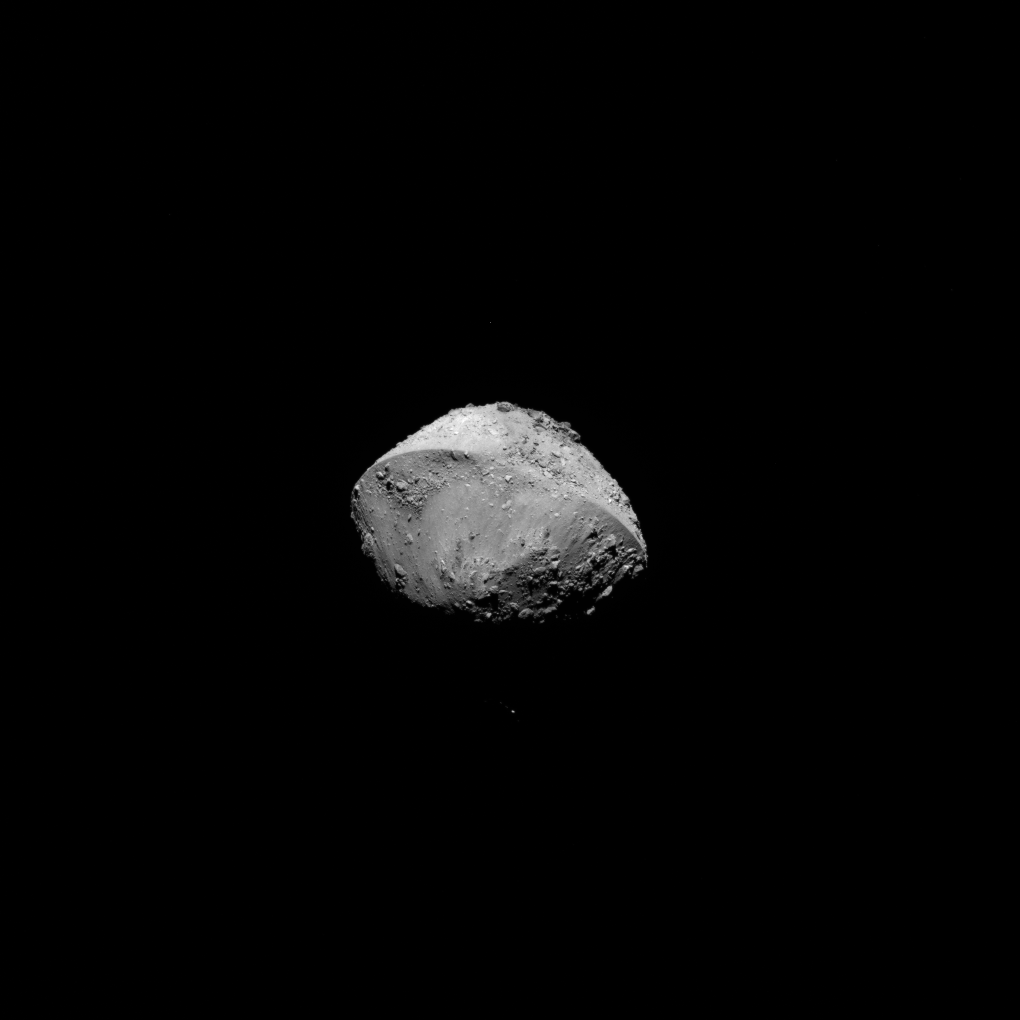
The Asteroid Framing Camera (AFC) produces monochrome images with a resolution of approximately 2.7 meters per pixel and is used for both navigation and scientific observations. Its image shows Didymos, which is 780 meters in diameter, with a sharp ridge running along its equator, while the 151-meter-wide Dimorphos is almost completely in shadow. The ridge most likely formed as a result of rapid rotation. Didymos completes one rotation in 2.2 hours, and at the equator, centrifugal force partially counteracts the asteroid’s weak gravity, causing dust and rocks to gradually move there from higher latitudes.
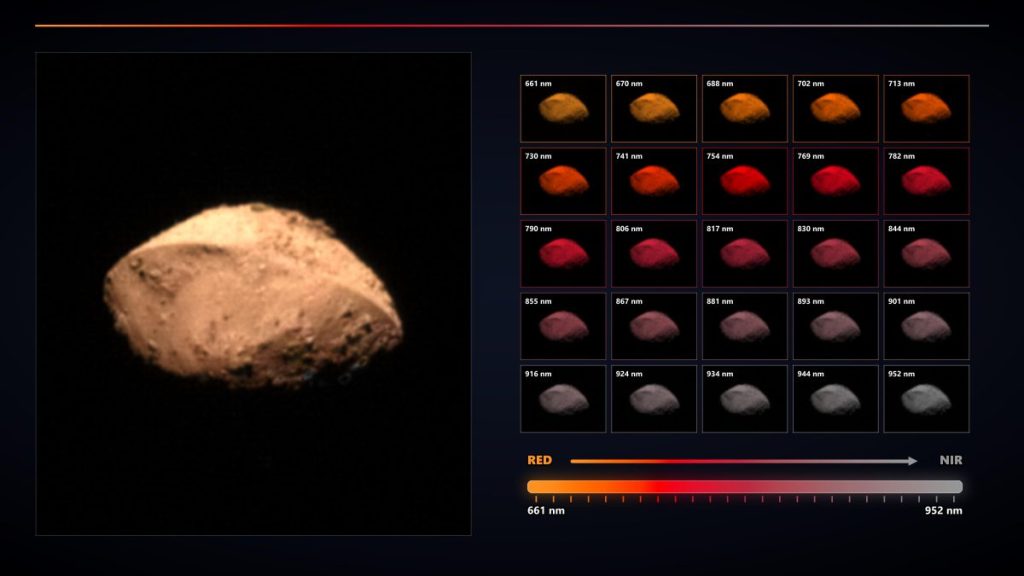
The HyperScout H spectral camera captures the surface of Didymos in 25 different shades, ranging from visible red light to the near-infrared range. Different minerals reflect radiation in different ways, so these variations are compared with laboratory measurements of meteorites and minerals to determine the composition of the rocks.
Dimorphos’s temperature
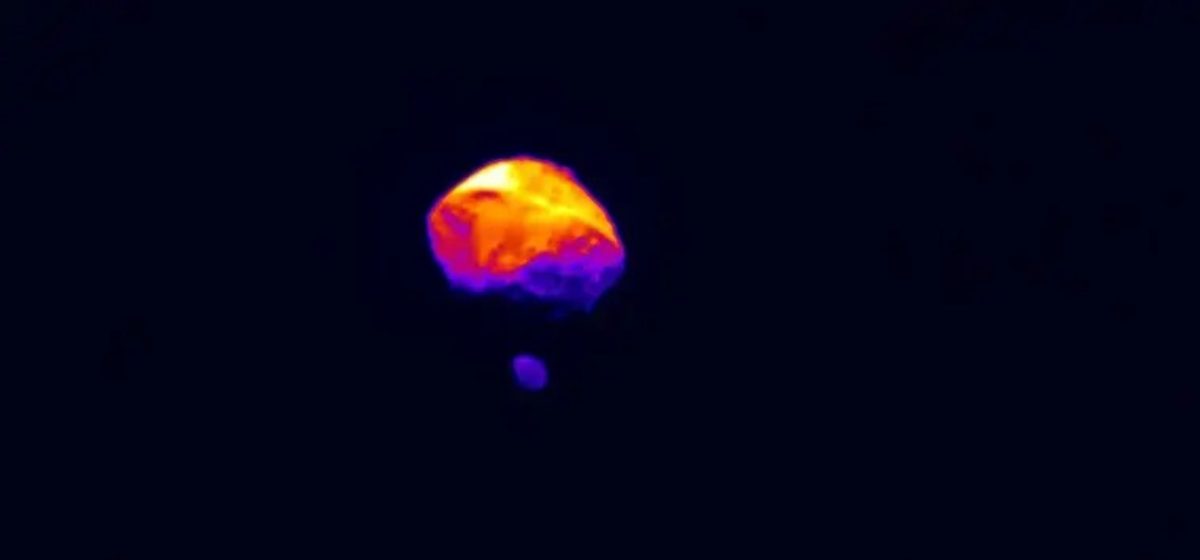
In the image from the Thermal Infrared Imager (TIRI), provided and operated by the Japan Aerospace Exploration Agency (JAXA), Dimorphos is fully visible. The camera measures how the surface temperature changes over time. Solid and porous rock, fragments, and loose dust heat up and cool down at different rates, so the thermal map reveals what the surface is made of. Mission Principal Investigator Patrick Michel points out areas covered with boulders, smoother patches, and possible signs of landslides near the central ridge on Dimorphos.
According to data from TIRI’s predecessor, which operated aboard Japan’s Hayabusa2 spacecraft, the boulders on the asteroid Ryugu turned out to be much more porous than expected. Porosity is equally important for Dimorphos because it determines how much material an impact ejects, which in turn affects how strongly the impact changes the asteroid’s orbit.
Tracing the impact
The Hera spacecraft was sent to investigate the consequences of the collision. On September 26, 2022, NASA’s 580-kilogram Double Asteroid Redirection Test (DART) spacecraft crashed into Dimorphos at a speed of 6.1 kilometers per second. Following the impact, Dimorphos’s orbital period around Didymos shortened by approximately 33 minutes, from nearly 12 hours.
The change turned out to be greater than the models had predicted, and scientists still cannot explain why. The answer depends on Dimorphos’s mass and internal structure, as well as whether the impact left a crater. Earlier images have already shown what the asteroid looks like four years after the impact and revealed strange patterns on its surface. However, its mass and internal structure can only be determined through close-up measurements.
In the coming months, the Hera team will deploy two shoebox-sized CubeSats that will approach Dimorphos more closely than the main spacecraft. Later, the spacecraft itself will attempt to land on the surface. ESA has promised to release detailed images of both asteroids on November 25.
