

The European Space Agency’s (ESA) Hera planetary defense mission has reached its targets — the binary asteroid system consisting of Didymos and its moon Dimorphos. The car-sized spacecraft has positioned itself just 25–30 km away from the pair. Its main task at this stage is to collect baseline data needed to develop systems for protecting Earth against asteroid threats.
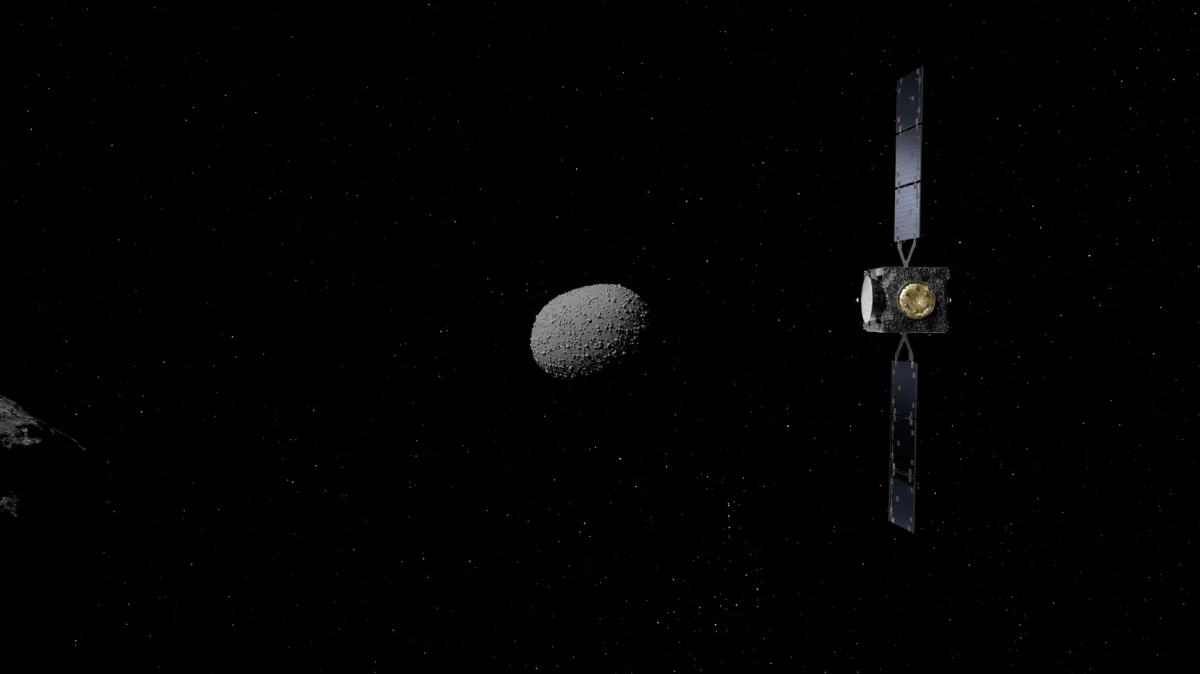
“Our goal now is to obtain an overall picture that will help us achieve the objectives of the planetary defense mission,” explains project scientist Michael Küppers. According to him, the spacecraft’s cameras will provide the first images of what a small asteroid looks like after the hypervelocity impact carried out in 2022 by NASA’s DART spacecraft. Previous computer models proposed numerous scenarios for how a celestial body might react to an impact, and Hera is now expected to determine which of the predictions, if any, turned out to be correct.
Flying in a rectangle
Maneuvering near asteroids is fundamentally different from conventional planetary missions. The primary body, Didymos, has a diameter of 780 meters and gravity approximately 40,000 times weaker than Earth’s. On the 151-meter-wide Dimorphos, the force of gravity is 200,000 times weaker than on Earth. Under such conditions, entering a conventional circular orbit loses its practical purpose.

Instead, Hera moves around the common center of mass of both bodies at a typical speed of just 12 cm/s — roughly the speed of an insect. At the same time, the spacecraft travels almost in straight lines. Every three days, and later every four days, when the probe begins moving away from the asteroids, it fires its engines and changes course by 90 degrees. As a result, Hera’s trajectory resembles a series of “rectangular orbits” that allow it to maintain a distance of 25–30 km.

This navigation approach was borrowed from the experience of the Rosetta comet mission. It is as safe as possible: if an engine fails to fire during a maneuver, the spacecraft will simply drift gently into space without any risk of collision. In addition, because of the low speeds involved, each turn requires only a tiny amount of fuel. Next month, Hera will move closer, to a distance of approximately 20 km, switching to more complex butterfly-shaped hyperbolic arcs for detailed observations of the objects.
Control from hundreds of millions of kilometers away

The spacecraft is controlled from ESA’s European Space Operations Centre (ESOC) in Darmstadt, Germany. Controllers communicate with the probe for approximately eight hours each day. It is currently located 196.5 million km away. Four 35-meter deep-space communication antennas located in Argentina, Spain, and Australia are used for this purpose.

The work of the operators is supported by ESA’s flight dynamics team. Using telemetry, specialists calculate the probe’s precise position relative to the asteroids and prepare commands for subsequent course corrections.
A detailed examination of the impact site

The story of this experiment began on September 26, 2022, when NASA’s 580-kilogram DART spacecraft struck Dimorphos at a speed of 6.1 km/s. The collision ejected a plume of debris that stretched 10,000 km into space and shortened the moon’s orbital period by approximately 33 minutes.

Despite the success of the “kinetic impact” test, scientists still have many questions. It is unknown whether the impact left a crater or completely changed the asteroid’s shape. The composition, internal structure, and mass of Dimorphos also need to be determined precisely to understand why its orbit changed much more significantly than calculations had predicted. In the coming months, Hera will conduct a thorough investigation using its suite of scientific instruments and deploy two shoebox-sized CubeSats for an extremely close examination of the surface, which will eventually end with their landing.
For those who want to follow the progress of the mission, ESA has also introduced Hera Space Companion — an interactive AI-powered communication platform connected to flight data that allows anyone interested to ask questions about the progress of the first planetary defense mission.
Earlier, we reported on what the asteroid looks like four years after the DART impact.
Based on ESA
