

Since 2022, astronomers have been trying to unravel the nature of a new class of cosmic objects known as Long-Period Radio Transients (LPTs). These mysterious sources emit bright bursts of radio waves into space at regular intervals ranging from several minutes to several hours. After ruling out the possibility of extraterrestrial civilizations, the main suspects became extremely slow-spinning neutron stars — pulsars. However, theoretical calculations suggest that a neutron star rotating this slowly simply cannot generate radio waves.
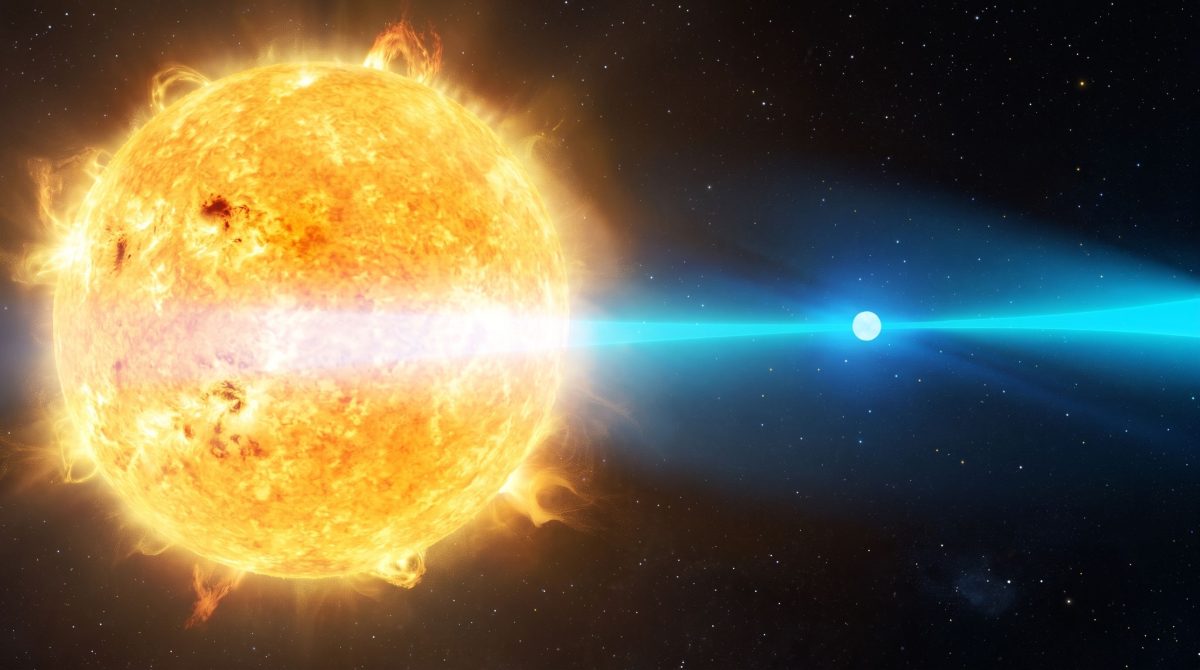
A breakthrough came when researchers managed to trace several such signals back to their sources. In all known cases, the same picture emerged: a binary system in which a small, cool red dwarf orbits a white dwarf — the dense remnant of a star similar to our Sun. However, a new study published in the journal Nature Astronomy has revealed a completely unexpected player.
A signal from the “wrong” star
In late 2024, a team of astronomers was searching for new radio sources using the Murchison Widefield Array radio telescope in Western Australia. Using a search method developed by postgraduate student Chanad Horvath, the scientists detected short radio bursts arriving with clockwork precision — every 7.9 minutes.
Soon, the pulses suddenly disappeared, and the airwaves remained silent for several weeks. When the researchers plotted all the periods of activity and inactivity, a clear pattern emerged: the bursts lasted approximately six hours, followed by a 26-hour pause. The most logical explanation was a binary system in which two stars complete one full orbit around each other every 32 hours, while the radio beam becomes visible from Earth only at certain relative positions of the stars.
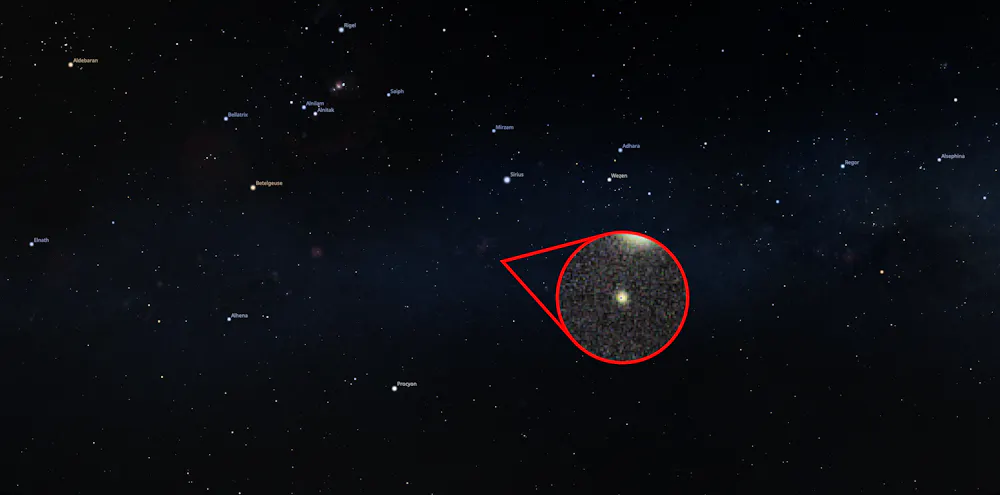
To identify the object, the scientists used the MeerKAT radio telescope in South Africa, which narrowed the search area down to a tiny patch of sky containing a single faint star. After that, the Keck telescope in Hawaii recorded its spectrum — a kind of optical fingerprint. The result astonished astronomers: instead of a tiny red dwarf, they found a spectral type G star that is almost identical to our Sun in mass and temperature.
How to weigh an invisible object
To finally establish that the source of the radio waves was not a neutron star, the researchers turned to cosmic timekeeping. As the system moves along its orbit, pulses from the source arrive on Earth four seconds earlier or later than the predicted time because the radio waves have to travel different distances. This timing variation allowed the researchers to determine the size of the orbit precisely.
At the same time, spectral analysis showed that the Sun-like star barely wobbles under the gravitational influence of its invisible companion. This means that it is significantly more massive than its partner. By combining data on the orbital size, orbital period, and spectrum, the scientists calculated the mass of the mysterious object: approximately two-thirds the mass of the Sun. This is too little for a neutron star, so the researchers concluded that they were looking at a white dwarf pulsar, discovered for the first time in a pair with a Sun-like star.
What lies behind the star’s glow
How did this strange pair form? Astronomers believe that the star that eventually became a white dwarf expanded to the size of a red giant near the end of its life and engulfed its companion. Friction within the giant’s envelope caused the companion star to spiral toward the giant’s core, shrinking its orbit. The outer layers of the expanded star were then expelled into space.
Such systems are probably quite common throughout the Universe, but they are extremely difficult to detect: the dazzling glow of the bright star completely masks the faint white dwarf from optical and X-ray telescopes. Radio pulses, on the other hand, can easily penetrate this glare. Searching for such hidden systems using next-generation telescopes, such as the SKA Observatory, will help astronomers better understand the origins of Type Ia supernovae — cosmic “standard candles” used to measure distances and the expansion rate of the Universe.
Earlier, we reported on how a mysterious gamma-ray source turned out to be a trail of particles from a pulsar.
Based on The Conversation
