

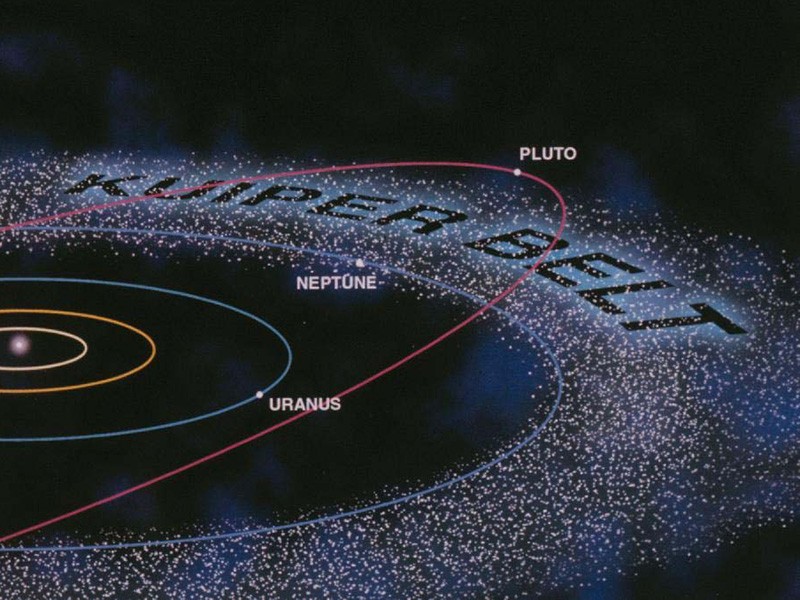
Somewhere far beyond Saturn’s orbit, perhaps even in the Kuiper Belt, large reserves of water may be preserved. This is the conclusion reached by scientists after studying particles of cosmic dust and ice from comets.
Water in the Solar System?
Where is most of the water in the Solar System concentrated? And how different is its composition from that of water on Earth? These are the questions researchers set out to answer in a study published in the journal Science Advances. As reported by Phys.org, they were able to do so with the help of just 12 microscopic particles of cosmic dust.
Water consists of two hydrogen atoms and one oxygen atom. However, both elements occur in different forms. Heavy isotopes of hydrogen — deuterium and tritium — are usually mentioned. But oxygen also has two heavier varieties in addition to its lighter form, which contains 8 protons and 8 neutrons. These heavier varieties also have 8 protons, but contain 9 and 10 neutrons, respectively. All these isotopes together form the mixture we know as water.
We are accustomed to thinking that most of the water in the Solar System is concentrated on Earth. However, ice samples from comets have long suggested that a reservoir of water must exist somewhere in the outer reaches of the Solar System. It has remained there since the system’s formation and therefore has a different isotopic composition. Then, the 2011 Genesis experiment showed that the Sun contains significantly more light oxygen than Earth does.
What the research revealed
The scientists therefore decided to analyze solid particles that they believe arrived from the Kuiper Belt. This is where more water containing the heavy oxygen isotope is expected to be found. Spectroscopic analysis revealed traces of exposure to high-energy particles, confirming that the particles formed somewhere far from the Sun.
The scientists are not entirely sure where exactly. They say the particles formed at least beyond Saturn, but how much farther out remains an open question. Moreover, the particles themselves are not water but various minerals. However, they contain traces of hydration and resemble clay in their composition.
The hydrated clay minerals found in the dust indicate that reactions between “heavy” water and rocks took place inside the parent bodies from which these particles originated, under low-temperature conditions. Although the water itself could not be measured directly, calculations showed that the initial ratio of oxygen-18 to oxygen-16 isotopes in this water was approximately 15% higher than in Earth’s ocean water. The researchers note that this is an upper-limit estimate obtained through modeling.
The authors of the study write: “We propose that amorphous silicate grains with nanophase inclusions of iron-nickel alloys (FeNi) and sulfides were the primary precursors of clay minerals in hydrated interplanetary dust particles (IDPs). This hypothesis is supported both by observations of the mineral composition of IDPs and Antarctic micrometeorites — which exhibit mineralogies intermediate between anhydrous and fully hydrated objects — and by experiments involving the hydration of anhydrous IDPs, which demonstrated the high reactivity of amorphous silicates and their easy hydration at low temperatures.”
According to the researchers, during the early stages of the Solar System’s formation, this reservoir of primordial water did not undergo significant mixing with the water located closer to the Sun. Another question is where exactly this water is concentrated: in the Kuiper Belt or inside Uranus and Neptune.
