

Scientists have studied the remarkable GPM J071507−114153 system. It consists of a Sun-like star and a white dwarf. Their orbital period is only 8 minutes, which generates signals that are clearly audible on Earth.
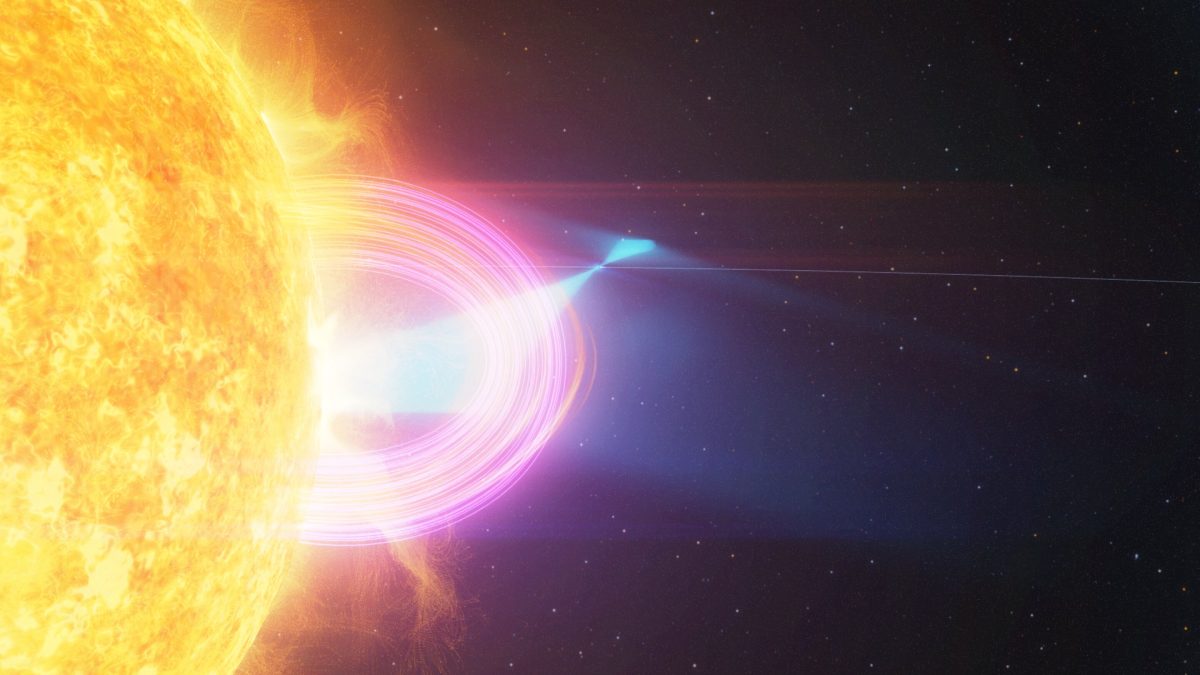
Long-period transient GPM J071507−114153
According to the website phys.org, scientists from Curtin University at the International Centre for Radio Astronomy Research (ICRAR) have identified the source of mysterious radio pulses that were coming from a specific region of the sky every 8 minutes. As stated in an article published in the journal Nature Astronomy, the source turned out to be the close binary system GPM J071507−114153.
Such sources of radio emission, in which the pulsation period is measured in minutes, are called long-period transients. They are not exactly a common phenomenon, but this is by no means an isolated example. However, in all other cases, the white dwarf’s companion is a red dwarf. In this case, however, it is a yellow star similar to the Sun.
The first long-period transient was discovered by the same team at ICRAR in 2021. Since then, about a dozen more similar systems have been found, and astronomers are still working to understand their nature. The new system provides the clearest picture yet of what is happening there.
Tight system
Although GPM J071507−114153 is located more than 5,000 light-years away from us, scientists have managed to determine not only that the source of the pulses is indeed a white dwarf, but also that the yellow star is experiencing flares similar to those we observe on the Sun.
Two stars orbit each other at high speed. And every time the white dwarf is facing us, we observe a flare. Their exact nature has not yet been definitively determined, but observations suggest that the yellow star in the GPM J071507−114153 system has extremely tall plasma loops—solar prominences.
It is quite possible that, at this pair of stars, matter is flowing toward the more massive component. There, it somehow interacts with its surroundings, causing electromagnetic radiation to be emitted.
