

In an amino acid from a sample of the asteroid Bennu, one carbon atom turned out to be more strongly enriched in a heavy isotope than in any other known organic compound from asteroids and meteorites, while the neighboring atoms are, on average, depleted in it. This difference within a single molecule preserves traces of the conditions under which it formed. In the well-known meteorite used for comparison, these differences are much weaker. The authors believe that the organic compounds in both bodies were synthesized in chemically distinct regions of the protoplanetary disk.
A record in the carboxyl group
Each carbon atom in a molecule comes from a particular precursor substance and retains its isotopic signature, meaning its proportion of the heavier carbon-13 isotope. If only the average value for the entire molecule is measured, these signatures become indistinguishable. Therefore, the team led by Ophelie McIntosh of Pennsylvania State University measured the carbon atom at the end of the molecule, in the carboxyl group, separately from the other two carbon atoms. These signatures make it possible to determine which substances and which reactions produced the amino acid.
According to the study published in the peer-reviewed journal Communications Earth & Environment, the carboxyl carbon in beta-alanine from Bennu has the strongest enrichment in carbon-13 ever recorded in an organic compound from an asteroid or meteorite. The other two atoms in the same molecule are, on average, depleted in this isotope. In the Murchison meteorite, which fell in Australia in 1969, the difference between the parts of the molecule is much smaller.
“I was genuinely stunned by the huge difference in isotopes between two neighboring atoms in a single molecule,” says Katherine Freeman.
Where the difference comes from
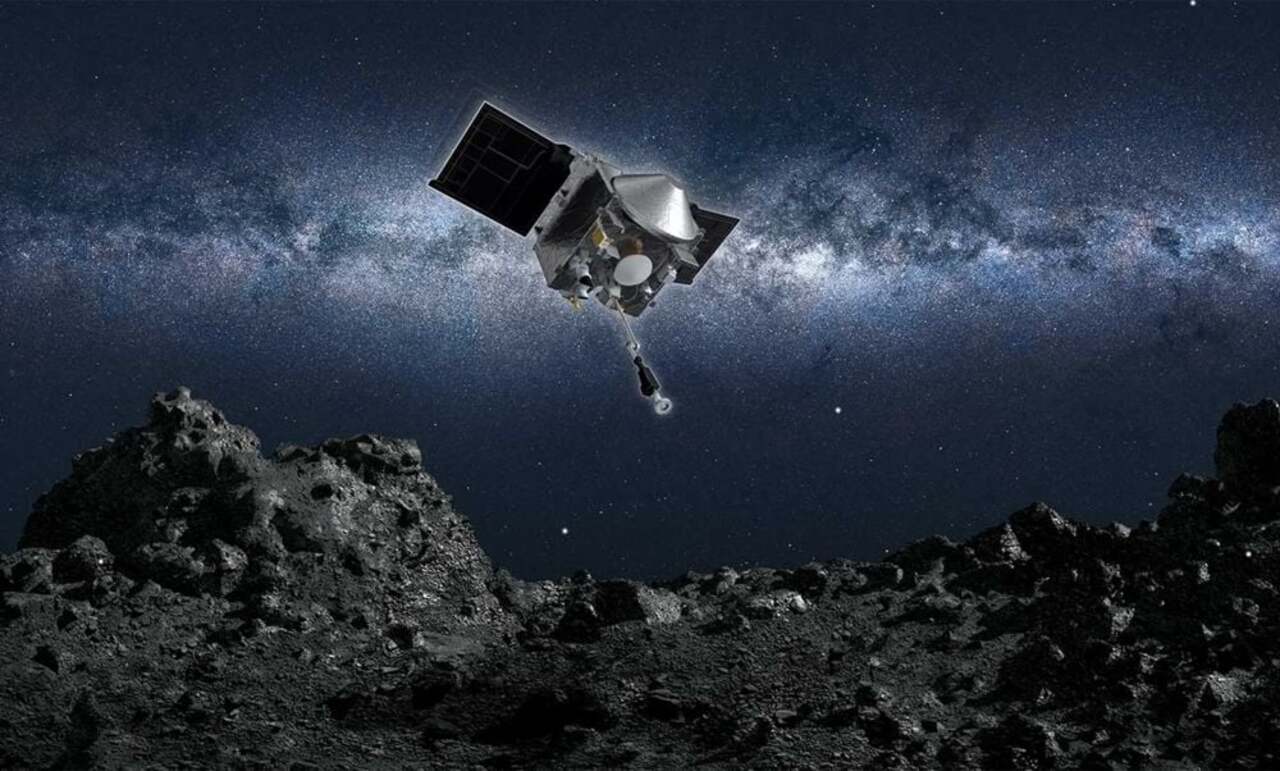
In the interstellar medium, carbon-13 preferentially accumulates in carbon monoxide, while carbon compounds containing hydrogen remain depleted in it. If the carboxyl carbon originated from carbon monoxide and the other two atoms came from hydrogen-containing compounds, the difference between them is preserved in the finished amino acid. The sample from Bennu, delivered by the OSIRIS-REx spacecraft, was protected from terrestrial contamination, so these signatures have not been altered.
Beta-amino acids in meteorites are most commonly explained by a reaction involving ammonia in liquid water. This explanation does not apply to Bennu because the nitrogen isotopic composition of beta-alanine does not match that of ammonia found in other samples from the asteroid.
Different regions of the same disk
The isotopic signatures in both samples are distributed similarly, so beta-alanine in them was likely produced by related reactions. However, the difference between the samples is too large to be explained by processes inside the asteroids. Heating amino acids in water to 150 degrees Celsius barely changes their isotopic composition.

The authors attribute the discrepancy to the conditions under which the molecules formed. Bennu’s parent body likely formed in a cold region of the disk beyond Jupiter’s orbit, while icy dust grains in the disk moved around and received different doses of ultraviolet radiation and heat. The isotopic differences between beta-alanine from Bennu and the Murchison meteorite indicate that organic compounds in the early Solar System were synthesized in chemically distinct regions of the disk. As Universe Today reports, these molecules may have formed even before Earth came into existence.
A reference point for the search for life
There is still insufficient isotopic data for other compounds from Bennu samples, so it is impossible to definitively identify the reaction that produced beta-alanine. However, these measurements already show what organic compounds formed without the involvement of life can look like.
This will be useful in the search for biomarkers. Such data will make it possible to compare organic compounds detected by instruments aboard future missions to the icy moons of Jupiter.
