

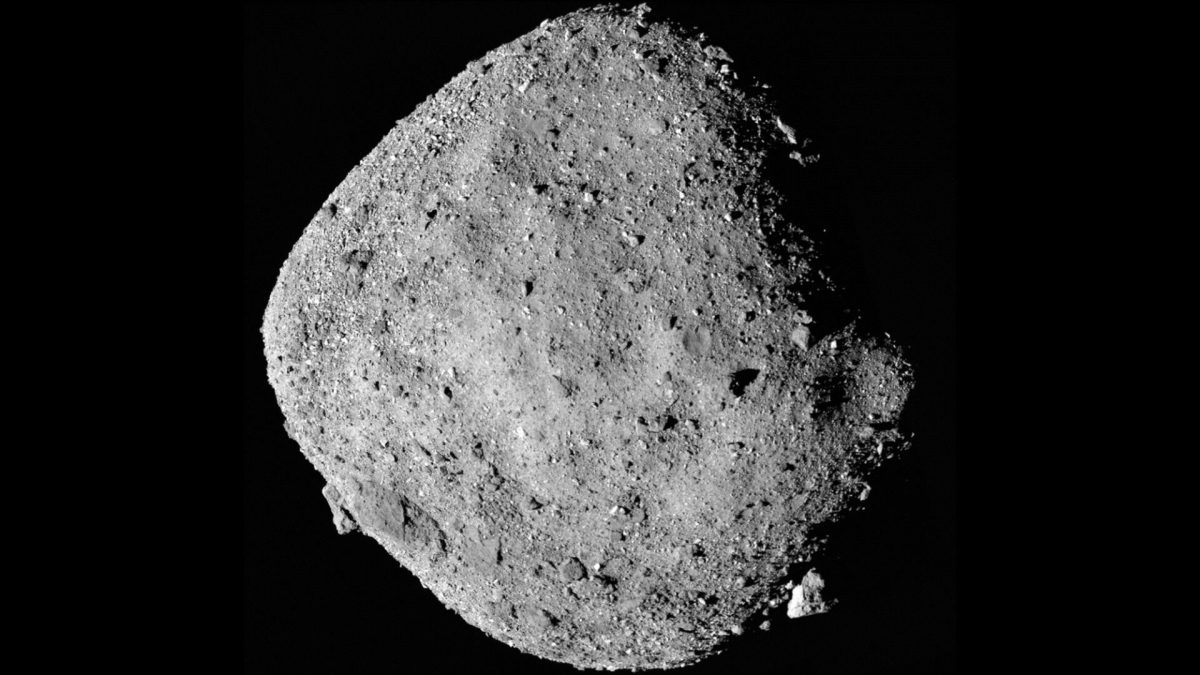
Scientists have determined how strong the surface of an asteroid should be. It turns out that many of them are actually covered with a thick layer of barely bound material. In particular, this is the case for Bennu, Ryugu and Itokawa, which have already been studied by spacecraft.
Fine Particles Stick Together
In a new study published in the journal Nature Communications, scientists developed a universal scale for estimating the strength of granular asteroids, demonstrating that their tensile strength can be predicted from the size and shape of the particles they are made of. This is reported by phys.org.
Space missions have shown that many small asteroids, such as Bennu, Ryugu and Itokawa, are not solid rocks but granular asteroids: loosely bound collections of dust, rocks and boulders held together by their own gravity and weak cohesive forces.
Scientists have been studying how these bodies remain intact for more than a decade. However, previous simulations treated fine grains only as perfect spheres, whereas in reality they have angular and irregular shapes. In this study, researchers found a way to account for realistic particle shapes in simulations.
Paul Sánchez, a senior research associate at the University of Colorado Boulder, notes: “We needed to determine what effect small cohesive particles could have inside an asteroid, but simulating all the necessary particles was — and still is — impossible. So it was proposed to use as a basis the liquid bridges that water on Earth forms between tiny grains of sand.”
The “Rubble-Pile” Spin Barrier
“It has been established that small asteroids, less than 150 meters in diameter, can rotate with periods shorter than 2.4 hours, while larger asteroids encounter a certain barrier — the ‘rubble-pile spin barrier.’ This barrier is a direct consequence of the asteroid’s self-gravity,” Sánchez noted.
A rubble pile rotating fast enough will fly apart, and for a body held together only by gravity, this limit does not depend on size. Larger asteroids obey this limit, which itself is evidence that they are rubble piles rather than solid rock.
Smaller asteroids do not. Their self-gravity weakens rapidly as their size decreases, while cohesive forces between grains remain the same. Below a certain size, cohesion can become the dominant force holding an asteroid together. However, cohesion does not replace gravity — it supplements it.
In 2010, Sánchez and his colleagues proposed that van der Waals forces between fine grains could provide this strength. These grains form the asteroid’s regolith — loose dust and rock covering its surface.
In 2014, the team tested this hypothesis using spherical particles, and the results showed that fine grains could act as a weak cement between larger boulders. However, two things were still missing: first, simulations could not yet account for realistic grain shapes; second, the material properties on which these calculations depend, such as the cohesive force between particles, also had to be assumed rather than measured.
The situation changed in 2023, when NASA’s OSIRIS-REx mission returned samples from Bennu, making it possible to measure these properties for the first time.
The Forces Holding the Particles Together
Instead of modeling an asteroid as a whole, the researchers modeled a small section of it. They placed a matrix of cohesive grains — fine material binding larger fragments together like cement in concrete — between two boulders, each one meter, or 3.3 feet, in diameter, forming a bridge. Pulling the boulders apart until the bridge failed made it possible to determine the tensile strength.
The team performed 78 such simulations using the contact dynamics method implemented in the open-source LMGC90 software.
In some samples, the grains were perfect spheres. In others, they were polyhedra, elongated or flattened into 10 different shapes, ranging from nearly round to highly elongated. Grain sizes ranged from 2 to 5 centimeters, or 0.8 to 2 inches, in both uniform and mixed batches. Their shapes were measured using a sphericity index.
The model incorporated both forces that hold a real asteroid together: van der Waals attraction as a constant force acting at points where two grains touch, and gravity calculated directly between every particle. The boulders were then pulled apart with forces that increased gradually in small increments. Stress in the bridge increased, reached a stable value and then suddenly fell to zero when the bridge failed. This peak value is the tensile-strength limit.
How Grain Size and Shape Affect the Strength of Asteroid Bennu
The simulations showed that strength depended on two factors: grain size and the degree to which their shapes deviated from a sphere. Smaller grains formed stronger bridges. If grain size is reduced, more grains fit into the same volume, which means more contact points are created to hold the structure together.
Shape also mattered. Two spheres touch at a single point, while two angular grains may touch along an edge or across an entire face. “Particle shape is important because non-spherical particles can have multiple contact points and can also pack very tightly, thereby increasing the number of contact points and reducing porosity, or the empty space between particles,” Sánchez explained.
These two effects can offset each other, so a bridge made of large angular grains may perform similarly to one made of small rounded grains. This is what makes the model universal: to predict strength, only one measurement — either size or sphericity — is sufficient.
Applied to Bennu, using cohesive forces measured from the returned samples, the model determined a surface strength of less than 1 pascal, consistent with independent estimates obtained through remote sensing and during the sample collection itself. This means that the surface of asteroid Bennu is 50 times weaker than a cylinder formed from freshly ground coffee. The reason is the lack of fine dust.
Applying the Theory to Asteroid Impacts
Almost everything known about asteroids comes from their visible surfaces. Their strength varies and becomes apparent only when some external force acts on them.
“Imagine that you have a box filled with rocks and dust. You can tilt the box and determine the angle at which the particles inside begin to slide downward — the event that causes failure — but how do you determine that angle without tilting the box?” Sánchez said.
This uncertainty is important for planetary defense because how far an asteroid moves after an impact depends on properties that otherwise have to be assumed. NASA tested this in 2022, when its DART spacecraft collided with the asteroid Dimorphos.
The new theory proposed in the study is linked to particle size, particle-size distribution and porosity. It can provide an initial approximation of asteroid tensile strength and cohesion values. These are fundamental material parameters for software codes that model asteroid impacts — the only proven method of deflecting asteroids.
As a next step, the team plans to extend the model to wider ranges of grain sizes and to the interiors of asteroids — a region that no mission has ever directly observed.
