

Physicists at the Large Hadron Collider have, for the first time within a single experiment, obtained evidence of one of the rarest decays predicted by the Standard Model: the decay of a neutral B meson into a muon and an antimuon. Unknown heavy particles, if they existed, could alter the rate of this process. The measured value agrees with the theoretical prediction, so the Standard Model has passed another test, leaving less room for hypothetical particles beyond those it predicts.
Once in Ten Billion
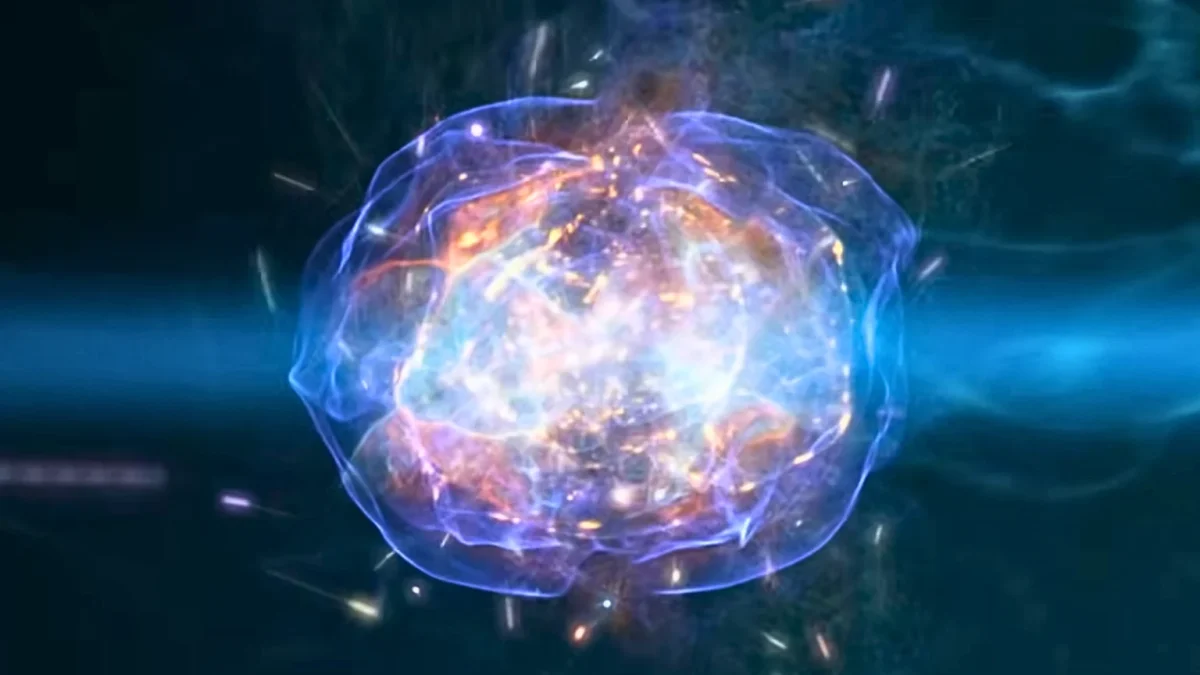
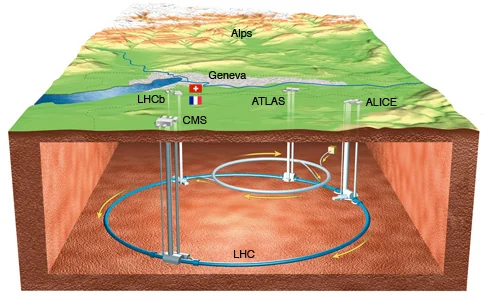
The Large Hadron Collider b-quarks experiment (LHCb) collaboration presented the result on November 3, according to ScienceAlert. The experiment operates at the Large Hadron Collider. Theory predicts that approximately one in ten billion mesons decays this way, and the measured rate agrees with that prediction.
The meson itself consists of two quarks. One is of the same type as those found in protons and neutrons, while the other is the antiparticle of the much heavier b quark. These mesons are produced in proton collisions and decay in approximately one and a half trillionths of a second.
Such a rare signal can easily be confused with background—that is, other processes that look similar in the detector. The result is therefore assessed using statistical significance, measured in sigma. Here, the significance is 3.2 sigma, meaning that the probability of background alone producing such a signal is less than three-tenths of a percent.
Why the Rate Matters
Theory has long predicted not only the decay itself but also how often it should occur. If unknown particles influenced it, the measured rate would differ from the calculated one. The two agreed, meaning that here, too, the theory correctly describes what happens in nature.
The Standard Model, the theory describing known particles and the forces between them, allows this decay only through an indirect route, rather than in a single step. The meson’s quarks can turn into a pair of muons only through a chain of intermediate particles that appear momentarily, including the heaviest known quark, the t quark. Each link in this chain makes the decay even less likely.
There is a second reason as well. The meson has no spin, or intrinsic angular momentum, so the muons’ spins must be aligned in a particular way. Such pairs are produced extremely rarely in the weak interaction through which the decay occurs.
This very rarity makes the decay useful for testing hypotheses about new particles. The Standard Model does not explain dark matter or why the Universe contains far more matter than antimatter, so scientists are searching for particles beyond those included in the model. Even if such particles are too heavy to be detected directly at the collider, they could provide an additional decay route. The usual route is so restricted that even a small additional contribution would noticeably change the rate.
No deviation is visible so far, so any new particles are either even heavier or influence the decay too weakly. According to the authors’ estimates, such measurements are sensitive to processes at energies of up to 100 teraelectronvolts, whereas the collision energy at the collider is 13.6 teraelectronvolts.
University of Cambridge video, “Physicists Knock on the Door of the Zeptouniverse.” Source: University of Cambridge / YouTube
Forty-Two Years of Searching
The search for this decay began in 1984 at the CLEO experiment in the United States. At the time, researchers could only establish that it occurred no more often than once in every five thousand decays. Since then, the sensitivity of the searches has improved by approximately a factor of two million, and only at this level did the decay finally emerge.
Back in 2015, a combined analysis of data from LHCb and the CMS detector hinted at this decay, but subsequent measurements did not confirm it. Since then, the experiments have moved ever closer to the predicted rate without confidently detecting the decay itself.
What the Upgraded Detector Changed
The analysis, led by Harry Cliff of the University of Cambridge, draws on data collected in 2024 and 2025 by the upgraded LHCb detector. In two years, it accumulated twice as much data as it had collected from 2011 to 2018 combined. Muons are now identified more accurately, making them less likely to be confused with other particles.
Even so, only around 26 such decays were expected in the sample, among hundreds of background events. To isolate the rare signal, the team used machine learning.
The results are currently available as a preprint on arXiv. The paper has been submitted to Physical Review X, so the findings have not yet undergone peer review.
More Data Needed for a Discovery
Physicists consider a result a discovery when its significance reaches at least 5 sigma. That threshold has not yet been reached, so this constitutes evidence for the decay rather than its definitive observation.
The next upgrade of the LHCb detector is planned for the 2030s, after which the amount of data is expected to increase by approximately an order of magnitude. A sample of that size would make it possible to reach the significance required for a discovery and measure the decay rate much more precisely.
