

A group of astronomers has discovered a rare example of a pulsar that escaped from the cloud of debris left behind by the supernova explosion in which it was formed. It is moving rapidly through space.
Runaway Neutron Stars
According to the website phys.org, a team of researchers from the Max Planck Institute for Radio Astronomy accidentally discovered a rare runaway pulsar. Very few such objects are known in space. This suggests that many similar observations may soon become possible with next-generation radio telescopes. Perhaps this will help astronomers find answers to unresolved questions about the origins of fast-moving pulsars and the surprising scarcity of supernova remnants in the Galaxy.
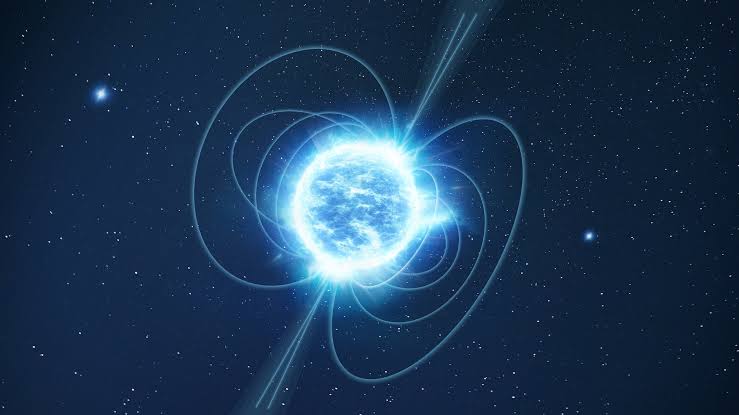
A pulsar is a highly magnetized, rapidly rotating neutron star that emits powerful beams of electromagnetic radiation from each of its poles. If one of these beams happens to point toward Earth, astronomers see it as an intense electromagnetic pulse that repeats with remarkable regularity, much like the beam of a lighthouse.
These strange objects form when the cores of massive stars collapse during supernova explosions, which also eject enormous clouds of gas and dust known as supernova remnants (SNRs). Each cloud forms a rapidly expanding shell that becomes thinner and disperses into interstellar space over approximately 100,000 years.
However, for reasons astronomers are still trying to fully understand, the pulsar itself often receives a powerful kick during the initial explosion, which sends it away from the center of the expanding cloud. As it moves through the surrounding gas, it can leave behind a comet-like tail.
In some rare cases, this kick is particularly strong. Scientists know of only four cases in which a pulsar formed after a core-collapse supernova explosion and moves faster than the diffuse ejecta that eventually becomes a shell. Such cases provide a unique opportunity to observe some of the fastest compact objects in our Galaxy.
In addition to the mystery of these kicks, there are also unresolved questions about the number of supernova remnants in the Galaxy. Astronomers estimate that approximately 2,000 supernova remnants should exist in the Milky Way, but only about 400 have been discovered so far.
Measuring the Relative Positions of Pulsars and Supernova Remnants
In their study, Dokara’s team initially set out to investigate this discrepancy using combined observational data from several large-scale radio surveys conducted by radio telescopes around the world over the past two decades, covering a wide range of frequencies. These surveys detect radio waves produced by electrons spiraling through magnetic fields inside the expanding shells of supernova remnants. They also make it possible to detect pulsars and their tails.
Combined with existing pulsar timing measurements, these data allowed astronomers to calculate three key parameters for any pulsar-supernova remnant pair. First, by measuring the rate at which a pulsar’s rotation slows down, determined through precise timing of its pulses, they were able to estimate its age. Second, by measuring the angular distance between the pulsar and the center of the shell in radio images, they could determine how far apart the two objects appear in the sky.
Finally, they took into account the fact that lower-frequency radio waves are slowed down more strongly by free electrons along their path, which are sparsely distributed throughout interstellar space. By measuring the difference in arrival times between higher- and lower-frequency radio waves, the team was able to estimate the pulsar’s distance from Earth and, consequently, the distance to the supernova remnant.
Based on these three factors, Dokara’s team was able to estimate both the pulsar’s speed and the size and evolutionary state of the supernova remnant, determining what stage it had reached in its transformation — from the initial supernova explosion to a fully dispersed cloud.
An Accidental Discovery
While carefully analyzing the data, Dokara discovered a connection that had previously gone unnoticed. “By chance, I found a new supernova remnant shell and a known pulsar located far beyond this shell, but its tail pointed very clearly toward the center of the shell,” he says. “We estimated its transverse velocity at more than 1,400 kilometers per second, making it one of the fastest pulsars in the Milky Way.”
Since the new shell and the pulsar’s tail were first detected in images obtained using MeerKAT, one of the latest-generation radio telescopes, this discovery has promising implications for the observational capabilities of modern instruments. Thanks to their increased sensitivity and resolution, the team now hopes that similar observations will become routine during future large-scale surveys.
