

Chinese scientists have simulated the formation of spicules — very narrow, twisting jets of plasma that periodically erupt from the surface of our star. They have linked their appearance to vortices that exist on the Sun’s surface and are caused by processes in the magnetic field of our star.
Spicules on the Sun
Spicules are thin jets of plasma that form in the Sun’s photosphere. They transport material from cooler lower layers into the extremely hot outer layers. At the same time, they often twist. As the website phys.org reports, a group of scientists from the Yunnan Observatories of the Chinese Academy of Sciences recently determined how they may form. The results of the study have been published in the journal Astronomy & Astrophysics.
Scientists have long suspected that spicules may be somehow connected to small vortices that arise between vortices in the Sun’s photosphere. They are very similar to spicules in structure, but until now, researchers had been unable to prove a connection between them. This time, however, they succeeded thanks to computer simulations using the MURaM software code.
At the same time, it is worth remembering that when it comes to the Sun and its components, all concepts of “small” and “cold” are relative. In reality, everything there is extremely hot and large by Earth’s standards; some things are simply small and cold compared with others.
What the Simulations Revealed
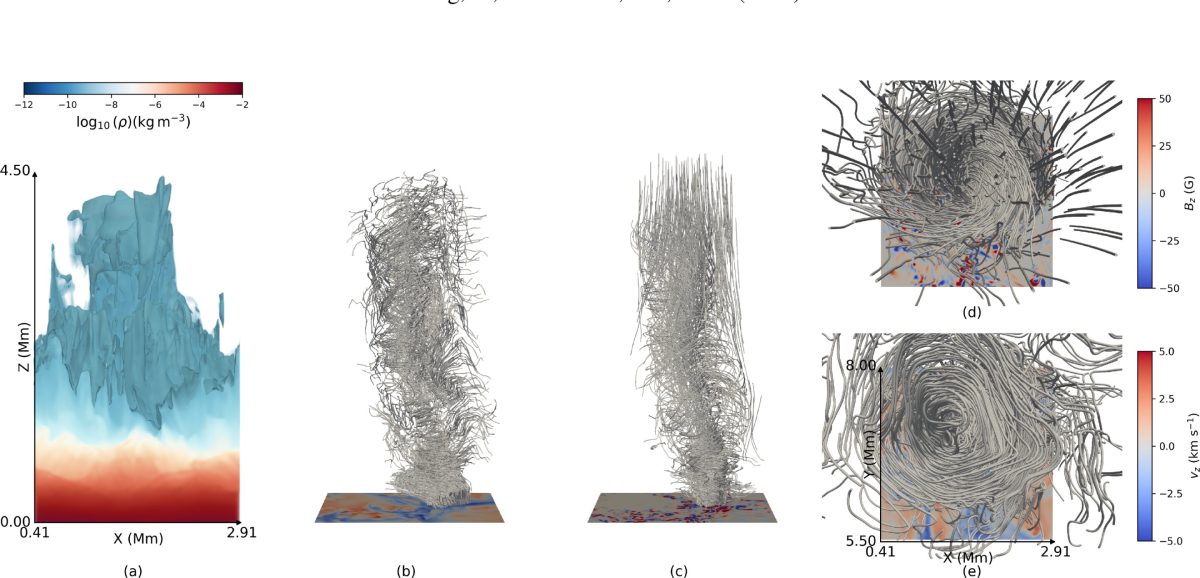
The researchers performed three-dimensional radiative magnetohydrodynamic simulations of a configuration with an open magnetic field. The computational domain covered the region from the upper part of the Sun’s convection zone to the lower layers of the corona.
The simulation indeed showed that vortices trigger the appearance of structures resembling thin jets, one of which lasted for 10 minutes. It is important to understand that the entire solar photosphere is permeated by magnetic field lines. They are constantly being deformed and often break and subsequently reconnect. This is what causes magnetic vortices to form.
Before the jet appeared, a photospheric vortex twisted the magnetic field lines. This spiral structure then propagated upward into the higher atmospheric layers, forming a kind of “magnetic tornado.” A jet gradually rose inside this structure, rotating around the same axis.
At the periphery of this “tornado,” downward-directed components locally appeared in the twisted magnetic field lines. They underwent reconnection with upward-directed field lines, both in the surrounding environment and in the vortex core, causing their configuration to change. At different stages of the event, thin current sheets and bidirectional flows were observed — characteristic signs of magnetic reconnection. As the “tornado” rose and rotated, the reconnection regions moved along with it, while numerous thin jet-like structures corresponded to upward flows generated in these regions.
What Makes the Jets Rise Higher?
The most interesting part of the study concerns what makes magnetic tornadoes rise higher. The simulations showed that the primary cause is a pressure difference: the entire mass of superheated, charged plasma is simply pushed upward. Then the Lorentz force comes into play, pushing the electrically conducting plasma with its charged particles through the action of the magnetic field.
This force acts primarily on the outer parts of these tornadoes, causing them to twist even more strongly. Thus, the process of spicule formation is quite complex. Several different mechanisms operating on the surface of our star are involved.
