

The tilt of a star’s rotation axis relative to the orbits of its planets appears to be established at the very moment a planetary system forms and remains almost unchanged afterward. Around the youngest stars, where planets are just beginning to form in a gas-and-dust disk, the axis is tilted relative to the disk about as often as it is tilted relative to the orbits of gas giants in systems billions of years old. According to several theories, however, this tilt should change noticeably as systems age.
From Millions to Billions of Years
A star’s obliquity is the angle between its equator and the plane in which its planets or disk orbit. According to astrophysicist Lauren Biddle of Princeton University, this angle provides clues about how the orientations of stars and orbits change over time. According to some theories, orbits can change their orientation significantly due to the gravity of other planets or neighboring stars, while the orbits of hot Jupiters — gas giants close to their stars — can also be affected by tidal forces. If this happened frequently, the proportion of tilted systems around young and old stars would differ noticeably.
To test this, Lauren Biddle and Brendan Bowler of the University of California, Santa Barbara, compared 114 Sun-like stars without stellar companions. Using their rotation periods, sizes, and rotational velocities measured from their spectra, they determined how each star’s axis is oriented relative to the line of sight and compared this with the orientation of the disk or the orbit of a transiting planet — one that passes between its star and the observer.
The proportion of tilted systems turned out to be approximately the same, regardless of age or the distance between the star and its disk or planets. As the astrophysicist explained to Universe Today, this suggests that major changes in planetary orbits are rare after their formation, while smaller changes cannot be detected with current measurements.
Four Groups of Systems
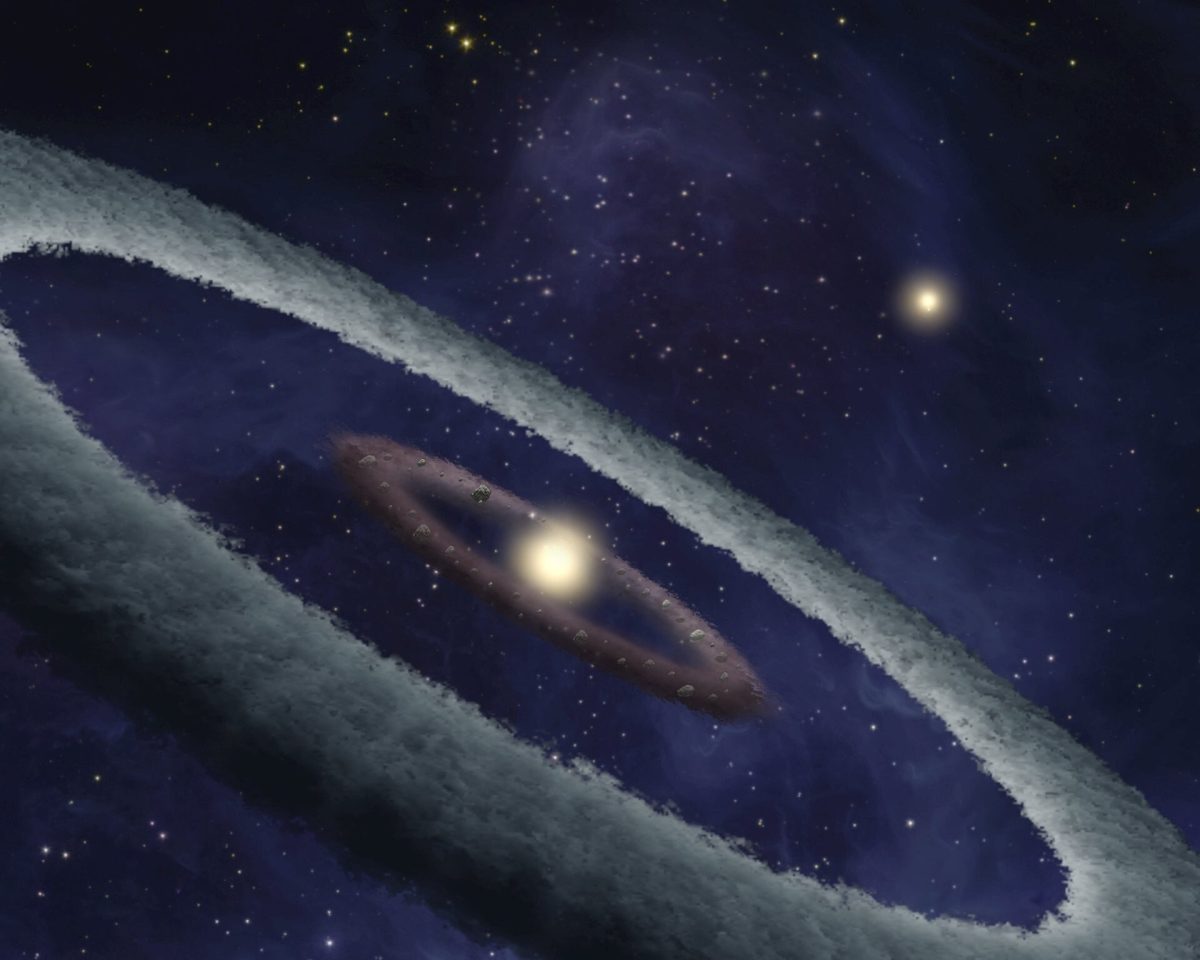
The stars were divided into four groups differing in both age and distance from their disks or planets. The 49 youngest stars are between 2 and 5 million years old and are still surrounded by protoplanetary disks tens to hundreds of astronomical units wide, where an astronomical unit is the distance from Earth to the Sun. Around 24 stars, with an average age of approximately 190 million years, are surrounded by debris disks made of dust and planetesimals left over after planet formation. The oldest part of the sample consisted of 21 systems with warm Jupiters, which orbit their stars in 10–100 days, and 20 systems with hot Jupiters, whose orbital periods are shorter than 10 days.
A system was considered tilted if its angle exceeded 10°. Such systems accounted for 33% of the youngest group, 21% of systems with debris disks, 23% of systems with warm Jupiters, and 20% of systems with hot Jupiters. The difference between 33% and 20% may seem significant, but the samples are small, and the uncertainty in each estimate reaches 7–10 percentage points, so statistically the proportions are consistent with one another.
All these estimates are minimum values because the rotation of a star’s axis around the line of sight cannot be measured, meaning that the actual angle may be larger. In tilted systems, the average angle ranges from 30° to 50°, depending on the group. The authors presented their findings in a paper on arXiv, which has already been accepted for publication in the peer-reviewed journal The Astronomical Journal.
The authors also paid particular attention to warm Jupiters. Gravitational perturbations that make an orbit more elongated could also tilt it, and the orbits of warm Jupiters can be highly elongated, with eccentricities reaching 0.8. In such cases, the point closest to the star is nine times closer than the farthest point. However, the tilt in these systems remains small, suggesting that an elongated orbit does not necessarily come with an inclined orbit.
The Sun’s Tilt and the Limits of the Sample
The Sun also has a tilt. Its equator is inclined by approximately 6° relative to the average orbital plane of the planets and dwarf planets, so according to the authors’ criterion, the Solar System would be considered aligned.
Lauren Biddle does not know for certain whether this angle has existed since the beginning. If the Sun’s equator initially coincided with the orbital plane, it could have been tilted by the passage of another star, the gravity of an unknown distant planet, the solar wind, or internal gravity waves — oscillations of matter inside the Sun, rather than waves in spacetime. Such a small angle does not contradict the study’s conclusions, because changes within 10° cannot be distinguished with current measurement accuracy.
According to Lauren Biddle, there is no evidence that a star’s tilt itself affects whether its planets can support life. However, it is connected to the history of planet formation and where planets eventually end up, both of which have a major influence on habitability.
The discovery of a planet around Barnard’s Star, the nearest star to the Sun without a stellar companion. Credit: ESO
For the part of the sample containing planets, the authors deliberately included only stars similar to or cooler than the Sun, with transiting gas giants. Close binary systems, hotter and more massive stars, small planets, and giant planets in distant orbits will have to be examined separately, because large tilts may be common in those systems.
