

The giant ALMA radio telescope located in South America has allowed scientists to examine the protoplanetary disk around the young star WISPIT 2. It has two confirmed planets. For the first time, scientists were able to see not only the planets themselves, but also how they absorb material while carving wide gaps through the gas and dust surrounding the star.
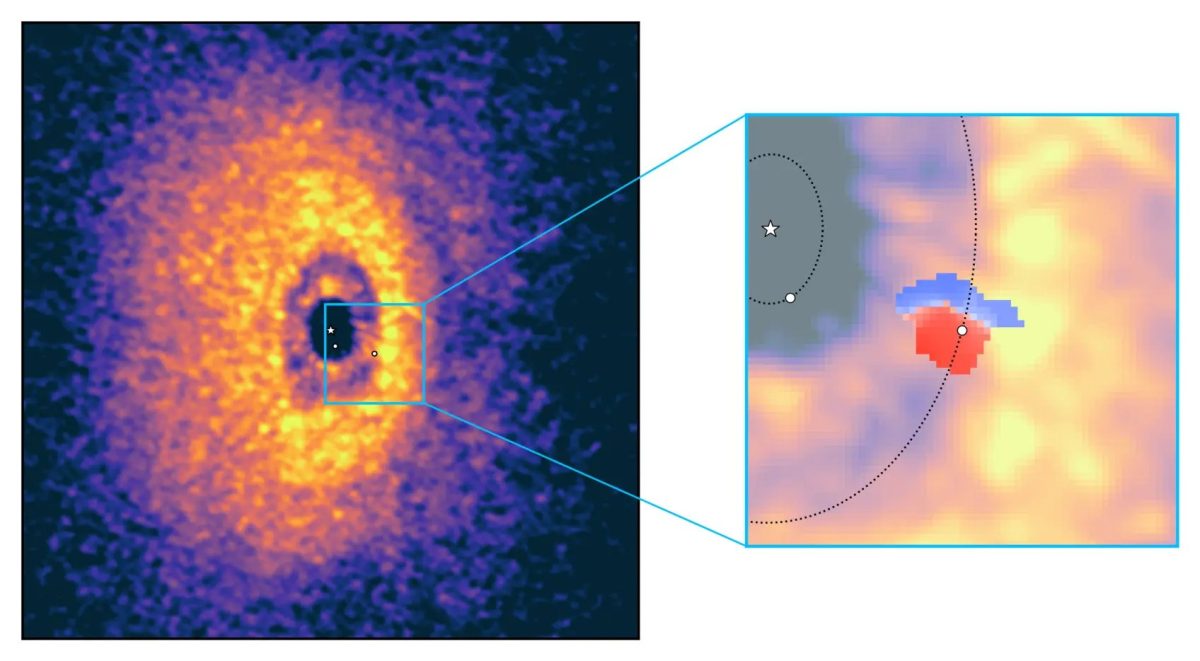
The WISPIT 2 System
The website of the Max Planck Institute for Astronomy reports that an international team of scientists has obtained the most detailed image of an exoplanet forming within a gas-and-dust disk around another star. They were assisted by the Atacama Large Millimeter/submillimeter Array (ALMA), located in Chile.
The system, designated WISPIT 2, is located 430 light-years away from us. It first attracted scientists’ attention in August 2025. At that time, using the SPHERE instrument installed on the European Southern Observatory’s Very Large Telescope and the Magellan Telescope, researchers discovered not only the disk surrounding the star, but also one planet orbiting within it.
Then, in March 2026, a second planet was discovered there, and it became clear that this system provides scientists with a unique opportunity to study the processes involved in the formation of new worlds. However, ALMA’s antennas had already been pointed at the system in the fall of 2025. The results of those observations have now been published.
What ALMA Revealed
To be fair, WISPIT 2 is not the first young system in which scientists have managed to image planets within a gas-and-dust disk. Researchers had previously done the same for the PDS 70 system and had even determined which chemical substances were present there. This time, however, scientists were able to see important details, largely thanks to the ALMA radio telescope and new methods for processing its data.
ALMA consists of 66 individual antennas that operate as a single large telescope with a diameter of 16 km. This gives it incredible resolution and allows it to obtain highly detailed images of objects. This time, it revealed what the WISPIT 2 system looks like. Scientists saw the star itself, the disk surrounding it, the gaps in the disk, and the two planets moving within those gaps. Moreover, they saw vortices of gas and dust surrounding the two bodies.
And this is actually the most important part. Scientists have repeatedly observed such vortices in protoplanetary disks before. According to current theoretical models, this is exactly how material around young planets should behave: it should continue falling onto them. However, the planets themselves were not visible in those earlier images, leaving open the possibility that they might not be there at all.
This is why the new ALMA image is so important. It makes it possible to confirm that everything is happening exactly as scientists had expected. A paper presenting the results of the study has been submitted to Astrophysical Letters and is already available on the arXiv preprint server.
