

Scientists want to test whether Lorentz invariance holds throughout the Universe. It means that Einstein’s laws apply everywhere. And verifying this does not necessarily require traveling to other galaxies. Installing neutrino detectors on the floor of the Mediterranean Sea is enough.
Searching for Discrete Spacetime Using Neutrinos
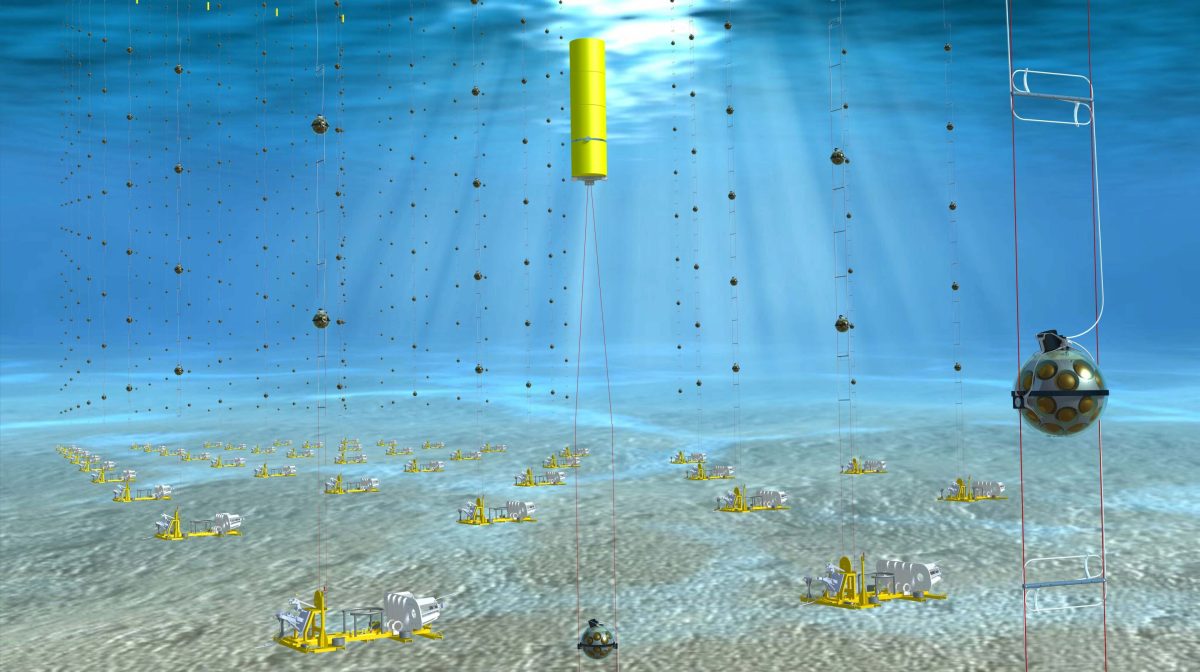
Are the laws of physics truly the same everywhere in the Universe? This fundamental principle, known as Lorentz invariance, underpins Einstein’s theory of relativity. However, some theories seeking to reconcile gravity with quantum physics suggest that it may not always hold. To investigate this possibility, scientists from the international KM3NeT collaboration analyzed 5,828 candidate atmospheric neutrino events recorded by KM3NeT/ORCA, a neutrino telescope deep in the Mediterranean Sea, according to phys.org.
Why question such a fundamental principle? One reason is the search for a theory of quantum gravity capable of unifying general relativity with quantum physics. Some theoretical approaches suggest that spacetime, which we usually consider continuous, may actually consist of extremely small, discrete units. This could have profound consequences for the laws of physics, potentially leading to violations of Lorentz invariance.
“We still do not know whether our spacetime is continuous or perhaps discrete,” explains Alba Domi, a researcher at the Erlangen Centre for Astroparticle Physics (ECAP) at Friedrich-Alexander University Erlangen-Nuremberg and one of the study’s two corresponding authors. “Searching for violations of Lorentz invariance is one way to investigate this possibility.”
As Domi explains, neutrinos are particularly promising tools for searching for signs of such new physics. These tiny particles rarely interact with matter, allowing them to travel enormous distances and even pass through Earth. They also have a remarkable property: as they travel, they can change from one type, or “flavor,” into another—a phenomenon known as neutrino oscillation. The probabilities of these transformations can be predicted with great precision. If observed behavior differs from those predictions, it could signal new physics, potentially including violations of Lorentz invariance.
To detect such deviations, the researchers analyzed 1.4 years of data collected by the first six KM3NeT/ORCA detection units, comparing the observed neutrino energies and arrival directions with theoretical predictions.
Setting Limits on Lorentz Invariance Violation
The researchers found no evidence of Lorentz invariance violation. This does not mean such violations are impossible, however: their results establish new limits on how large certain effects could be without contradicting observations. Although obtained using an early, partial detector configuration, these results are competitive with those from long-running experiments such as IceCube and Super-Kamiokande. For the first time, scientists also established direct limits on certain possible Lorentz-invariance-violating effects involving two neutrino flavors—muon and tau neutrinos—and how they oscillate between one another.
These findings are particularly promising given that, when the data were collected, ORCA was still in an early stage of construction and operating with only six detection units. The detector is still being expanded toward its full planned configuration.
“These results demonstrate KM3NeT/ORCA’s potential to test fundamental principles of physics, even with a relatively small detector,” says Lukas Hennig, an ECAP doctoral student and another co-author of the study. “With more data and a larger detector, we will be able to search for even smaller effects.”
Expanding Research with Neutrino Detectors
In the future, the researchers hope to extend their work to KM3NeT/ARCA, which focuses on much higher-energy neutrinos arriving from distant astrophysical sources. Such neutrinos could be particularly promising for these searches because some possible effects of Lorentz invariance violation become more pronounced over very long distances and at higher energies. “ARCA could be especially well suited to this kind of research, but we do not yet have enough astrophysical neutrino events to carry out such an analysis,” Domi explains.
The growing importance of high-energy neutrino research was recently recognized with the award of the 2026 Nobel Prize in Physics to Francis Halzen for his pioneering contributions to the IceCube Neutrino Observatory and the discovery of high-energy neutrinos from space.
