

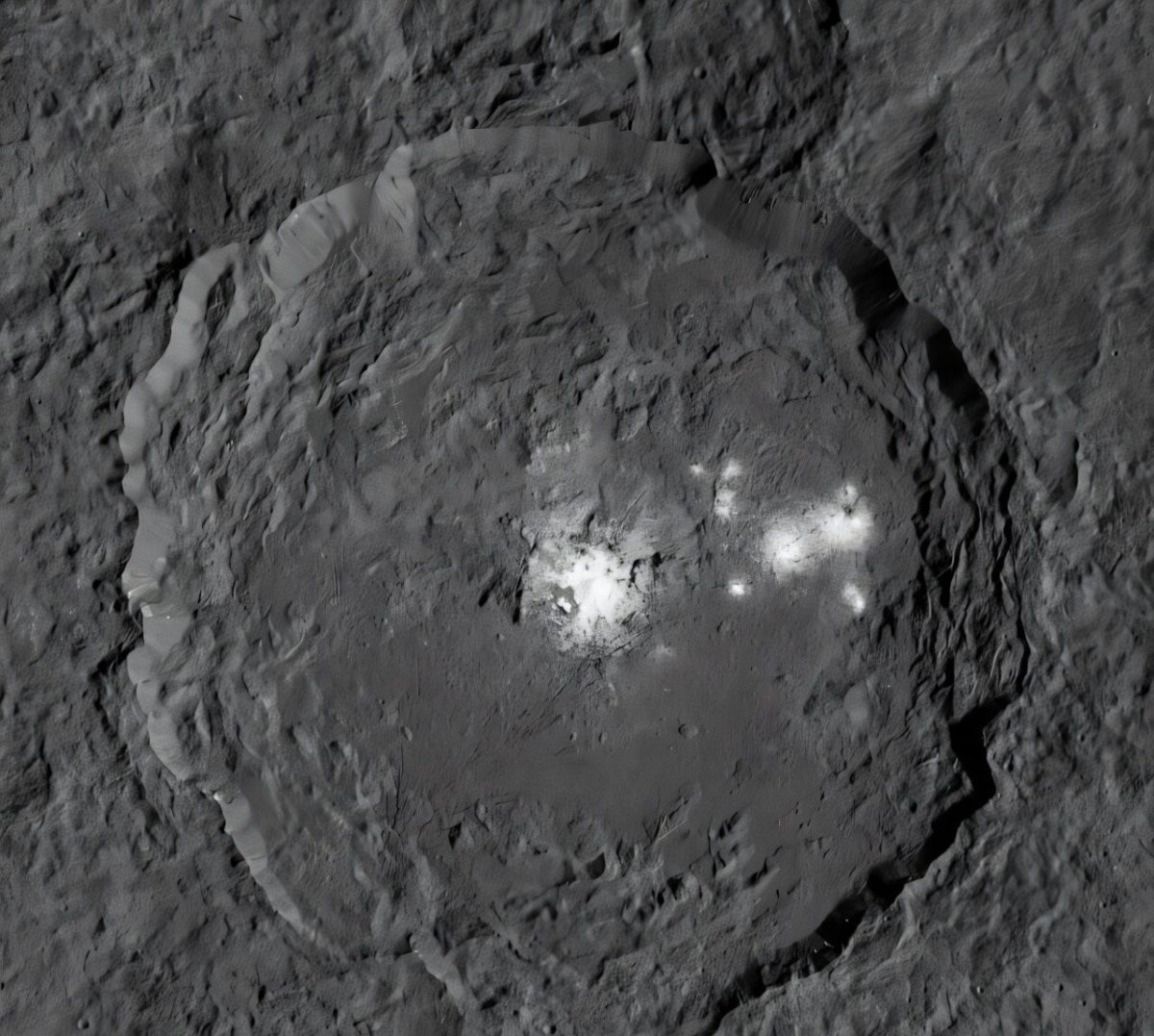
Ceres is a dwarf planet in the main asteroid belt. Bright white patches on the floor of one of its large craters have been identified as exposed salt deposits. Scientists believe, however, that water ice—or even an ocean—may lie hidden beneath them.
The Mystery of Salt Deposits on the Dwarf Planet
Two researchers at the California Institute of Technology (Caltech) may have brought us closer to understanding the connection between water-ice activity on Ceres and its surface salt deposits. In findings published in Journal of Geophysical Research: Planets, the scientists presented evidence that previous estimates of the amount of salt in deposits observed by NASA’s Dawn spacecraft, which explored Ceres from 2015 to 2018, may have been inaccurate. The study is reported by phys.org.
Ceres is perhaps one of the most overlooked and underappreciated planetary bodies in the Solar System. This may be because, although Ceres has the same dwarf-planet status as Pluto, it is mostly regarded as an asteroid because it lies in the main asteroid belt. Yet Ceres is not only the largest object in the main asteroid belt; it also accounts for 25–30% of the belt’s total mass.
Although this has yet to gain recognition, Ceres has a layered interior, like most rocky worlds, including Pluto. Its surface also shows signs of past water-ice activity, known as cryovolcanism, in the form of several “bright spots”—highly reflective salt deposits. But what can these deposits tell scientists about Ceres’s formation and evolution?
Ceres Has More Salt Deposits Than It Appears
For the study, the scientists combined Dawn spacecraft data with a series of computer models to investigate the evolution of water-ice and salt deposits on Ceres’s surface. Their main goal was to bridge a longstanding gap between observations of these surface deposits and the processes actually taking place. Specifically, the study focused on how salt deposits form as water ice turns directly into vapor—a process scientifically known as sublimation—and whether Dawn’s data provide accurate estimates of the amounts of water ice and salt.
The researchers ultimately concluded that salt deposits may be concealed beneath layers of water ice with which they are mixed. The amount of salt could be 30–50% greater than previously estimated. They also found that landslides expose larger areas of surface ice, which then sublimates, leaving behind the bright, salty patches observed by Dawn. Some of the water-ice deposits detected by the spacecraft may therefore have been recently exposed by landslides.
A Model of Salty-Ice Segregation on Ceres
Based on observations, the scientists proposed a qualitative model for the long-term surface evolution of Ceres’s salty ice, similar to thermal segregation on icy moons. Ice in salt-bearing deposits sublimates more readily and can migrate to colder areas, creating a feedback process that produces compositional differences between colder, icy surfaces and warmer, salt-rich regions.
“Continuous replenishment of ice at the optical (visible) surface is necessary to reconcile the numerous detections with ice’s geologically brief lifetime. This finding resolves an existing paradox concerning how salt-rich deposits arise in Ceres’s near-surface layer: they were probably not salt-rich initially, but formed through salt enrichment at the optical surface as salty ice sublimated,” the researchers write in their paper.
Sublimation Leaves Salt Behind
Essentially, heat and sublimation sort the salt and water-ice deposits: salt mixed with water ice accelerates the ice’s sublimation, leaving salt deposits behind. This creates a feedback cycle that produces different proportions and types of mixtures in individual water-ice and salt deposits. Landslides also expose surface water ice, intensifying this sublimation feedback cycle.
Finally, the study clears up a longstanding misunderstanding about how salt deposits form and evolve: they do not begin with large amounts of salt. Instead, they start with small amounts, and their salt content increases as the salt-bearing water ice sublimates.
