

When a water molecule absorbs a high-energy X-ray photon, it can break apart before the processes of electronic relaxation are complete. An international team of scientists has discovered that, under certain conditions, both chemical bonds between the oxygen atom and the hydrogen atoms break in just a few femtoseconds. As a result of this ultrafast process, an electrically neutral oxygen atom in an excited state can be formed.
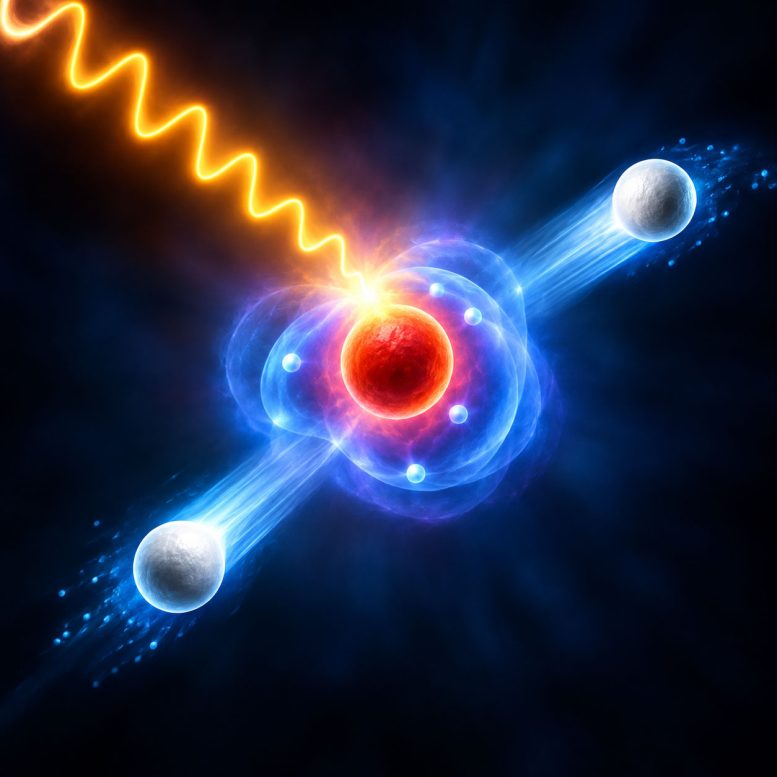
When a water molecule absorbs a high-energy X-ray photon, one of the inner-shell electrons of the oxygen atom can leave the molecule. A vacancy is created in its place, triggering a rearrangement of the electron shell. One of the main mechanisms of this rearrangement is Auger decay: an electron from a higher energy level fills the vacancy, while the released energy is transferred to another electron, which is ejected from the molecule.
However, the researchers found that the molecular structure changes even more rapidly. A special electronic state induced by the absorption of an X-ray quantum generates powerful repulsive forces that literally break both oxygen-hydrogen bonds before Auger decay begins.
According to Florian Trinter from the Fritz Haber Institute (FHI) in Berlin, the most interesting aspect of this result is that the motion of atomic nuclei effectively wins the race against the electrons, breaking the molecule apart before electronic relaxation is complete.
Confirmation at Two Synchrotrons
To capture this elusive process, the team studied isolated water molecules in the gas phase using high-resolution electron spectroscopy. The experiments were conducted in parallel at two powerful synchrotron facilities: PETRA III at the German research center DESY (Hamburg) and the FlexPES beamline at the Swedish MAX IV Laboratory (Lund).
Both sets of measurements recorded unusually narrow and distinct peaks at certain electron energy values. These anomalous signals could not be explained either by the breakup of entire water molecules or by the behavior of the fragments normally expected to be observed after irradiation. As Gunnar Ewald from the MAX IV Laboratory noted, obtaining an identical signal at two different facilities provided decisive evidence that the scientists had discovered a real, previously unknown pathway for molecular fragmentation.
An Unexpected “Fingerprint”
To determine the origin of the unusual signals in the electron spectra, physicists conducted detailed quantum mechanical calculations. The calculated electron energies closely matched the experimental data and indicated that the signals arise from the electronic decay of excited neutral oxygen atoms, rather than hydroxyl fragments (OH), as previously assumed.
This distinction is fundamental because the energy of emitted electrons depends directly on the electronic structure of the particle emitting them. The exceptionally narrow spectral lines became a kind of “fingerprint” of an oxygen atom that had already completely separated from the original water molecule. This was explained by Ludger Inhester from the Center for Free-Electron Laser Science (CFEL) at DESY.
A New Perspective on Radiation Chemistry
This discovery offers a new explanation for high-energy electronic features that were recorded in previous studies of water many years ago. Signals that scientists previously associated with hydroxyl groups may in fact belong to excited neutral oxygen atoms produced by ultrafast fragmentation.
Since free atomic oxygen is extremely chemically reactive and readily enters into further reactions, understanding the mechanism behind its formation will help significantly refine models of chemical processes triggered by X-ray radiation — particularly in biological tissues and the space environment.
Previously, we explained how dangerous radiation is in space and in the event of a nuclear power plant accident.
Based on material from scitechdaily.com
