

Researchers have simulated what would happen if an asteroid-mass primordial black hole passed near the Sun and concluded that our star’s gravity is powerful enough to capture it. However, the black hole could continue to exist inside the Sun and even destroy the star.
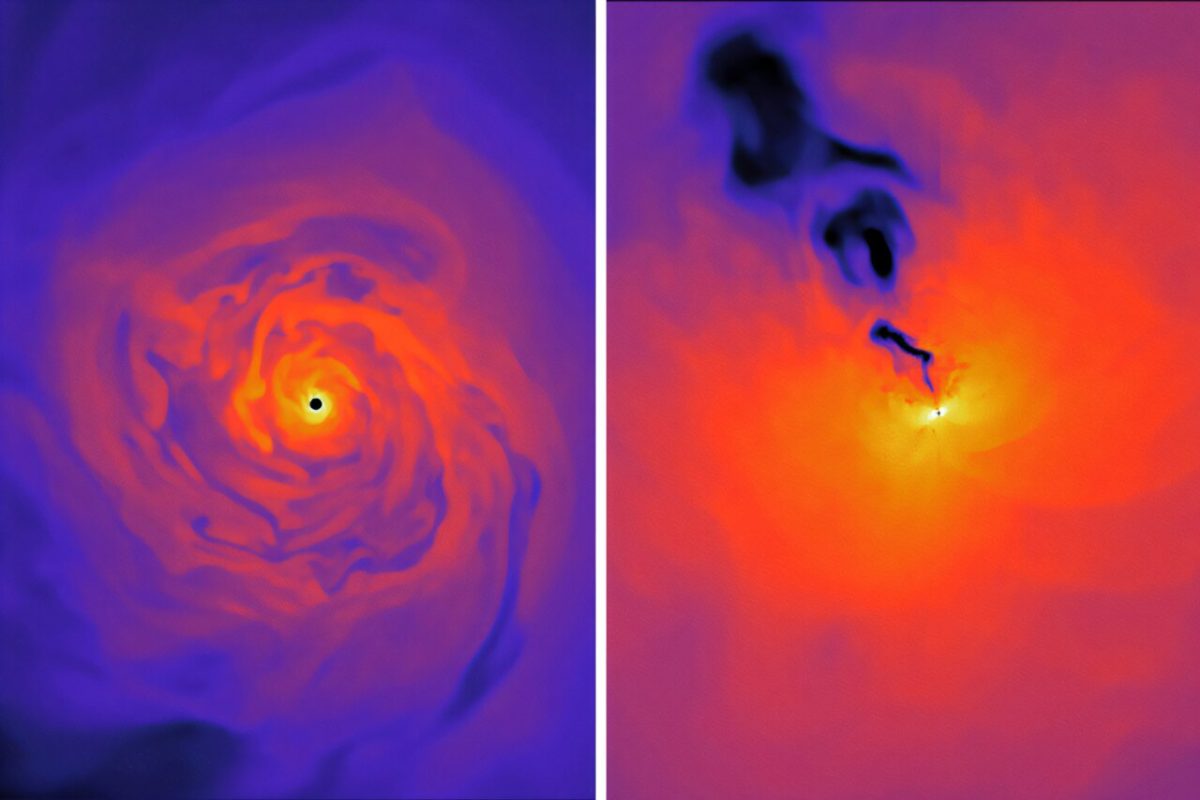
Primordial Black Holes
Researchers from the Massachusetts Institute of Technology have simulated how primordial black holes, if they still exist, might interact with stars. The website phys.org reports that a paper on the subject has been published in The Astrophysical Journal.
Scientists are not entirely sure that primordial black holes exist. Current physical theories do allow for the possibility that fluctuations in spacetime at the very beginning of the Universe’s existence gave rise to such objects. Moreover, their mass was not subject to any lower limit, as is the case with stellar collapse. However, the smallest of them should have evaporated one way or another over the time that has passed since then.
Relatively large objects, however, with masses roughly comparable to that of a large asteroid, could still be drifting somewhere in space and may even make up what is known as dark matter. By definition, dark matter does not interact with ordinary matter in any way other than through gravity.
A Black Hole at the Center of the Sun
The researchers’ calculations show that if such a black hole approaches a star the size of the Sun, gravitational forces will inevitably pull it inside. At the same time, because of its incredible density, the black hole itself is tiny, about the size of an atom. However, once inside the star, it does not dissolve.
Instead, it begins actively consuming matter and growing. A tiny accretion disk starts forming around its equator, and eventually ultraviolet and X-ray jets are expected to shoot out from its poles. The study’s authors say these jets will be powerful enough to trigger an explosion that could be observed from an enormous distance.
In this way, researchers could confirm that primordial black holes really do exist. However, it is unclear what would happen to stars that encounter them. And even more so, what would happen to our Sun if a black hole entered its interior. It is entirely possible that this represents a new danger that we are unaware of.
On the other hand, doubts remain as to whether such a tiny black hole would be able to efficiently consume matter from its surroundings, let alone form jets and an accretion disk. After all, it would exist inside an extremely dense and hot environment containing strong electric charges, so it is unclear how this would affect the behavior of the matter around it.
