

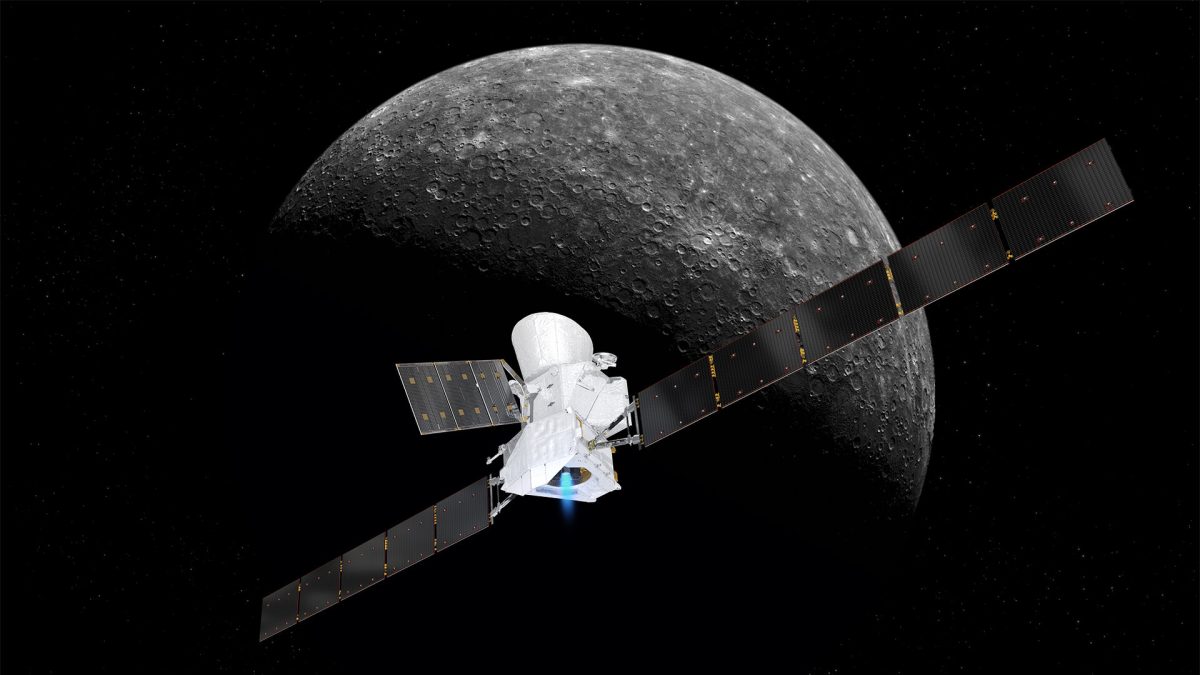
On 21 November 2026, the BepiColombo spacecraft entered orbit around Mercury and began manoeuvres to lower its orbit. It is then expected to separate into two spacecraft, each of which will carry out its own scientific mission.
Why do we need BepiColombo?
These days, BepiColombo is completing its eight-year interplanetary journey and entering orbit around Mercury. It has already provided scientists with a number of interesting findings about the planet closest to the Sun, but its main scientific work is now about to begin. Why, though, has it taken so long to get there, and what new information can it provide about a planet that is not all that far away?
The fact is that Mercury’s apparent proximity to Earth is deceptive. People have observed it in the sky since ancient times, but it can only be seen around dawn or sunset. This has always made observations somewhat difficult.
Yet observing Mercury is nowhere near as difficult as reaching it. Unlike the outer planets, Mercury has a higher orbital speed than Earth. To travel there, a spacecraft must first accelerate to escape Earth’s gravity and then slow down considerably. All this requires a great deal of propellant, so it is hardly surprising that, during the first 40 years of space exploration, only Mariner 10 managed to reach Mercury. You can read more about it in the article ‘Mariner 10: Why Is It So Difficult to Reach Mercury?’
Mariner 10 made just three flybys of Mercury and was unable to observe the planet from every side. Mercury continued to tantalize scientists, who spent many years developing plans to reach it. Clearly, a spacecraft would first need to follow a highly economical trajectory involving several gravity-assist manoeuvres before braking near the planet to enter orbit.
The first spacecraft to accomplish this was the American probe MESSENGER. Launched in 2004, it did not enter orbit until 2011, after several flybys, and continued operating until 2015. The mission taught us a great deal about the planet closest to the Sun. Meanwhile, European and Japanese scientists were preparing their own, more comprehensive mission, which would take considerably longer to reach Mercury.
The design of BepiColombo
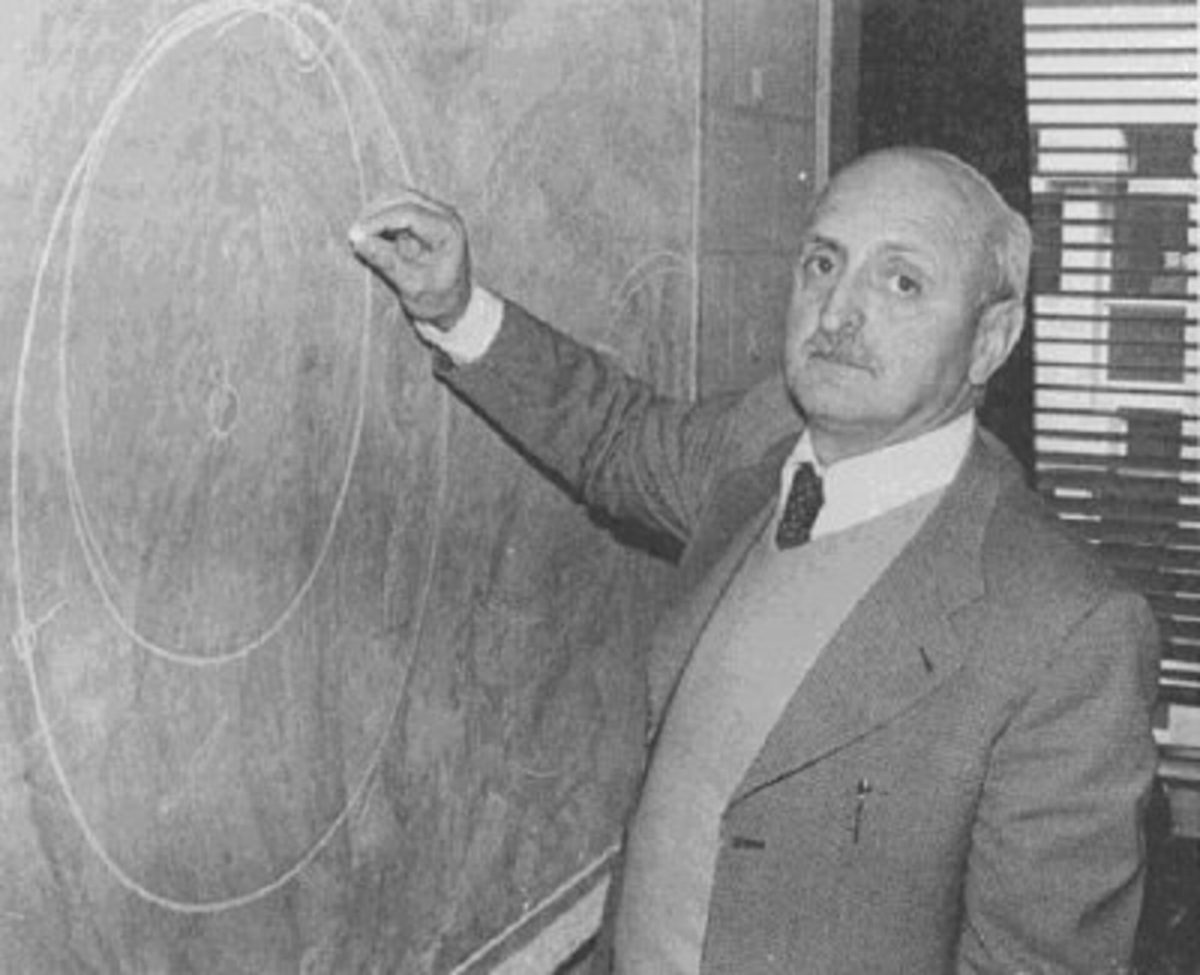
The new mission was named BepiColombo in honour of the Italian scientist Giuseppe Colombo, whose calculations had helped Mariner 10 reach Mercury. In fact, the mission consists of three spacecraft joined together: the Mercury Transfer Module, the Mercury Planetary Orbiter and the Mercury Magnetospheric Orbiter.
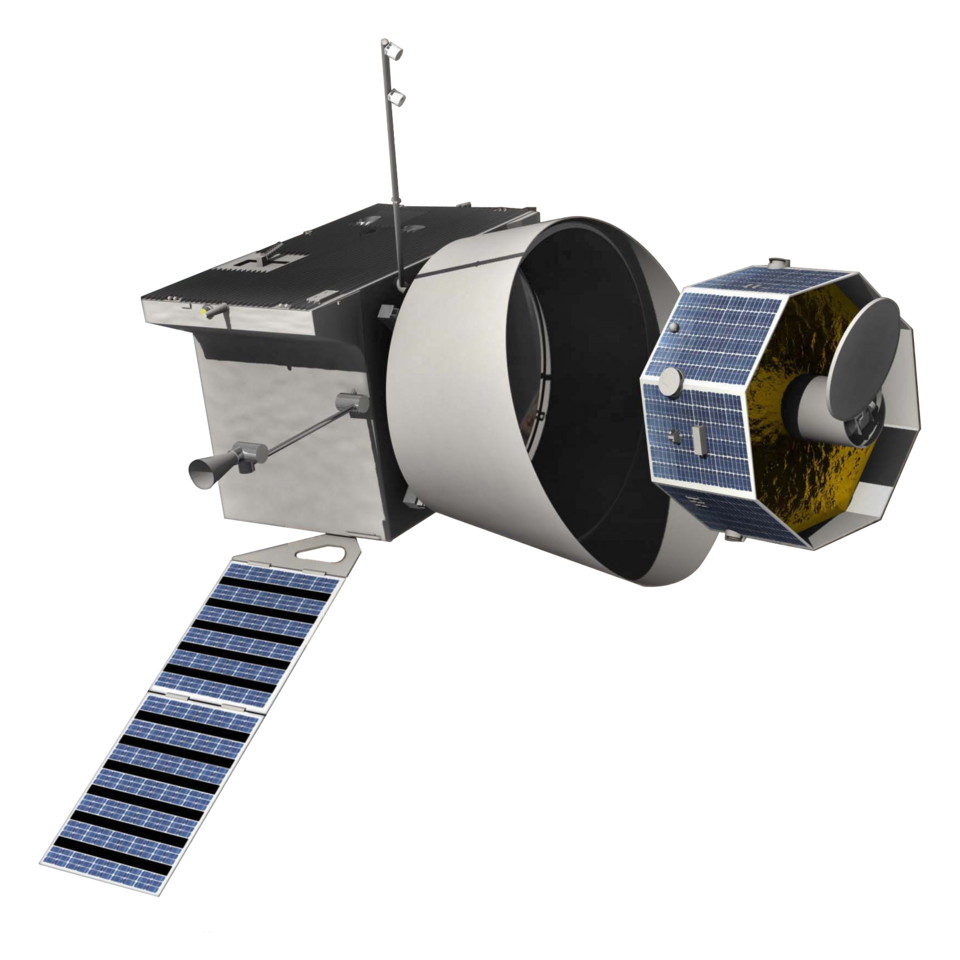
The Mercury Transfer Module (MTM) is essentially a propulsion stage, albeit a highly unusual one. It has a mass of 2,615 kg, of which 1,400 kg is xenon. This inert gas serves as the propellant for four QinetiQ T6 ion thrusters. Together, they produce a tiny 290 mN of thrust, but their specific impulse reaches an impressive 4,300 seconds. This means that each kilogram of xenon delivers several times more impulse than an equivalent mass of the hydrogen–oxygen propellant combination used in the most efficient chemical rocket engines.
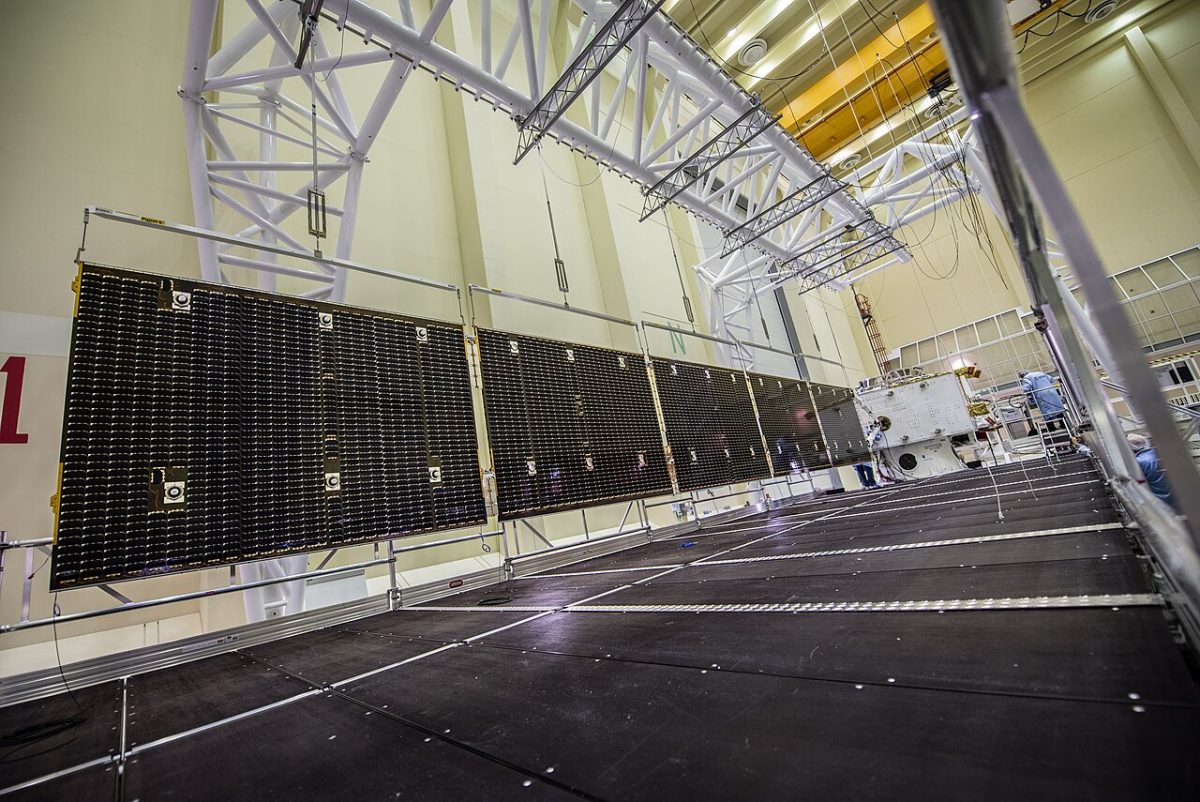
The propellant in the ion thrusters is accelerated using magnetic fields, which require electrical energy. This is supplied by two solar arrays, each 14 m long. Depending on the spacecraft’s distance from the Sun, each array can generate between 7 and 14 kW of power.
The Mercury Planetary Orbiter (MPO) is the main scientific spacecraft, developed by ESA. Its total mass is 1,150 kg. It also has its own small thrusters and solar panels, which not only provide it with electrical power of up to 100 V, but can also act as a heat shield, preventing it from heating above 200 °C.
The spacecraft’s principal payload, however, is its scientific equipment: cameras; spectrometers operating in the infrared, ultraviolet, gamma-ray and X-ray ranges; a radiometer; a laser altimeter; a magnetometer; a particle analyser; a Ka-band transponder; and an accelerometer.
There are 11 scientific instruments on board in total. Most are mounted on the nadir-facing side of the spacecraft to keep the detectors at a low temperature, apart from the MERTIS and PHEBUS spectrometers, which are positioned on the main radiator to provide a wider field of view.
The MPO is responsible for the principal investigations of Mercury itself. It will produce a detailed map of the planet, covering not only its physical features but also its geology. It will conduct observations across almost every part of the electromagnetic spectrum and, of course, transmit the results to Earth using a 1 m antenna.
The Mercury Magnetospheric Orbiter (MMO), also known as Mio, is an independent scientific spacecraft built by the Japanese space agency JAXA. It takes the form of an octagonal prism with a mass of 245 kg. It will orbit much farther from Mercury than the MPO, focusing on the planet’s magnetic field and its interactions with the charged particles streaming from the Sun. Its five instruments are designed to investigate magnetic fields, high-energy particles, dust and the electrical phenomena arising from their interactions.
At launch, all three modules were joined together, forming a spacecraft measuring 3.9 × 3.6 × 6.3 m – roughly the size of a minibus. Its mass before launch was 4,100 kg.
BepiColombo’s journey
BepiColombo was launched into space on 20 October 2018 aboard an Ariane 5 rocket from the Kourou spaceport in French Guiana. Initially, its trajectory closely resembled Earth’s orbit. In effect, it travelled around the Sun in the same direction as most of the planets. This allowed it to approach Earth again about a year and a half later and slow down slightly.
Another six months later, on 15 October 2020, it approached Venus to within 10,000 km, tested its instruments, collected some data and slowed down further. Less than a year later, on 10 August 2021, it returned to the second planet from the Sun. This time it made a relatively risky flyby at a distance of just 552 km, allowing it to reduce its speed further and lower its perihelion.
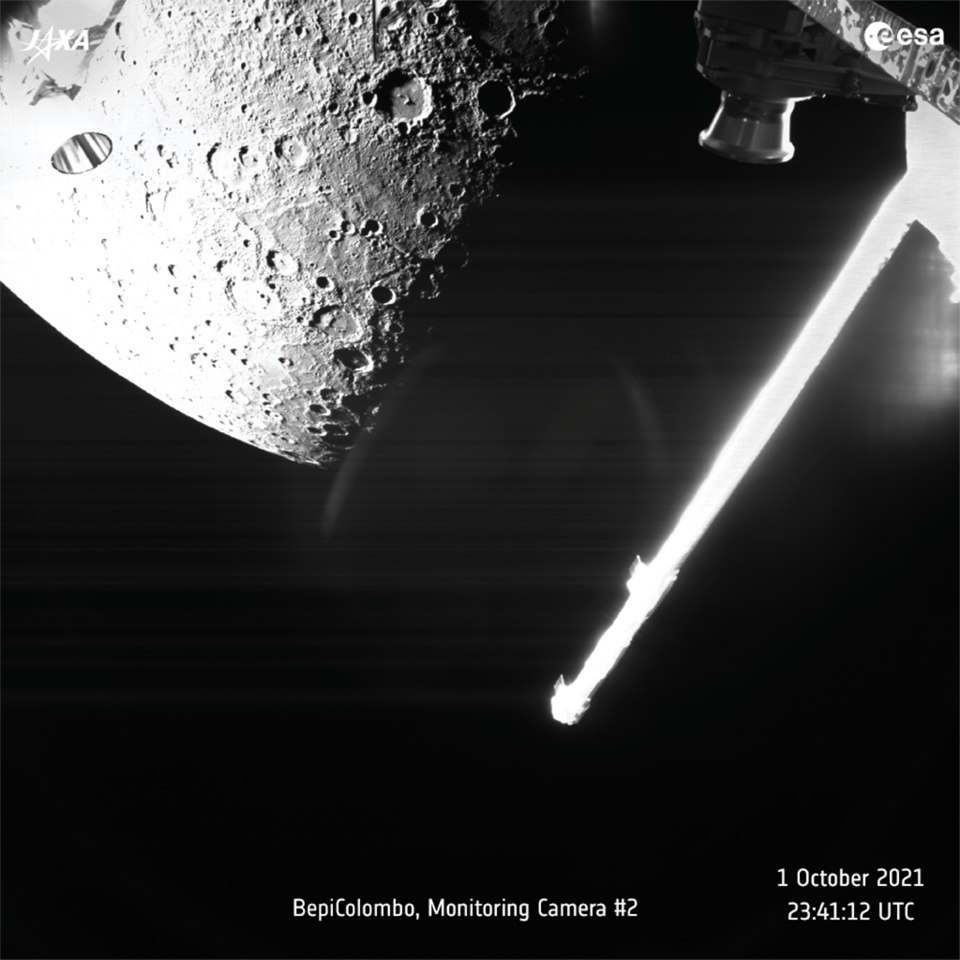
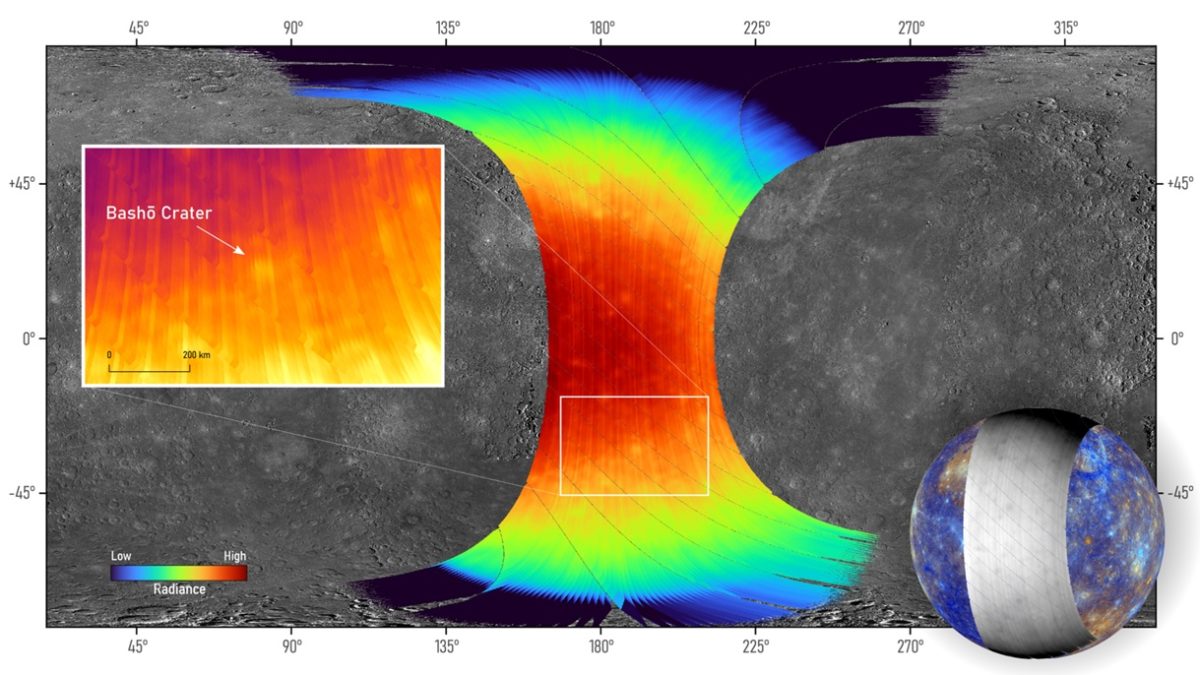
On 1 October 2021, BepiColombo flew past Mercury for the first time, coming within just 199 km of its surface. This enabled it to obtain exceptionally high-quality images and collect scientific data.
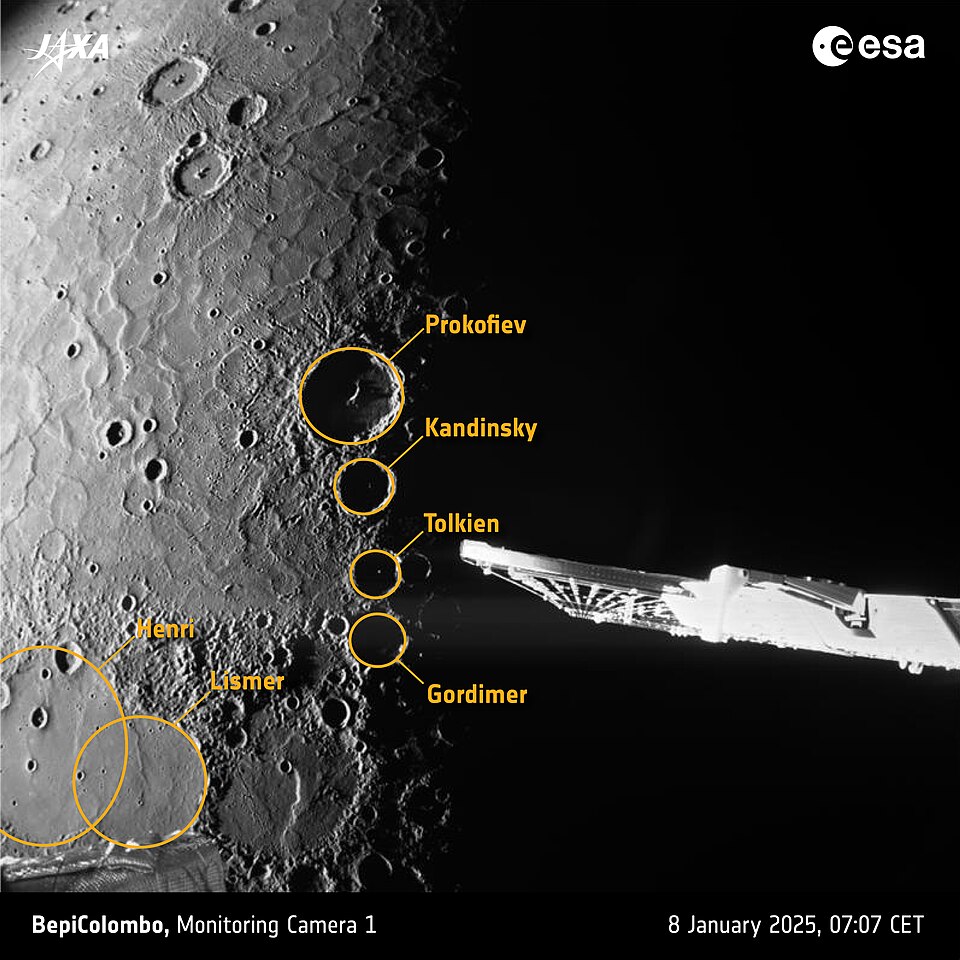
The spacecraft subsequently lowered the aphelion of its orbit and returned to Mercury five more times: on 23 June 2022, 19 June 2023, 4 September and 1 December 2024, and 8 January 2025. All but one of these encounters were sufficiently successful to allow BepiColombo to continue its investigation of the planet.
On 3 September 2026, the MTM completed its work and was separated from the two scientific orbiters. From then on, they continued towards their rendezvous with Mercury. Scientists rehearsed the forthcoming manoeuvres and eventually reached the point at which the spacecraft was close enough to the planet to begin braking.
What happens next?
On 21 November, BepiColombo entered orbit around Mercury. As planned, it was unable to shed all its speed and is currently following an orbit that is too high and highly eccentric.
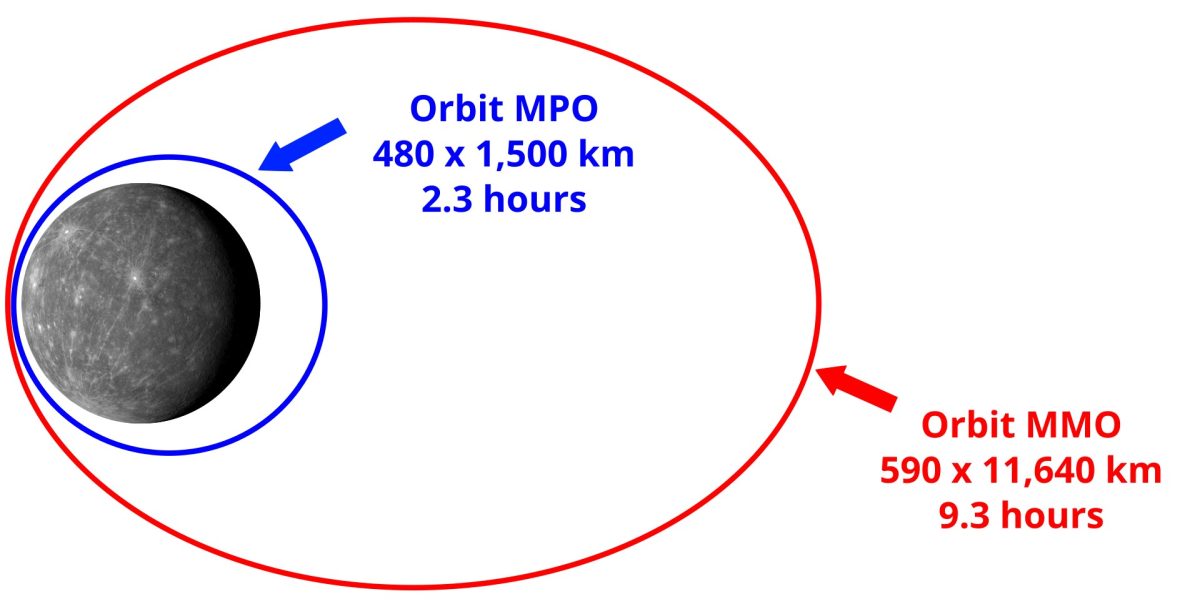
Over the following days, it will gradually lower this orbit until, on 10 December, it reaches one with an apocentre of 11,640 km. At that point, the MMO will separate and begin operating independently. The MPO will continue to lower its orbit until it reaches its operational orbit at the very beginning of 2027.
One of BepiColombo’s most important tasks is to produce a complete, detailed map of Mercury’s surface. The surfaces of Mars and the Moon can now be examined at resolutions of a few metres, whereas the resolution of images of the planet closest to the Sun is still measured in kilometres. This should soon change.
Another question that has puzzled scientists for decades is whether Mercury has deposits of water ice. On the one hand, its surface becomes so hot that water would boil almost instantly, even if it had an atmosphere – and Mercury has virtually none. On the other hand, craters at its poles may be deep enough for water ice to survive for billions of years, because sunlight strikes them at such a shallow angle.
This hypothesis has been confirmed for the Moon, but the situation on Mercury remains uncertain. BepiColombo is expected to resolve the question conclusively.
The spacecraft will also attempt to look deep inside the planet and into its past. The structure of Mercury’s interior and its evolutionary history are closely linked, but scientists still know very little about either.
The planet’s magnetic field is another important subject. What is it really like? What sustains it? How does it interact with the solar wind, which is much stronger near Mercury than near Earth? The answers will provide insight not only into the corona of our star, but also into the processes that influence the evolution of a planet orbiting so close to it.
The spacecraft will also carry out a series of experiments to test predictions of the general theory of relativity. Mercury orbits close enough to the Sun for its motion to be affected by the gravitational effects predicted by the theory.
