

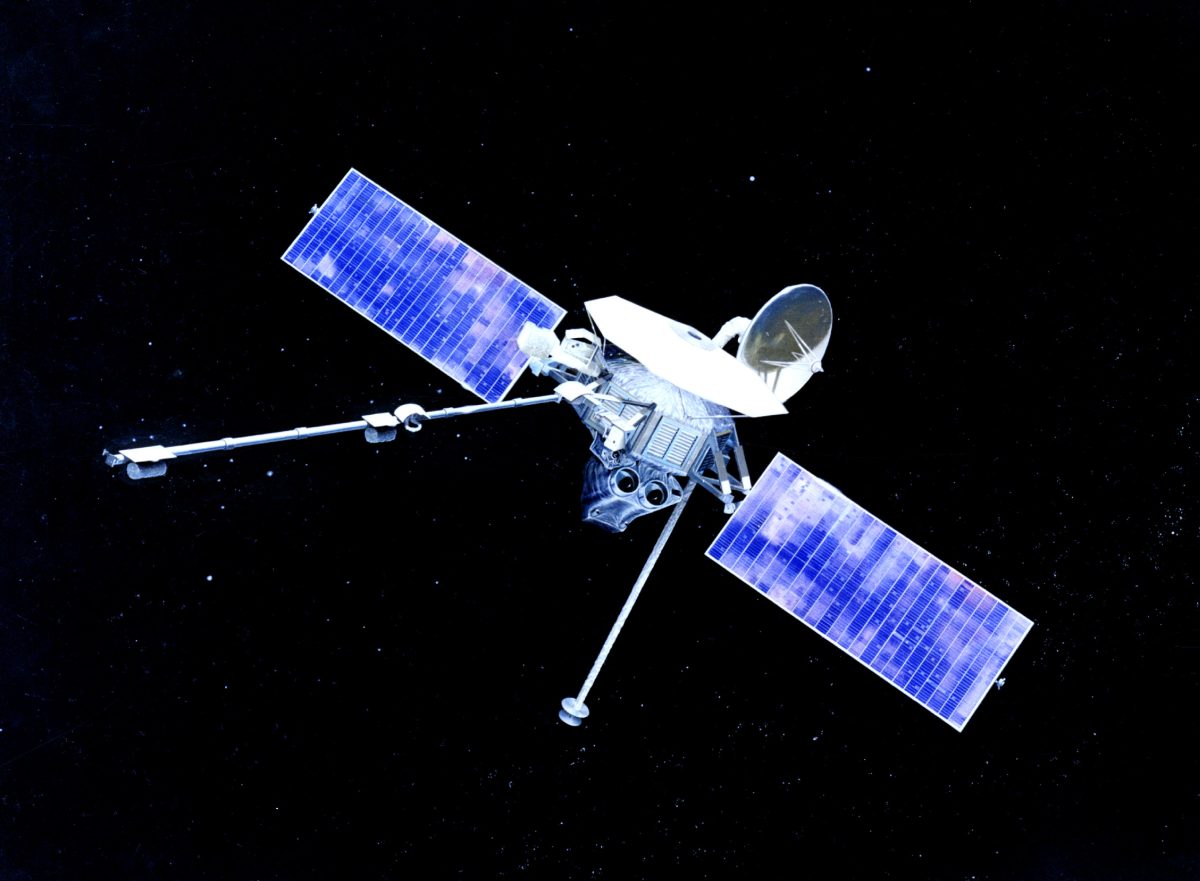
On November 3, 1973, the Mariner 10 spacecraft was launched into space. Its destination was Mercury, the planet closest to the Sun. The mission was so challenging that a similar feat was not accomplished again until the 21st century.
A flight to Mercury
By the end of 1965, human-made automatic probes had already flown past three celestial bodies: the Moon, Mars, and Venus. Given their relative distances, it would be logical to assume that Mercury would be the next destination, as its average distance from Earth is even shorter than Mars’s.
However, over the years, spacecraft continued to travel to Mars and Venus, but no new worlds were explored. Finally, in March 1972, a spacecraft was launched: Pioneer 10, bound for Jupiter. This may seem surprising, given the immense distance to the largest planet in the Solar System.
However, interplanetary travel is not so straightforward. Each planet follows its own orbit at a particular speed, which decreases with distance from the Sun. When a spacecraft leaves the vicinity of Earth and enters an independent orbit around the Sun, its speed relative to the Sun is determined by the vector sum of Earth’s orbital velocity and the spacecraft’s own velocity relative to our planet.
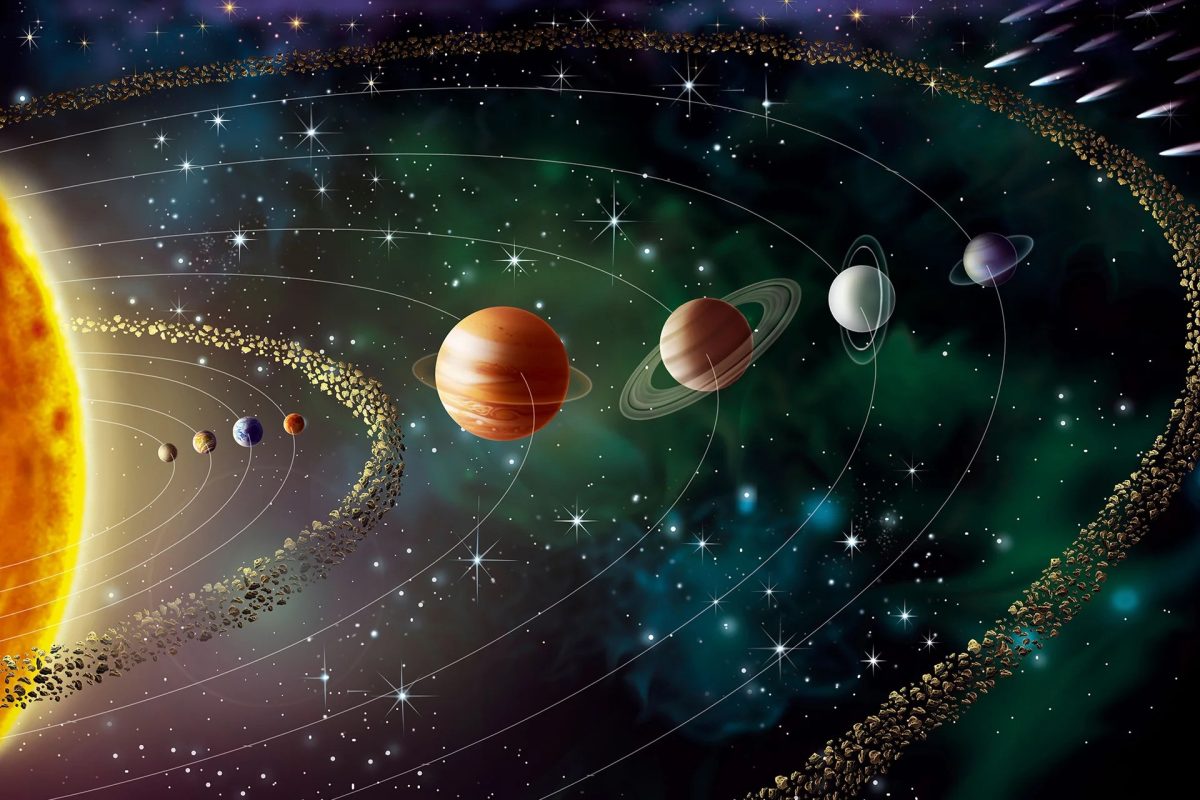
In practice, this means that a spacecraft gaining additional speed in the direction of Earth’s orbital motion shifts to a heliocentric orbit with a larger semi-major axis. Its aphelion lies further from the Sun, which allows the probe to be directed toward the outer planets. However, simply increasing speed is not enough to reach them; the launch time must be calculated precisely so that both the spacecraft and the planet arrive at the same point in space simultaneously.
For a flight to Venus, the situation is the opposite. The spacecraft must reduce its speed relative to the Sun, moving into an orbit with a smaller semi-major axis, where the perihelion lies near Venus’s orbit. Since Venus orbits the Sun faster than Earth does, the launch time is selected so that, during the transit, the planet reaches the rendezvous point with the probe.
The situation is even more complex with Mercury, which is located much closer to the Sun and moves along its orbit faster than Earth. To reach this planet, the spacecraft must first be accelerated to a speed sufficient to overcome Earth’s gravitational pull. At the same time, however, the launch trajectory must be calculated so that the probe’s speed relative to the Sun decreases. This will allow it to enter an elongated heliocentric orbit, with a perihelion that reaches the orbit of Mercury.
All of this would have required a significant amount of fuel. Therefore, when NASA began planning the flight of the tenth spacecraft in the Mariner series to Mercury, engineers decided to employ an unusual method: a gravity assist maneuver near Venus. The planet’s gravity would alter the probe’s trajectory and reduce its speed relative to the Sun, enabling it to reach Mercury without requiring substantial additional fuel. Italian scientist Giuseppe Colombo played a key role in the mission’s development. He demonstrated that, with a carefully selected trajectory, the spacecraft could not only fly past Mercury once but also return to it repeatedly.
This technique, known as a gravity assist, was first used by Mariner 10 to travel from one planet to another. It is now employed regularly.
The Mariner 10 design
In developing Mariner 10, NASA engineers drew upon the experience gained from previous missions in the series; however, the spacecraft’s design was significantly adapted to meet new objectives. It retained the characteristic octagonal platform, to which two large solar panels, antennas, and scientific instruments were attached. The probe’s launch mass was approximately 503 kg.
To capture images of Venus and Mercury in the visible and near-ultraviolet ranges, the spacecraft was equipped with two television cameras featuring 15-centimeter Cassegrain telescopes. Additionally, it carried an infrared radiometer—also equipped with two Cassegrain telescopes—designed to measure thermal radiation from the clouds of Venus and the surface of Mercury.
To study the atmosphere of Venus and search for the extremely tenuous atmosphere of Mercury, the spacecraft was equipped with two ultraviolet spectrometers. Magnetometers, a plasma analyzer, and a high-energy particle detector were included to study the planet’s magnetic field, the solar wind, and the flow of charged particles.
Furthermore, the scientific program included a radio-science experiment focused on celestial mechanics. By precisely tracking the spacecraft’s motion, the mission aimed to refine the gravitational characteristics of Venus and Mercury and to test certain predictions of the general theory of relativity.
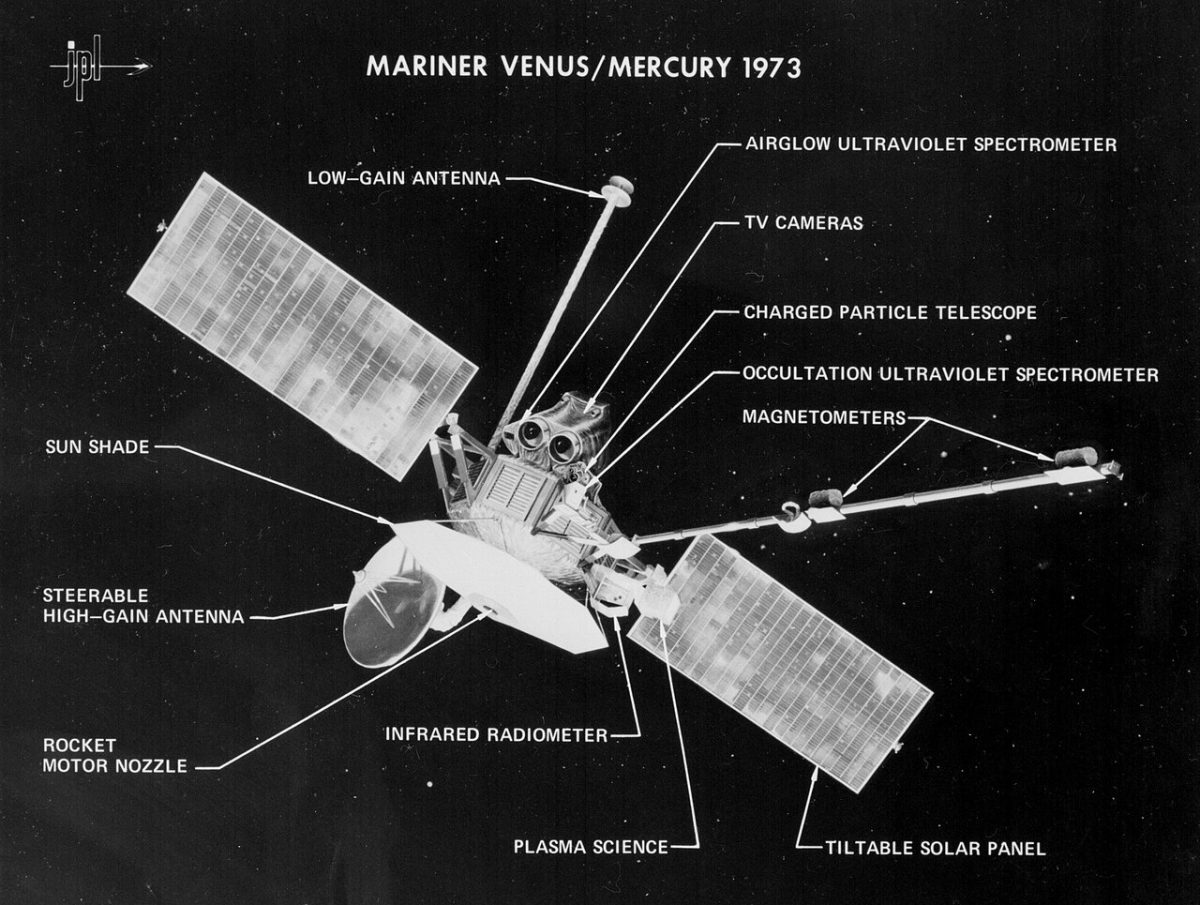
The most significant design changes to Mariner 10 were driven by the need to protect the spacecraft from intense solar radiation. At Mercury’s average distance from the Sun, the solar flux is nearly seven times greater than it is near Earth. Consequently, engineers had to develop a specialized thermal control system.
To protect the spacecraft’s body and electronics, engineers employed multi-layer insulation and a sunshield made of “Beta cloth”—a Teflon-coated fiberglass fabric that was also used in the spacesuits worn by Apollo program astronauts. Additional protection was provided by specialized reflective metallic surfaces, which helped minimize heating caused by solar radiation.
However, this approach was not feasible for the solar panels. Accordingly, the engineers aligned them in a single direction and designed them to rotate 76° about an axis, thereby protecting the panels from overheating.
Start of the flight
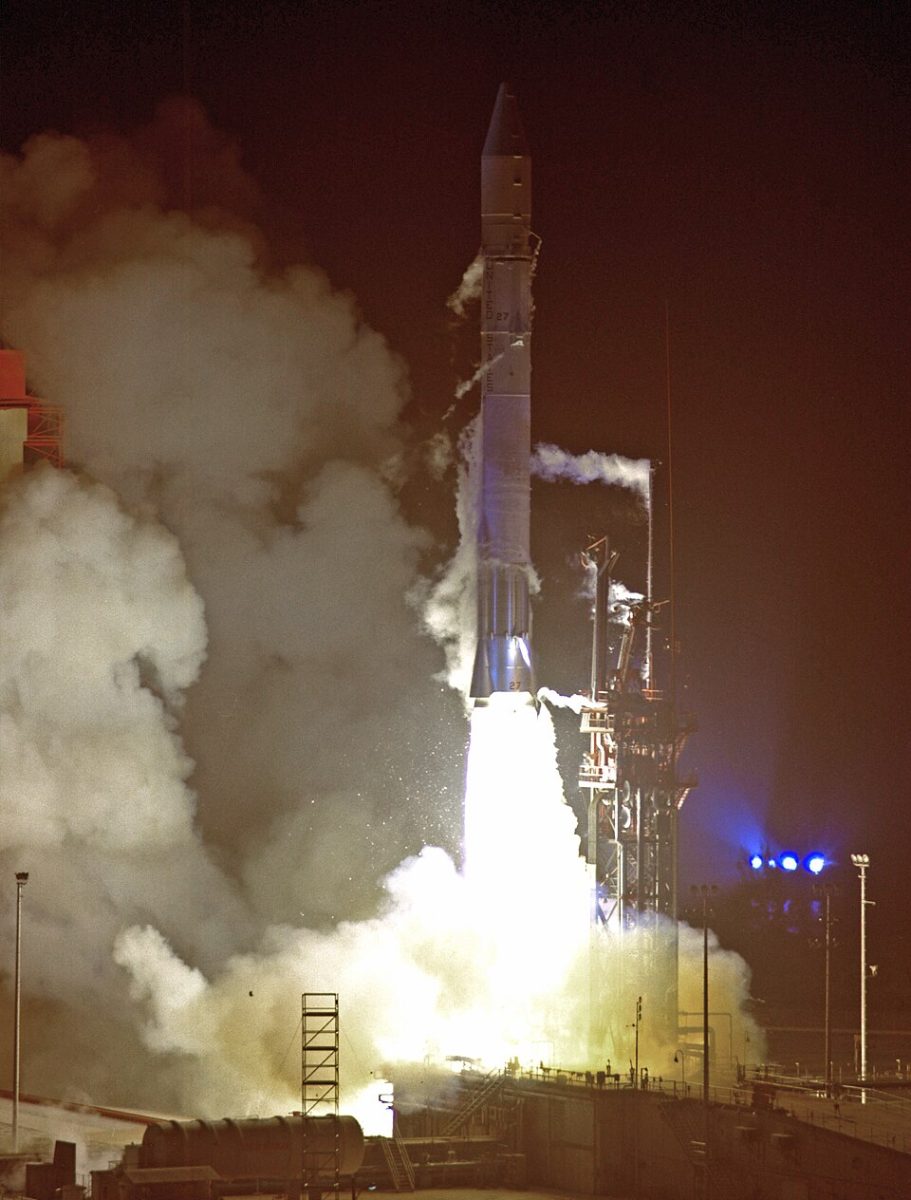
Mariner 10 was launched from Cape Canaveral on November 3, 1973. Problems arose almost immediately after liftoff. The first issue involved the television camera heaters, which failed to turn on; to prevent the optics from becoming too cold, engineers had to keep the cameras themselves powered on constantly. Later, the onboard computer began to malfunction, occasionally rebooting unexpectedly. The most significant trouble was caused by the sensor designed to track the bright star Canopus, which helped the spacecraft maintain its proper orientation in space. Small particles—specifically flakes of the protective coating—would detach from the probe’s surface and glint brightly in the sunlight. The sensor would sometimes mistake these for the star, causing it to lose its orientation. The automated system would then attempt to reacquire Canopus by maneuvering the spacecraft using thrusters powered by compressed nitrogen. Due to these repeated maneuvers and other malfunctions, the gas supply was depleted much faster than anticipated.
Engineers at NASA’s Jet Propulsion Laboratory found a solution in light itself. Although the pressure exerted by photons is minuscule, it acts continuously. By adjusting the tilt of the solar arrays and the antenna, the team was able to maintain and correct the spacecraft’s orientation without using a single gram of fuel. Mariner 10 became the first spacecraft to intentionally utilize solar radiation pressure for attitude control. Its standard solar panels effectively functioned as a type of solar sail. Although they were not intended to propel the probe, this experience served as a significant step in the development of solar sail technology.
On February 5, 1974, Mariner 10 flew past Venus at a distance of 5,800 km. Its cameras, equipped with ultraviolet filters, made it possible for the first time to examine the complex structure of Venusian clouds up close and track their movement. Observations confirmed a remarkable phenomenon: the upper layers of the atmosphere rotate around the planet in approximately four Earth days, whereas Venus itself takes 243 days to complete a single rotation on its axis. This phenomenon has been termed “atmospheric super-rotation.”
Three flybys of Mercury
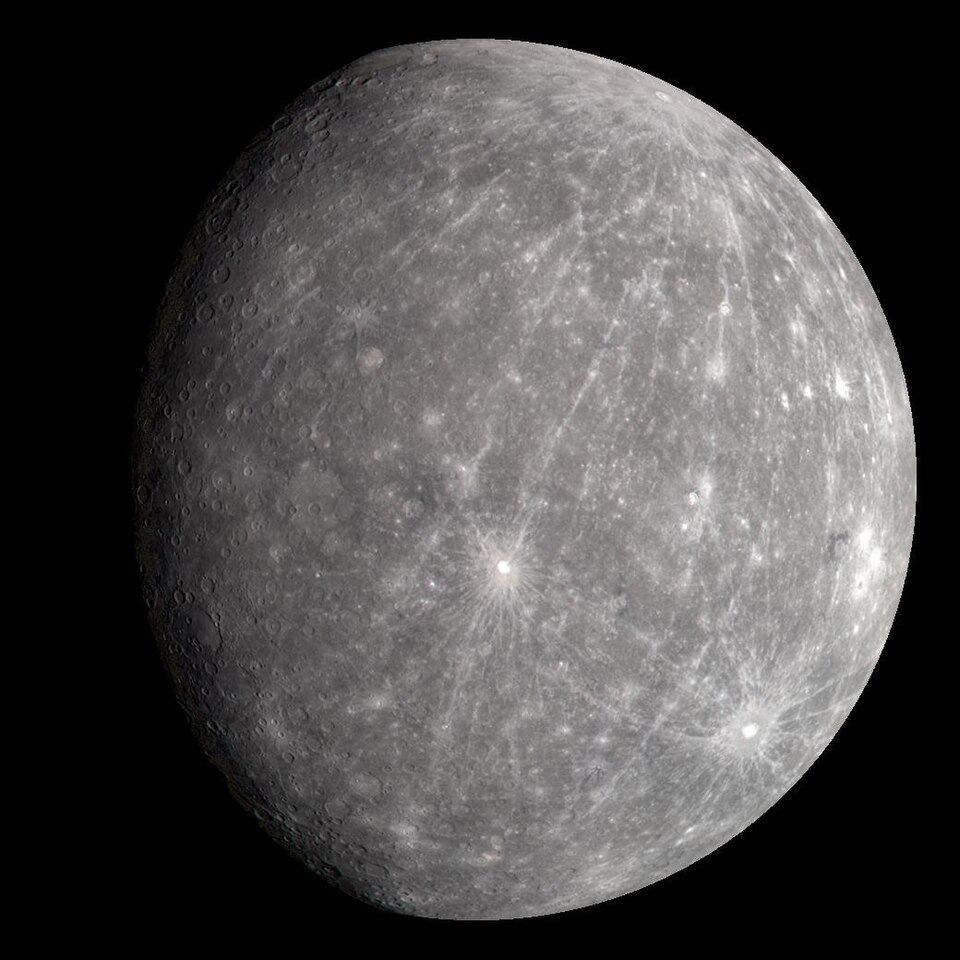
On March 29, 1974, Mariner 10 passed within 703 km of Mercury’s surface. Images of a world never before observed by telescope were transmitted to Earth. The initial images impressed observers with their resemblance to the Moon. The surface was covered with craters of varying sizes, ranging from barely visible pits to rings hundreds of kilometers wide. The differences became apparent upon closer examination.
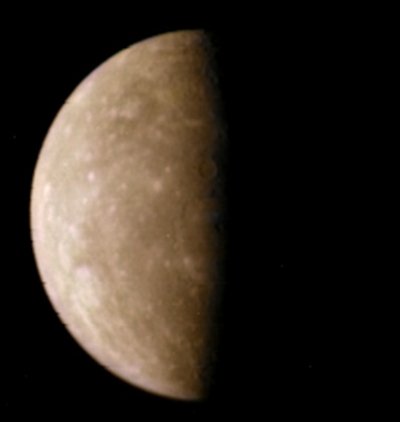
At the boundary between day and night, the cameras captured half of the immense impact basin known as Caloris Planitia (from the Latin word for “heat”). When Mercury reaches the point in its orbit closest to the Sun, this region is exposed to direct sunlight. Current estimates place the basin’s diameter at 1,550 km. The impact that formed it was so powerful that seismic waves likely converged on the planet’s opposite side, deforming the surface into chaotic hills.
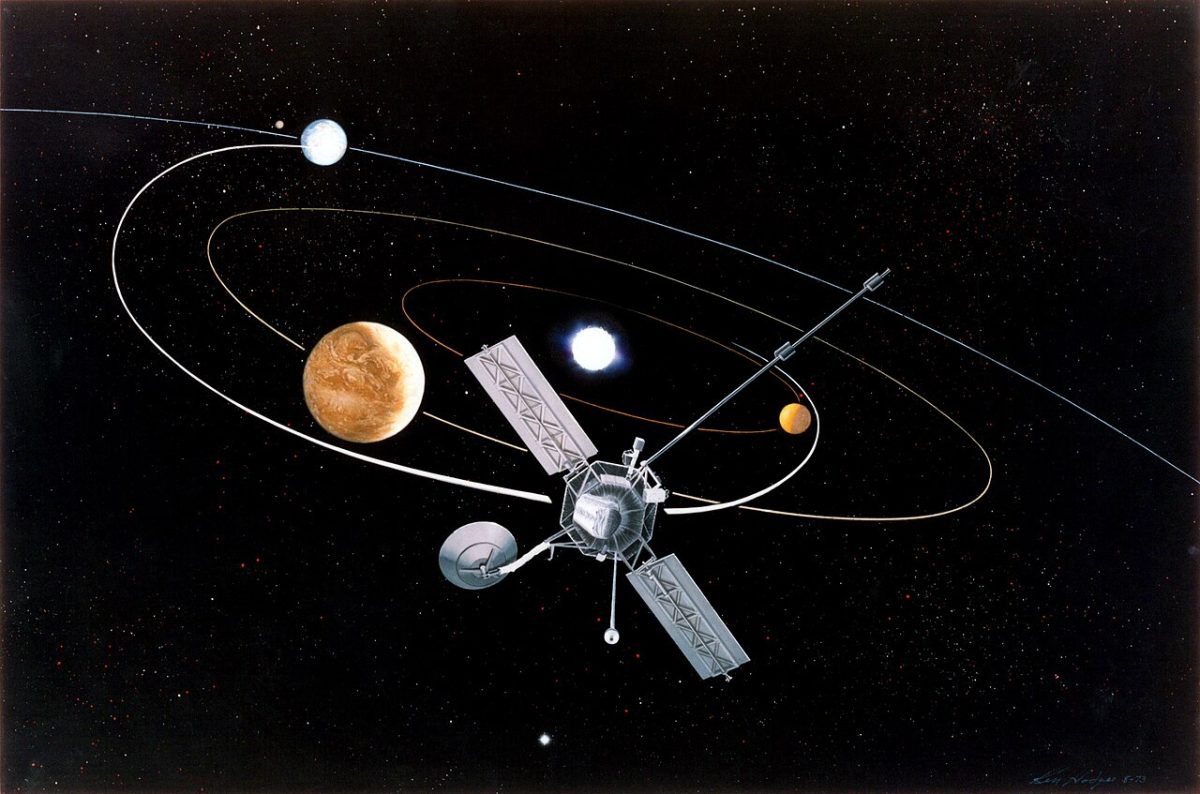
After passing the planet, the probe entered a heliocentric orbit with a period of 176 days — exactly twice the length of a Mercurian year. Consequently, the spacecraft could return to Mercury repeatedly. Colombo had previously explained the planet’s unusual rotation: for every two orbits around the Sun, it rotates three times on its axis.
The second flyby occurred on September 21, 1974, when the spacecraft passed 48,000 km from the planet. The trajectory was selected to provide observations of the southern hemisphere. The third flyby, which took place on March 16, 1975, was the closest, bringing the spacecraft to within 327 km of the surface. On this occasion, scientists focused on studying the magnetic field.
The same resonance that enabled three flybys also restricted the field of view. During each flyby, sunlight illuminated the same hemisphere of the planet. The cameras could image only 40–45% of the surface, leaving the remainder unexplored for more than three decades.
Key scientific findings of the mission
During its mission, Mariner 10 made a number of significant scientific discoveries. As it flew past Venus, it captured detailed images of the planet’s cloud cover in the near-ultraviolet range. These images clearly revealed characteristic V- and Y-shaped structures, as well as atmospheric waves and vortices. These observations helped scientists gain a better understanding of the complex atmospheric circulation on Venus.
Measurements also confirmed that Venus lacks a significant global magnetic field of its own. Instead, the spacecraft investigated the interaction between the solar wind and the planet’s ionosphere. Furthermore, Mariner 10 studied the chemical composition of the upper atmosphere and helped refine the understanding of its temperature structure.
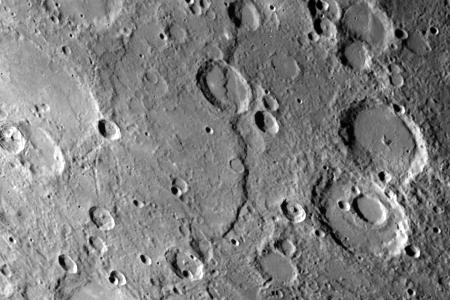
During its three flybys of Mercury, the mission captured more than 2,800 images, revealing that the planet’s surface closely resembles the Moon’s. The mission significantly advanced our understanding of Mercury, whose surface features could not be observed through telescopes.
The mapped areas encompassed most or all of the Shakespeare, Beethoven, Kuiper, Michelangelo, Tolstoy, and Discovery quadrants; half of the Bach and Victoria quadrants; and small portions of Solitude, Persephone (later Neruda), Liguria (later Raditladi), and Borealis.
Mariner 10 also discovered that Mercury is surrounded by an extremely tenuous gaseous envelope—an exosphere—found to contain helium. One of the most significant findings was the detection of the planet’s own magnetic field, which confirmed the hypothesis that a large metallic core exists within its interior. The spacecraft’s infrared radiometer measured the temperature of Mercury’s surface: in the surveyed areas on the night side, it dropped to approximately −183 °C, while on the day side, it reached +187 °C. Subsequent studies revealed that in the hottest regions of the illuminated surface, temperatures can rise to approximately +430 °C.
On March 24, 1975, eight days after its third flyby, Mariner 10 exhausted the nitrogen supply for its attitude-control thrusters. Mission Control then transmitted a command to shut down the transmitter, after which the spacecraft fell silent permanently. Mariner 10 itself is likely still orbiting the Sun.
Mariner 10’s flight path proved to be so energy-inefficient that no spacecraft were sent to Mercury for the next 30 years. The next spacecraft to head toward Mercury did not launch until 2004—the American probe MESSENGER. To conserve fuel, it performed a series of gravity-assist maneuvers: one near Earth, two near Venus, and three near Mercury itself. The probe flew past the planet for the first time in January 2008, nearly four years after its launch. It took another three years to sufficiently reduce its speed and, in March 2011, enter orbit around Mercury, becoming its first artificial satellite.
The third was a joint European-Japanese mission launched in October 2018. Over the course of eight years, it flew past Earth once, Venus twice, and Mercury six times. It is scheduled to enter orbit around Mercury on November 21, 2026, less than three weeks after the 53rd anniversary of the Mariner 10 launch. The mission was named BepiColombo in honor of the Paduan mathematician who first recognized that a single probe could observe Mercury three times.
