

The first detailed images of the asteroid Dimorphos, which NASA’s DART spacecraft deliberately crashed into in 2022, have surprised scientists. A crater spanning the entire width of the asteroid has been left behind, and Dimorphos now rotates chaotically, without a stable axis. Hundreds of boulders are circling around it and its larger companion, Didymos. The Hera spacecraft has revealed that the consequences of the impact were much more powerful than expected.
A Crater Spanning the Entire Asteroid
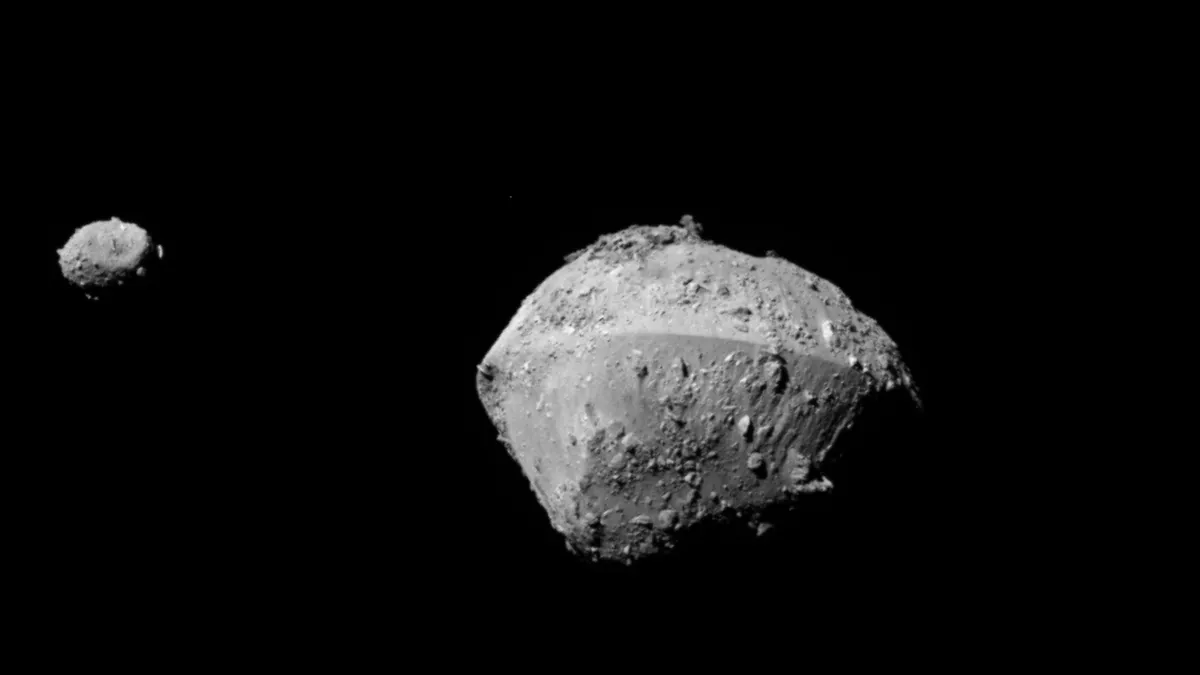
The images were presented on November 25 in Berlin during an ESA broadcast. After two years of flight, the Hera spacecraft slowed down near the system, consisting of two asteroids, Didymos and its moon Dimorphos. The spacecraft is now holding a position 30 kilometers away, moving slowly around the pair. The crater left by DART occupies the entire side of Dimorphos struck by the spacecraft and extends across the asteroid’s full width, while Dimorphos is flattened on that side. The rest of the surface has remained almost unchanged, and the boulder fields there are the same as those seen in DART images from 2022.
ESA broadcast presenting the first images of the asteroid Dimorphos taken by the Hera spacecraft. Source: ESA / YouTube
Dimorphos itself is about 151 meters across, roughly the size of a football stadium. Didymos, around which it orbits, is about 780 meters in diameter, according to the German Aerospace Center (DLR). According to Michael Küppers, Hera mission scientist at ESA, an asteroid that humanity may one day need to deflect in a real planetary defense situation will most likely be about the same size as Dimorphos.
Why the Consequences Are Difficult to Predict
According to scientists’ calculations, the impact was expected to produce one of two outcomes. It would either leave a small crater or completely change the asteroid’s shape. “In reality, we have both,” said mission principal investigator Patrick Michel. During the presentation, it was recalled that when Hera was being designed, scientists expected a crater about 10 meters wide and deep.
Predicting the consequences of an impact is difficult because gravity on such a small body is extremely weak. A speed of about 6 centimeters per second is enough to escape Dimorphos. The rocks on the surface of such an asteroid are held so loosely that the surface may offer almost no resistance. This is what happened on the asteroid Bennu, when the sampling head of NASA’s OSIRIS-REx spacecraft sank into the surface as if it were soft foam.
A strange elongated structure is visible in the center of the new crater. Scientists do not yet know what it is, but it may help them determine how the crater formed.
Chaotic Rotation and Boulders
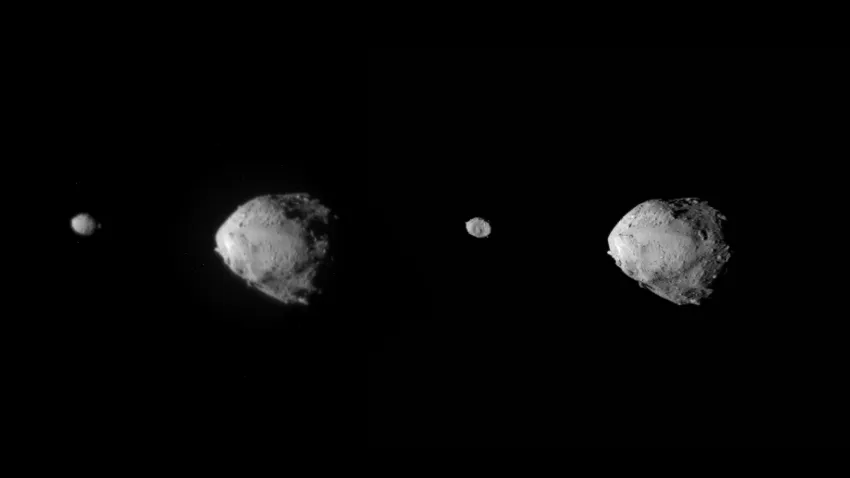
Before the impact, Dimorphos, like the Moon in relation to Earth, always kept the same side facing Didymos. Now, as Michael Küppers explained, the asteroid rotates chaotically and occasionally flips by 180 degrees. Its motion can be predicted less than a day in advance. No other known object in the Solar System has such chaotic rotation.
An animation made from images taken by the Hera spacecraft every two minutes shows one rotation of Dimorphos around Didymos, viewed from the southern side. Dimorphos’s chaotic rotation is clearly visible thanks to the large crater left by the DART impact. The spacecraft was, on average, 28.6 kilometers from the asteroids. Credit: ESA
Another surprise was discovered when scientists removed both asteroids from the images. Hundreds of bright moving dots remained. These are boulders several meters in size that are circling around the pair, as reported by Space.com. After the impact, telescopes had already detected a huge cloud of debris, and in 2023, the Hubble telescope observed boulders flying away from Dimorphos. Therefore, scientists expected the system to clear itself naturally, making the hundreds of boulders remaining in orbit a surprise.
The debris is also important because it caused DART to change Dimorphos’s orbit more significantly than expected. A reduction in its orbital period around Didymos of at least 73 seconds would have been considered a success. Instead, the period was shortened by 33 minutes because the recoil from the ejected material amplified the push delivered by the spacecraft itself.
The Next Stages of the Mission
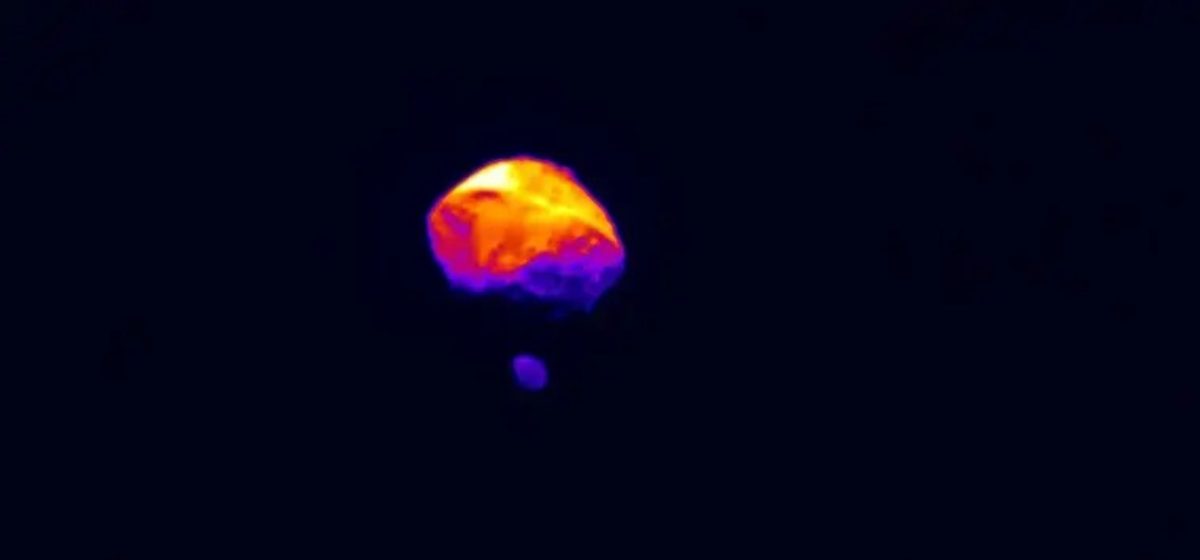
The Hera spacecraft will spend six months near the asteroids and will eventually approach them to within approximately 13 kilometers. So far, most of the images have been taken with a conventional camera, although the presentation also included the first images from its hyperspectral and thermal cameras. Their data will be used to determine the composition and temperature of the surface.
In January, the spacecraft will release two CubeSats. The low-frequency radar aboard Juventas will provide the first look inside an asteroid, and the CubeSat is subsequently expected to land on Dimorphos. Data from the second CubeSat, Milani, will be used to study the dust surrounding the system.
Data from the spacecraft and the CubeSats will help refine the mass of Dimorphos. Knowing its mass and the change in its orbit will make it possible to calculate how effectively an impact can deflect an asteroid. This is precisely the parameter that will be incorporated into plans for future planetary defense missions.
