

In September 2022, a NASA spacecraft deliberately crashed into a small asteroid. It was humanity’s first test of planetary defense technology. Now, a new probe is heading toward the resulting debris to examine the scene of the cosmic collision up close.
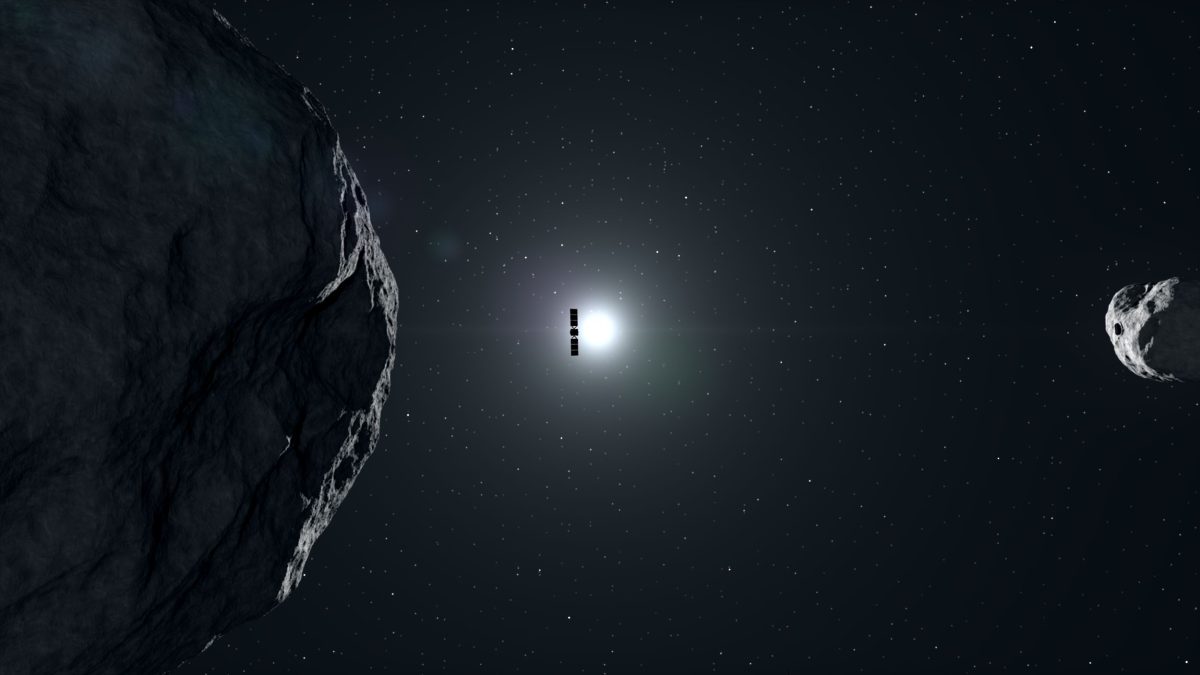
On October 7, 2024, the European Space Agency (ESA) launched the Hera mission as a crucial follow-up to DART—the first attempt to alter a celestial body’s orbit. The small, car-sized spacecraft recently performed a braking maneuver to slow down ahead of its first close approach to the binary asteroid system, scheduled for early November.

Hera will thoroughly investigate the aftermath of the impact. The scientists’ main goal is to turn a one-off space experiment into a reliable, well-understood planetary defense technique while also learning more about how asteroids form.
Anatomy of a Cosmic Impact
During the DART test, the 607-kilogram spacecraft slammed at tremendous speed into Dimorphos, a 170-meter space rock orbiting its larger, 800-meter companion, Didymos. Ground-based observations showed that the collision shortened Dimorphos’s orbital period from 11 hours and 55 minutes to 11 hours and 23 minutes.

The mission was declared an unequivocal success: it demonstrated that we can deliberately change asteroids’ trajectories. But hitting a target and understanding all the underlying consequences of the impact are different things. To assess the method’s true effectiveness, scientists needed an on-site investigation.
Investigating the “Crime Scene”
ESA estimates that current ground-based observations have an uncertainty of approximately 10%, while existing computer models still cannot precisely determine Dimorphos’s mass and composition. This is where Hera comes in, carrying an array of scientific instruments.

Once the spacecraft reaches Dimorphos, it will not only inspect the “crime scene” but also precisely measure the space rock’s mass and its altered orbit. The probe will conduct the most detailed survey yet of a binary asteroid system. Although such objects account for approximately 15% of all known asteroids, none has ever been studied at such close range.
Miniature Helpers
Earlier this month, Hera captured its first images of its target. The spacecraft photographed the Didymos system from approximately 236,500 kilometers away. On October 15, the probe adjusted its trajectory and fired its thrusters to match its velocity with that of the asteroids.
In early November, the robotic explorer will approach to within 30 kilometers of the space rocks and begin collecting data. Hera will subsequently move even closer and, in January 2027, deploy a pair of miniature CubeSats, each about the size of a shoebox: Milani and Juventas. Milani will analyze the composition of Dimorphos’s surface, while Juventas will use radar to probe its interior.
Following its two-year journey through space, Hera is expected to spend at least six months in the Didymos system, collecting data vital to our planet’s future safety.
We previously reported on how scientists questioned the causes of the asteroid Dimorphos’s unusual behavior.
Based on material from ESA.
