

According to the results of new simulations, the unusual orbits of the most distant icy bodies in the Solar System are best explained by a yet-undiscovered planet with a mass close to that of Earth. It would orbit much farther away than Neptune, and its gravity would have altered the motion of these bodies over billions of years. The planet has not yet been confirmed by observations. However, a way to test the hypothesis has now emerged.
The Mass and Orbit of the New Planet
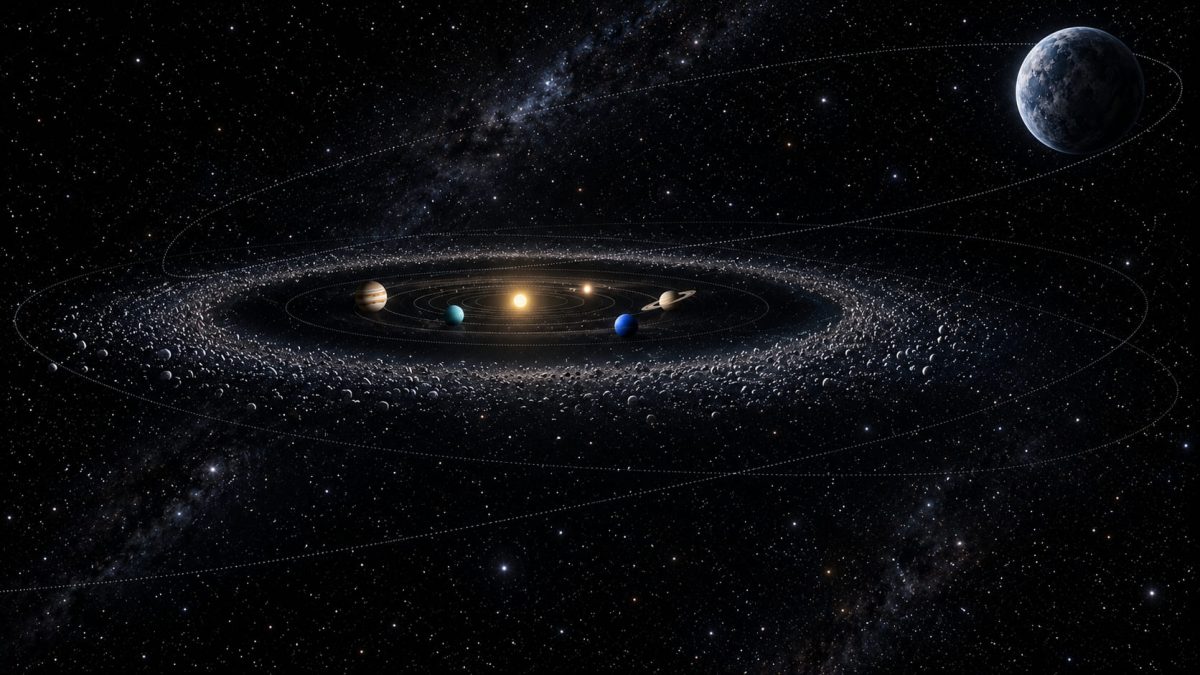
The authors named the hypothetical world Planet X2. An international team led by Patryk Sofia Lykawka, which also included Jonathan Horner and Pedro Bernardinelli, modeled how the orbits of objects beyond Neptune changed over 4.5 billion years — almost the entire history of the Solar System.
They tested planets with masses ranging from one to two Earth masses, and the results that best matched observations were those involving a planet with twice Earth’s mass and an average distance of 350–500 astronomical units (AU) from the Sun. One astronomical unit is equal to the average distance between Earth and the Sun, approximately 150 million kilometers. Even at the closest point of its orbit, the planet would remain about 200 AU from the Sun, or five times farther away than Pluto’s average distance. The study has been published in the peer-reviewed journal Monthly Notices of the Royal Astronomical Society.
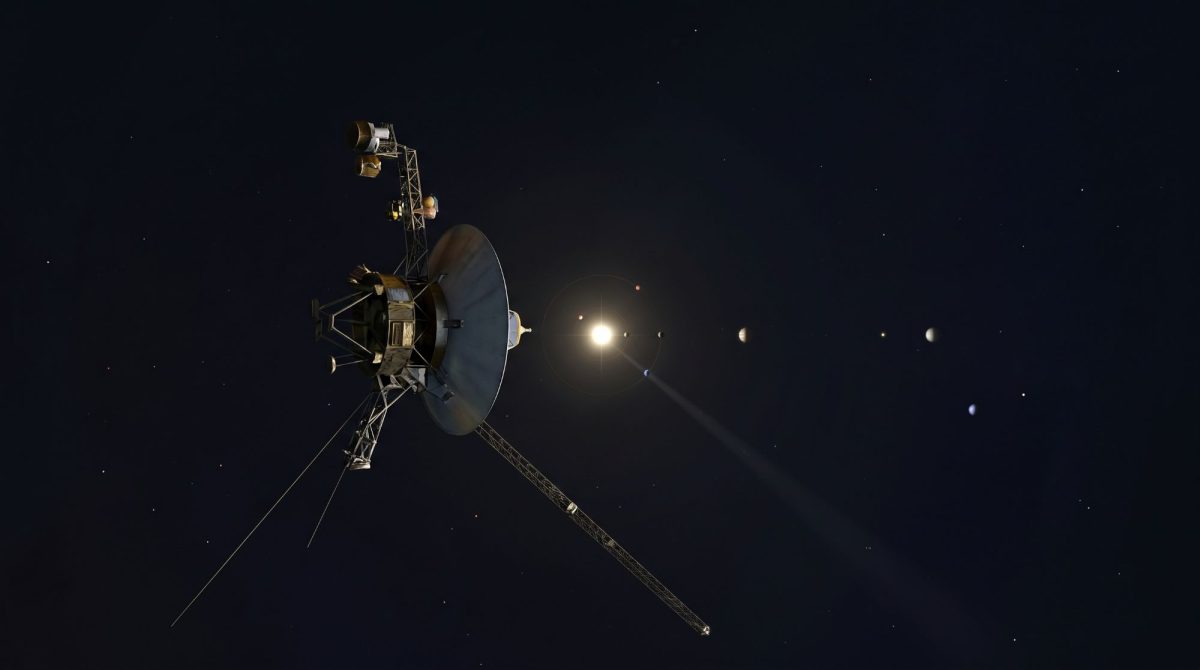
Sunlight would take two to three days to reach such a planet, whereas it takes about eight minutes to reach Earth. Meanwhile, humanity’s most distant spacecraft, Voyager 1, has traveled only about 170 AU in nearly half a century.
At the same time, the hypothetical Planet X2 discussed here is considerably less massive than the hypothetical Planet 9, which astronomers have been searching for for more than a decade. In the model used for comparison, Planet 9 had a mass of 6.2 Earth masses, or approximately three times that of Planet X2. Planet Nine itself was proposed to explain why the orbits of some distant objects appear to be aligned in the same direction.
However, several independent research teams believe that this clustering is a result of observational bias and the small number of known objects. Moreover, the orbits of objects discovered in recent years, and the way they should change over time, do not agree with the predictions for either Planet Nine or its closer and less massive counterpart.
Orbits Beyond Neptune’s Influence
Beyond Neptune orbit trans-Neptunian objects, icy bodies, most of which belong to the Kuiper Belt and travel at distances of 38–50 AU from the Sun. However, over the past two decades, an increasing number of distant objects with highly elongated or inclined orbits have been discovered. The known planets cannot explain these orbits.

These include Sedna, whose closest orbital point to the Sun lies far beyond Neptune’s sphere of influence. Such bodies are called detached objects because Neptune’s gravity hardly perturbs them. Their origin has long puzzled astronomers. According to Patryk Sofia Lykawka, if Planet X2 exists, it would change our understanding of the history of the Solar System and how its most distant objects ended up in such unusual orbits.

In the model, the gravity of the distant planet gradually pushes the closest points of these objects’ orbits farther away from Neptune over billions of years, or tilts the orbits themselves at steep angles relative to the plane in which the planets move. This made it possible to reproduce the orbits of all known extreme objects — bodies with the most distant, most elongated, or most highly inclined orbits. These include Sedna, 2012 VP113, and 2015 BP519. Early in the history of the Solar System, Neptune gradually moved farther away from the Sun, and its gravity redistributed the orbits of nearby objects. In the model, this migration shapes the inner structure of the Kuiper Belt, while Planet X2 is needed to explain everything beyond 50 AU.
A Rejected Scenario
The authors also tested another explanation. Early in the history of the Solar System, planetary embryos with masses ranging from that of Mars to that of Earth may have formed within 30 AU of the Sun. As they approached the giant planets, these embryos would have received gravitational kicks and moved into distant, elongated orbits, while their own gravity would have rearranged the orbits of smaller bodies along the way.
However, in the simulations, most of these embryos were ejected from the system within just a few tens of millions of years. This was too short a time for distant populations of objects to form. The observed orbits could be reproduced in only three out of 200 models, and even in those cases, there were too few objects on highly inclined orbits.
How to Test the Hypothesis
Some discrepancies with observations remain, and Patryk Sofia Lykawka acknowledges that they still need to be investigated. Overall, the simulation results may be consistent with data from the Dark Energy Survey. However, among objects with orbital distances ranging from 60 to 250 AU, the models lack those whose orbits are closer to the upper limit of this range, so the model will need to be refined.

Observations from the Vera C. Rubin Observatory, where the ten-year Legacy Survey of Space and Time (LSST) is underway, will help test the hypothesis. Its data could make it possible to find the planet directly or determine whether distant objects in the outer reaches of the Solar System really have the orbital characteristics predicted by the model. “The most exciting thing is that we now have an opportunity to test this idea,” said co-author Jonathan Horner.
