

On November 14, 2003, Michael Brown, Chad Trujillo, and David Rabinowitz discovered a trans-Neptunian object later named Sedna. Ukrainian scientist Hanna Okhotko explained what makes this object particularly interesting.
Hanna is a junior research associate in the Department of Physics and Astronomy at Vasyl Stefanyk Carpathian National University (KNUVS). She was selected in a competition organized by the Ministry of Education and Science of Ukraine and received a grant to conduct her PhD research project, “Physical and Dynamic Characteristics of Objects in the Hot Population of the Kuiper Belt.” She also holds a part-time position at the KNUVS Astronomical Research Station.
Hanna’s research focuses on Kuiper Belt objects, particularly those in the hot population. Her work examines the physical and dynamical characteristics of these objects, as well as the differences between the hot and cold populations.
What distinguishes Sedna from other trans-Neptunian objects?
90377 Sedna is of particular interest because it is situated in a region where Neptune’s gravitational influence can no longer adequately account for the formation of its orbit.
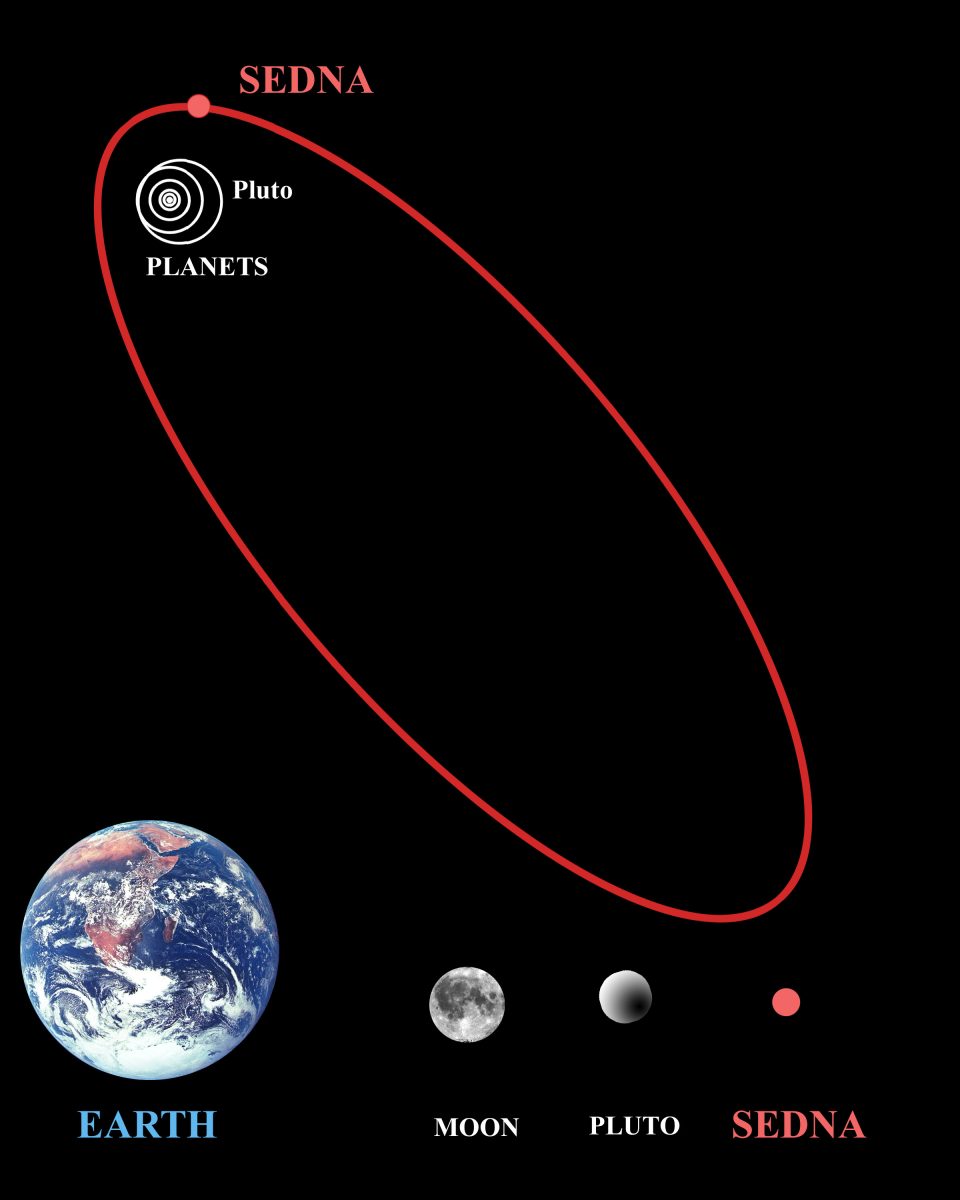
At its closest point to the Sun, known as perihelion, Sedna is approximately 76 astronomical units away (1 AU is approximately 149.6 million km). At its farthest point, known as aphelion, it is nearly 937 astronomical units away. By comparison, Neptune orbits the Sun at an average distance of approximately 30 astronomical units. Thus, even at its closest approach to the Sun, Sedna remains significantly farther from the Sun than Neptune’s orbit, and its orbital period is approximately 11,400 years.
Sedna’s orbit around the Sun likely preserves information about the early stages of the Solar System’s formation. Studying Sedna helps test hypotheses regarding the formation of the outer Solar System, the possibility that other stars influenced its orbit during the Sun’s early existence, and the existence of as-yet-undiscovered massive planets beyond Neptune.
What is Sedna composed of?
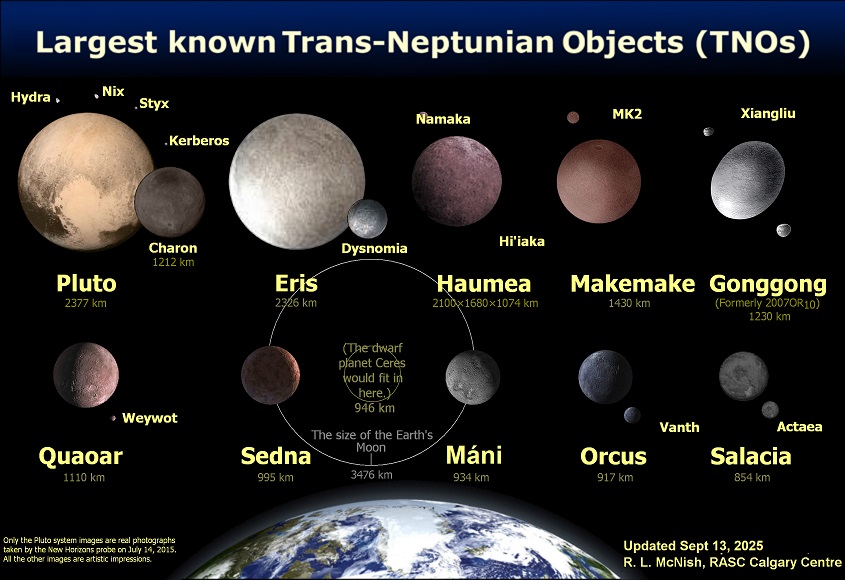
It is important to note that the exact chemical composition of Sedna remains unknown. Given its considerable distance from Earth and relatively small size — its diameter is approximately 995–1,000 km, or about 40% that of Pluto — detailed studies of its surface are currently challenging.
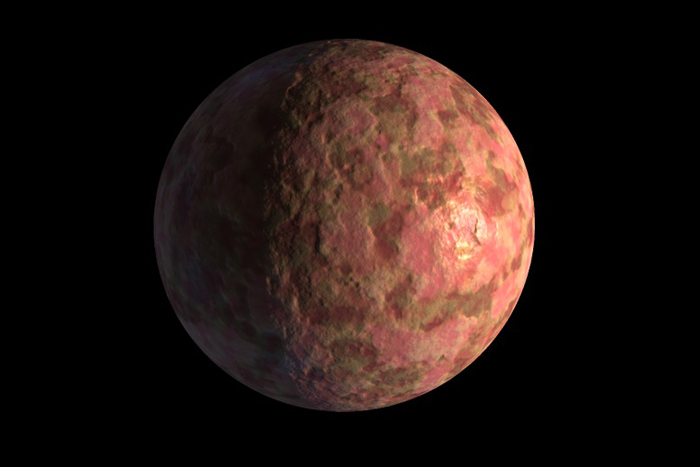
However, observations obtained using the SMARTS (Small and Moderate Aperture Research Telescope System) consortium of scientific telescopes indicate that, in the visible spectrum, Sedna is among the reddest objects in the Solar System, nearly as red as Mars. Scientists hypothesize that Sedna’s dark red color results from a thick surface layer of hydrocarbon polymers known as tholins. Tholins are reddish, amorphous, heterogeneous organic mixtures that, according to one hypothesis, formed from simpler organic compounds through billions of years of exposure to ultraviolet radiation, interstellar particles, and other extreme conditions during Sedna’s close approaches to the Sun or its possible passages through interstellar space.
Furthermore, advances in space telescope technology enabled spectroscopic observations by the James Webb Space Telescope in 2022, which revealed significant quantities of ethane ice (C₂H₆) and complex organic compounds on Sedna’s surface. The spectroscopic data also indicated traces of ethylene (C₂H₄), acetylene (C₂H₂), and, likely, carbon dioxide (CO₂).
Sedna has a highly elongated orbit and a long orbital period. Are there other similar objects beyond Neptune?
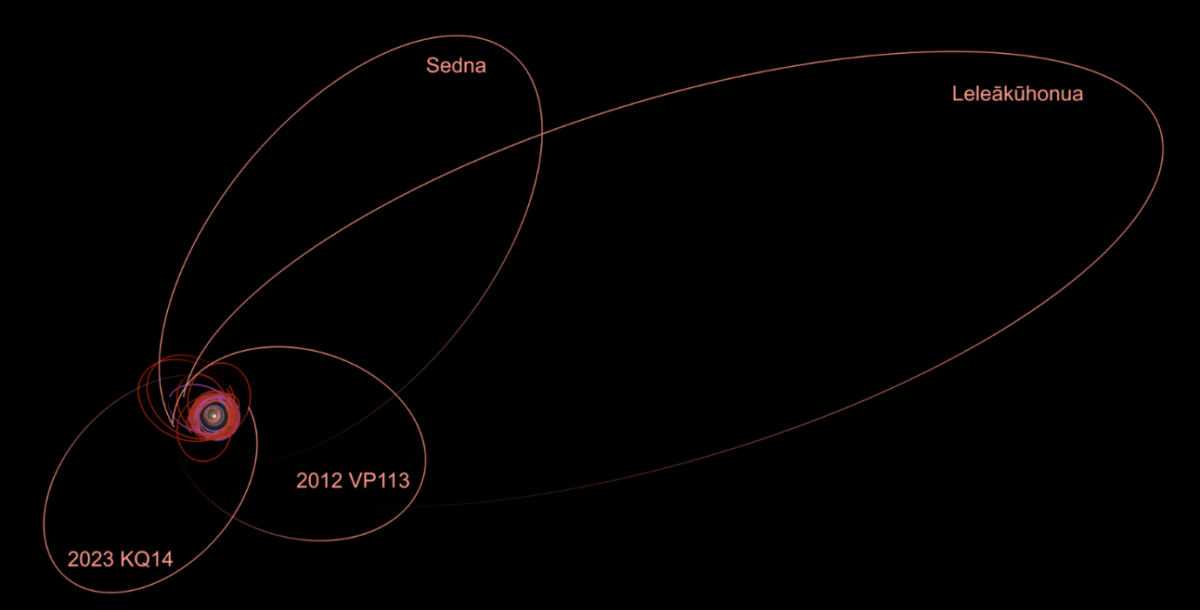
Yes, a class of objects known as sednoids is characterized by large perihelia and elongated orbits. Sednoids are also classified as detached objects because they lie beyond the region in which Neptune can effectively account for their large perihelia.
Currently, four objects are known: 90377 Sedna, 2012 VP113 (also known as “Biden”), 541132 Leleākūhonua, and 2023 KQ14 (also known as “Ammonite”). Each has a perihelion greater than 60 AU.
Several hypotheses may account for their current elliptical orbits. These objects’ orbits may have been perturbed by a nearby star passing through the cluster in which the Sun formed; altered by an unknown, planet-sized body beyond the Kuiper Belt, such as the hypothetical Ninth Planet; or influenced by a rogue planet that passed through the early Solar System.
Is Sedna classified as a dwarf planet?
Officially, Sedna has not yet been classified as a dwarf planet, although it is frequently regarded as a candidate for that status.
According to the definition adopted by the International Astronomical Union in 2006, a dwarf planet must meet the following criteria:
- to orbit the Sun;
- have sufficient mass for its own gravity to overcome the forces acting on the solid body;
- as a result, it assumes a shape close to hydrostatic equilibrium (nearly circular);
- fails to clear the vicinity of its orbit of other objects;
- not to be a satellite of another celestial body.
Sedna meets the first and final criteria. Moreover, its size and shape suggest that it may be close to hydrostatic equilibrium. However, its mass, internal structure, and shape have not yet been sufficiently characterized to confirm that it meets this criterion. Its official status may change in the future if sufficiently precise data on its physical characteristics become available.
The planets of the Solar System and their moons are generally named after figures from Greek and Roman mythology. Sedna, however, is an exception. Why is this the case?
Sedna was named after the Inuit goddess of the sea. The Inuit are the Indigenous peoples of the Arctic regions of North America and Greenland. According to legend, Sedna resides at the bottom of the frigid Arctic Ocean and rules over its sea creatures. Astronomers selected this name for a specific reason.
Sedna is situated in an exceptionally cold and remote region of the Solar System, where surface temperatures may approach absolute zero. Accordingly, the image of a goddess dwelling in the ocean’s frigid depths symbolically reflects the conditions of this celestial body.
Are there any plans to study Sedna and other trans-Neptunian objects using spacecraft?
Certainly. Research on Sedna and other trans-Neptunian objects represents one of the most promising and significant areas of study.

The James Webb Space Telescope currently provides unique opportunities for this type of research. Its operation in the infrared spectrum is particularly valuable for studying cold and distant objects. This instrument enables us to investigate the surface composition of trans-Neptunian objects, identify spectral signatures of water, methane, and other ices, and analyze organic compounds. These data help determine the extent to which the compositions of objects in different dynamical groups vary and what these differences may reveal about the conditions under which they formed and their subsequent evolution.
For example, in August 2026, the results of the James Webb Space Telescope’s observations of 40 trans-Neptunian objects were published. This demonstrates that, even in the absence of a close flyby of these objects, it is possible to obtain fundamentally new information about their physical properties.
Sedna is expected to reach perihelion around 2075–2076, providing scientists with an opportunity to study it in greater detail, as its next close approach will not occur for approximately 12,000 years.
Overall, integrating observations from space-based telescopes, ground-based telescopes, and future interplanetary missions represents the most promising approach to studying distant objects in the Solar System. Ground-based telescopes can help identify objects of the greatest scientific interest, while future direct observations by space telescopes could verify these findings and provide data that cannot be obtained remotely.
