

The radio source Centaurus A is one of the closest galaxies to us with an active nucleus. At its center lies a supermassive black hole that launches relativistic jets into space. Recently, scientists managed to explain one of their interesting features.
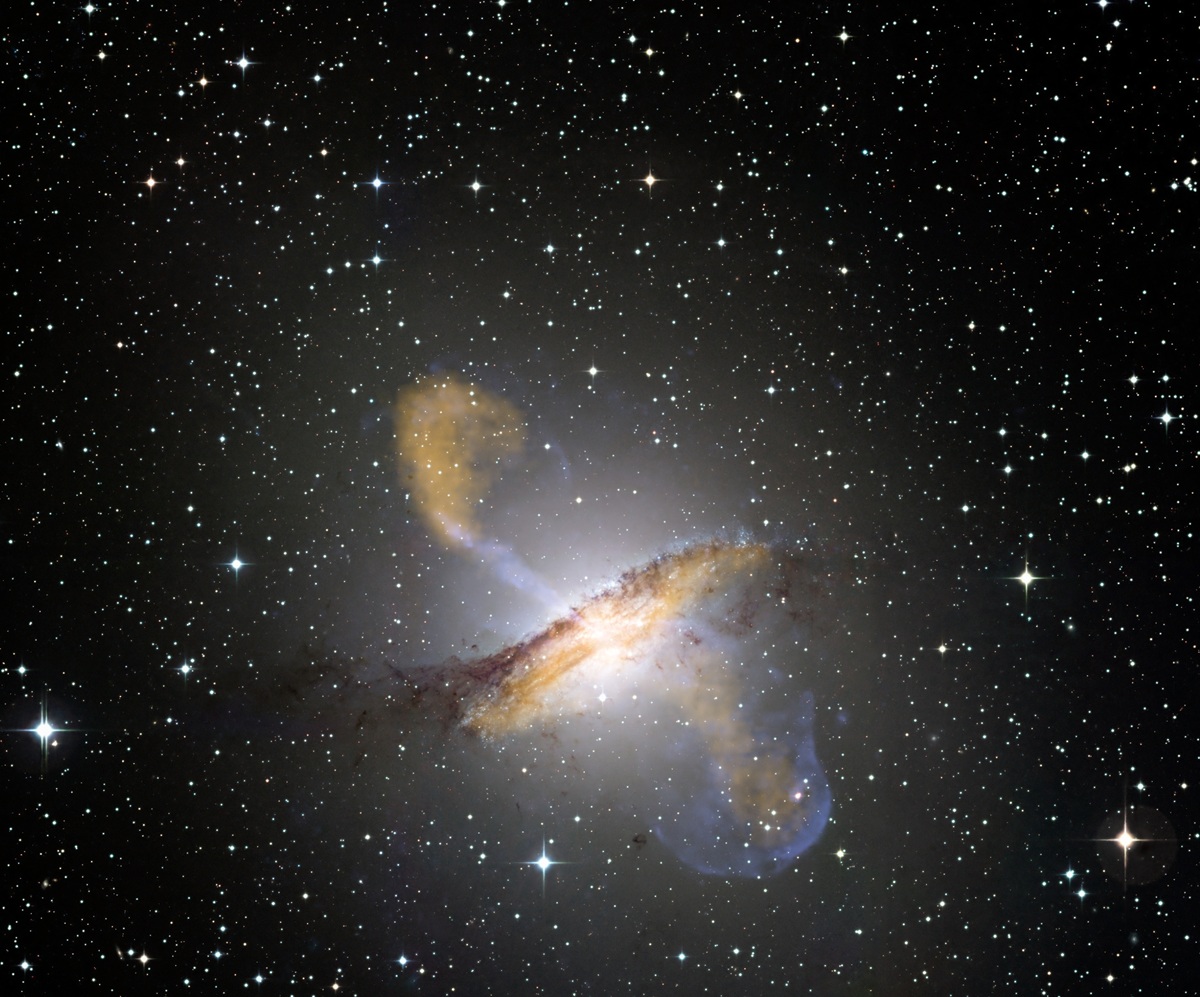
The black hole in Centaurus A
Researchers from the Department of Astronomy at the University of Würzburg recently published a study on the black hole in Centaurus A in the journal Astronomy & Astrophysics. As reported by Phys.org, the study investigates why the brightest parts of the jets emerging from its poles are their edges rather than their centers.
The name “Centaurus A” itself indicates that the object was first discovered in the radio range, at a time when this branch of astronomy was still very young and scientists were not yet very good at identifying radio sources with objects that could be seen in the visible spectrum. However, it is one of the brightest radio sources in the sky and is truly hard to miss.
Scientists eventually identified Centaurus A as a galaxy located 12 million light-years away from us. They later realized that its source was a supermassive black hole at the galaxy’s center, actively consuming matter. Such objects are usually called radio galaxies, and Centaurus A is the closest of them.
The mystery of relativistic jets
However, Centaurus A still held a mystery that puzzled scientists. As in any active galaxy, its black hole actively consumes matter. It also ejects some of this material back into space in the form of jets emerging from its poles. Matter in these jets travels at speeds close to the speed of light and is therefore extremely hot.
However, the highest temperatures are observed not at the center of the jets, where one might expect them to be, but along their edges. In the new study, scientists managed to understand why. The cause turned out to be the powerful magnetic fields that exist inside the jet. They have a complex geometry, and this is where the explanation lies.
Extremely detailed computer simulations showed that electrons move along magnetic field lines and end up in the outer regions of the jet, which explains their brightness. This is in very good agreement with images obtained by the Event Horizon Telescope (EHT) at a wavelength of 1.3 millimeters.
“Centaurus A is our closest ‘window’ into the physics of relativistic jets,” says Felix Glaser, a master’s student at the Department of Astronomy and lead author of the study. “The fact that our model, which takes plasma properties into account, reproduces the observed edge-brightening shows that we correctly understand important aspects of the fundamental physics behind these processes. Such phenomena are likely not unique to Centaurus A but are also characteristic of relativistic jets throughout the Universe.”
