

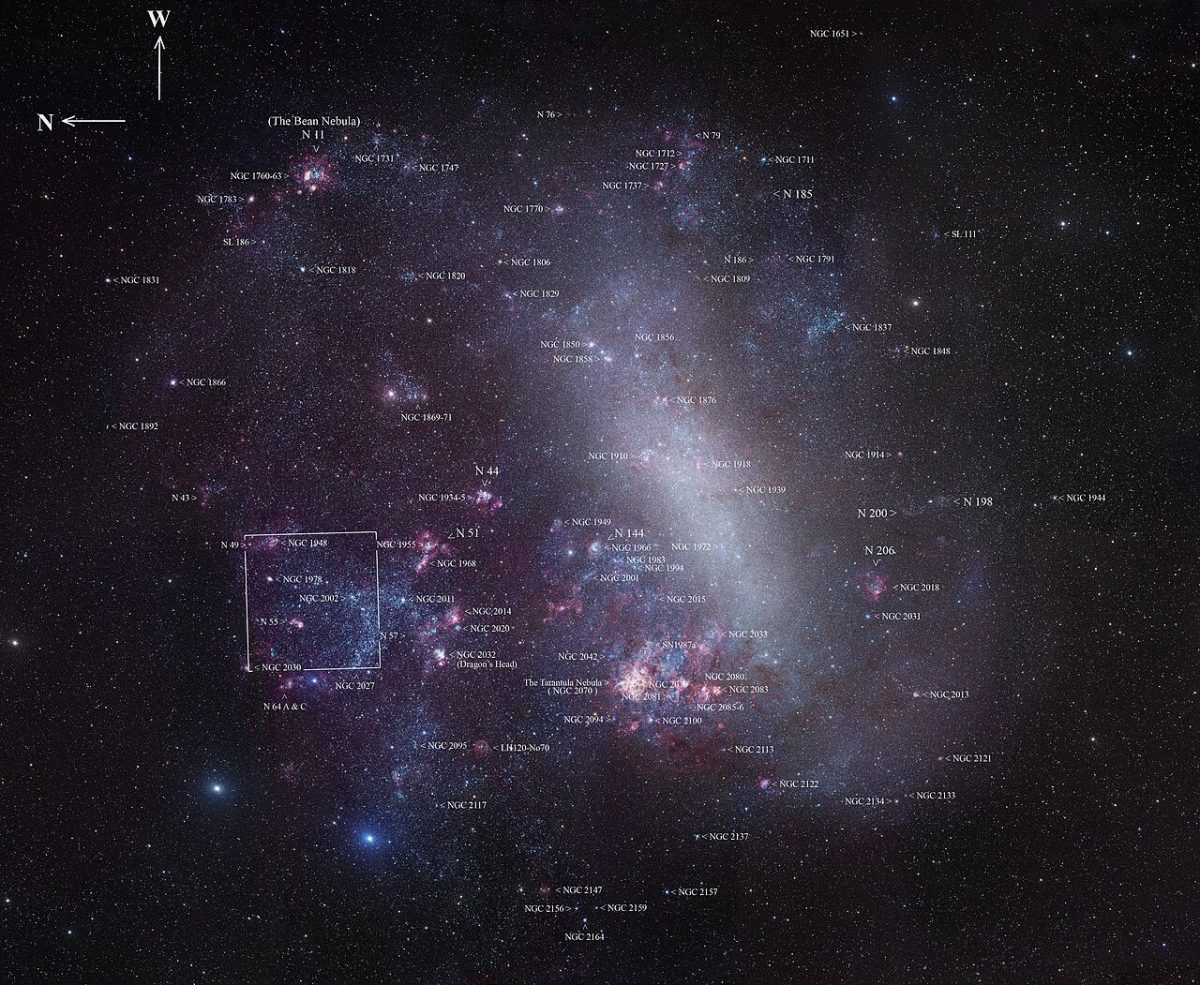
Some time ago, scientists began to suspect that there was a black hole in the star cluster NGC 1850, located in the Large Magellanic Cloud. However, a recent study has shown that it is simply a massive star rotating extremely rapidly.
Binary “impostor systems”
Sometimes massive stars can imitate the behavior of a black hole and deceive astronomers, causing them to misinterpret their true nature. As reported by Phys.org, this is exactly what is happening in a strange pair of stars in the NGC 1850 cluster in the Large Magellanic Cloud (LMC). Initially, the system was believed to contain a star approximately five times more massive than the Sun orbiting a stellar-mass black hole. However, a new study led by Rhys Seeburger of Liverpool John Moores University shows that this is a black hole “impostor system.”
Massive stars are mostly born and live in binary systems. When one star exhausts its fuel and explodes, a neutron star or a black hole remains in the binary system alongside its companion. A black hole in such a system may emit almost no X-rays. It is then called a dormant black hole. Such systems are difficult to find because the only way to detect them is through their influence on the visible star’s motion.
Models predict around 100,000 such systems in our Galaxy. Only a few dormant black holes have been confirmed, including VFTS 243 in the Large Magellanic Cloud and HD 130298 in the Milky Way. However, ordinary pairs of stars can also imitate this signal, especially after mass transfer, when one star becomes stripped and bloated, potentially outshining its companion. As a result, such impostor systems can enter observational samples.
In 2022, researchers interpreted NGC 1850 BH1 as a system containing a dormant black hole with a mass of 11 solar masses orbiting an ordinary star with a mass of five solar masses, since one of the objects was “invisible.” Their reasoning was that a normal star of such mass would outshine its companion. Subsequent studies took different approaches but did not produce a definitive result. The companion could either be a compact object, such as a black hole, or a bright star hidden within a thick disk.
A rapidly rotating star
In this study, the team used a technique known as spectral disentangling. This method makes it possible to separate the combined light of two stars into the individual spectra of each one. It was applied to new, clearer observations obtained using FLAMES, a spectrograph on the Very Large Telescope. These observations cover shorter wavelengths of the spectrum.
And it turned out that there really are two stars. A relatively cool and bloated star orbits its more massive and hotter companion, which rotates rapidly, with a projected rotational velocity of about 280 km/s. According to the researchers, this configuration is most easily explained by previous mass transfer.
“Spectroscopic investigation has shown that the system known as NGC 1850 BH1 does not actually contain a compact companion, but belongs to the class of ‘impostor’ systems with two luminous components,” the team writes in the paper. The study rules out the presence of a black hole in NGC 1850 BH1. Instead, it is an “impostor” consisting of two bright stars that may have interacted in the past.
A valuable example of binary systems
Drawing on the results of previous studies, the authors of the paper refined these measurements. Previously, the visible star was believed to have a mass equivalent to five solar masses, while its invisible companion was estimated at eleven. The current measurements have lowered these estimates: the system consists of a donor star with a mass of 1.7 solar masses and a bright companion with an estimated mass of 5.2 solar masses.
“However, some open questions remain,” the team notes. The mass ratio of the two stars is not yet known precisely, so the system cannot be fully described at this stage. This is important because the system is located in a cluster whose age, composition, and distance are well known, making it a valuable example for understanding interactions between binary stars.
A previous study showed that the companion contributes less than 10% of the light in a certain wavelength range, but the current study finds a contribution of 30%–50% in the same range. The researchers are unsure why this discrepancy exists.
The next step is to obtain clearer, cleaner spectra. The team notes that such observations are challenging because NGC 1850 BH1 is located in a densely populated stellar region, and both stars are relatively faint. At present, they can only be carried out from space, using spectroscopic observations with the Hubble Space Telescope, or with highly efficient blue-sensitive spectrographs such as X-Shooter, or integral-field spectrographs mounted on 8-meter ground-based telescopes.
