

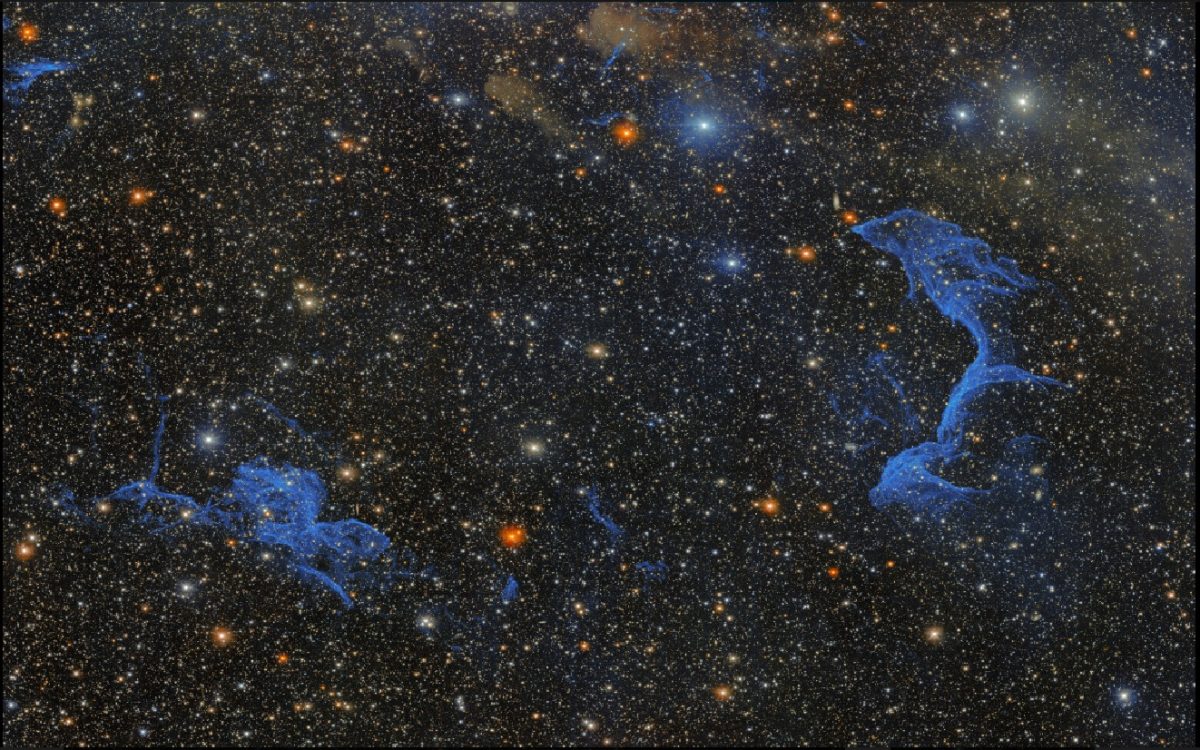
The Dark Energy Camera, created by the U.S. Department of Energy, has captured an image of the supernova remnant SNR G295.5+09.7. It is known as the Betta Fish Nebula. In the image, this object really does look like the blue tail of an amazing cosmic fish.
The Dark Energy Camera
An amazing image of a cosmic fish’s tail has appeared on the website of the scientific organization NOIRLab. At least, these amazing ribbons, which seem to float through space, look most like one. And the most interesting thing is that this picture was obtained using such a serious instrument as the Dark Energy Camera.
In fact, it is a special instrument installed on the 4-meter Victor M. Blanco Telescope at the Cerro Tololo Inter-American Observatory in Chile by the U.S. Department of Energy. And in reality, it does not see any dark energy, because it is fundamentally impossible to see it, even through its gravitational influence.
However, this instrument can see the distribution of galaxies in space and the vectors of their motion. These make it entirely possible to trace a global force acting throughout the Universe or perhaps in some part of it. However, from time to time, this instrument also looks at something simpler, and that is when such captivating images are produced.
The Cosmic Betta Fish Nebula
This time, the object observed by the 570-megapixel Dark Energy Camera was the supernova remnant SNR G295.5+09.7. It is a nebula formed from the expelled outer layers of a dead star. At its center is a neutron star. Such objects can have quite complex and unusual shapes.
Specifically, SNR G295.5+09.7 has been named the Betta Fish Nebula because that is what it looks like from the outside. It has been photographed before, but this new image shows it in all its glory. The sheets of gas expanding into space really do resemble fish tails.
The nebula is located in the Carina–Sagittarius Arm of our Galaxy, the Milky Way. In this image, thousands of stars from this arm serve as its background. Among this stellar diversity, other galaxies lying beyond our own are also hidden. Can you find them in the zoomable version of this image?
In addition, blurred brown patches are visible against the background of SNR G295.5+09.7 — these are interstellar clouds within our Milky Way. Interstellar clouds are similar to nebulae, but they are much more diffuse structures. Our Solar System, incidentally, is located inside one of these structures, known as the Local Interstellar Cloud.
