

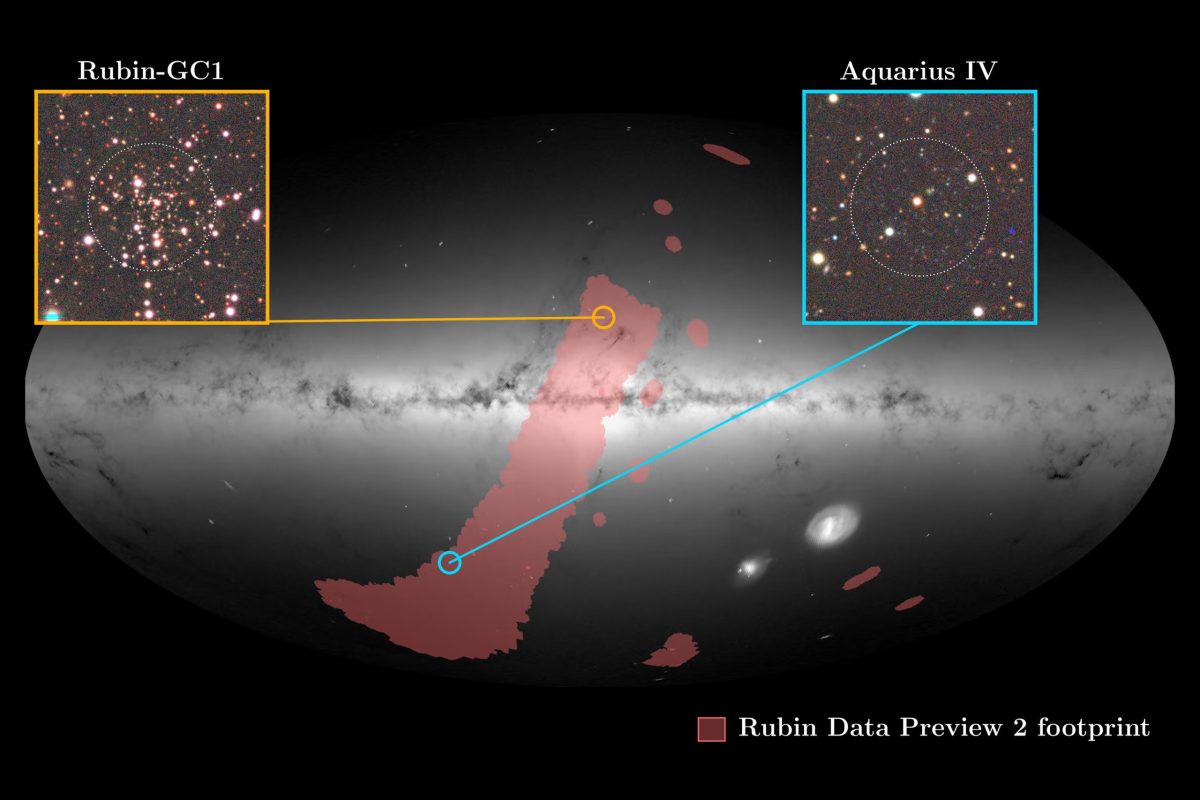
The Vera C. Rubin Observatory has begun delivering its first scientific results. Among them is the discovery of new Milky Way satellites: the dwarf galaxy Aquarius IV and the star cluster Rubin-Gc1. Scientists are confident that these will not be its last discoveries on the outskirts of our Galaxy.
Discovering Satellites of the Milky Way
According to the Italian National Institute for Astrophysics, researchers have discovered two new satellites of the Milky Way. They were aided by the new telescope at the Vera C. Rubin Observatory, which began operating only last year. These are just its first major discoveries in this field.
Two papers describing the discoveries have been published in Research Notes of the AAS and The Astrophysical Journal Letters. They report the discovery of the dwarf galaxy Aquarius IV and the star cluster Rubin-Gc1. Many similar objects orbit the Milky Way, whose central disk measures approximately 100,000 light-years across. A substantial number are already well known to researchers.
However, astronomers have long understood that numerous smaller structures remain beyond their view. This is particularly true of the Milky Way’s diffuse, spherical component, known as the halo. It extends hundreds of thousands of light-years around the galactic disk and its spiral arms. Detecting these small structures was one of the main reasons for building the Vera C. Rubin telescope.
What the New Observatory Found
The Vera C. Rubin Observatory is ideally suited to finding objects on the outskirts of the Milky Way. Its telescope has an aperture of 8.4 meters, allowing it to focus light onto the world’s largest 3,200-megapixel imaging sensor and detect even the faintest objects.
This is how Aquarius IV was discovered. It lies 350 light-years away and is extremely faint. The star cluster Rubin-Gc1 is on the opposite side of the Milky Way from us, heavily obscured by dust. Nevertheless, the observatory detected both. They are most likely not the last Milky Way satellites it will discover.
The Legacy Survey of Space and Time aims to map the Galaxy’s entire surrounding region, particularly in the southern sky. Observations of faint objects will also help reveal how much mysterious dark matter surrounds us—matter that interacts with other material only through gravity.
