

The story of the largest spacecraft NASA has ever built for a planetary mission can now be seen on screen. The agency has released the documentary The Europa Concept, about the people who spent more than a decade developing Europa Clipper. Meanwhile, the spacecraft itself is on its way to Jupiter. Near its moon Europa, scientists will investigate whether the ocean beneath its icy crust could be suitable for life.

Eleven Years in One Hour
The premiere took place on November 23, 2026, on the NASA+ streaming service. The film is also available through the NASA app and on the agency’s website, and will appear on YouTube in December. It can be watched free of charge and without advertising. The documentary runs for just over an hour. It shows how specialists fought to secure approval for the mission and overcame unexpected problems before launch.
Official trailer for the documentary The Europa Concept about the development of the Europa Clipper spacecraft. Source: NASA
Work on the spacecraft began in 2013 at the Jet Propulsion Laboratory, which is managed by the California Institute of Technology. The Johns Hopkins University Applied Physics Laboratory became a partner, and several NASA centers also took part. Over 11 years, engineers assembled a 6-ton spacecraft equipped with nine scientific instruments. The wingspan of Europa Clipper’s solar arrays exceeds 30 meters, making it greater than the wingspan of the An-26 transport aircraft, which is 29 meters.
These efforts are driven by the mission’s objective. Europa is one of the few places in the Solar System where liquid water is likely to exist beneath the surface, meaning that conditions suitable for life may be present. These are precisely the conditions that scientists aim to assess using data from Europa Clipper.
Radiation and a Hurricane
Radiation was the most difficult challenge for the designers. Jupiter’s magnetic field captures charged particles and accelerates them to enormous speeds, while Europa orbits right in the middle of this radiation zone. The particles damage electronic equipment, so the most sensitive components were placed inside a protective vault with thick metal walls. For the same reason, the spacecraft will not enter orbit around Europa. Instead, it will fly past the moon repeatedly and return from the most dangerous radiation zone.
In addition to radiation, the team had to contend with the pandemic and the weather. Because of Hurricane Milton, which reached Category 5, the launch was postponed from October 10 to October 14, 2024, and tornadoes also passed near the Kennedy Space Center in Florida.
The Journey to Europa
The Europa Clipper spacecraft has already been traveling for two years, and its entire 2.9-billion-kilometer journey to Jupiter will take five years, according to NASA. In March 2025, the spacecraft flew near Mars, and the planet’s gravity adjusted its trajectory. Along the way, the spacecraft photographed the interstellar comet 3I/ATLAS.
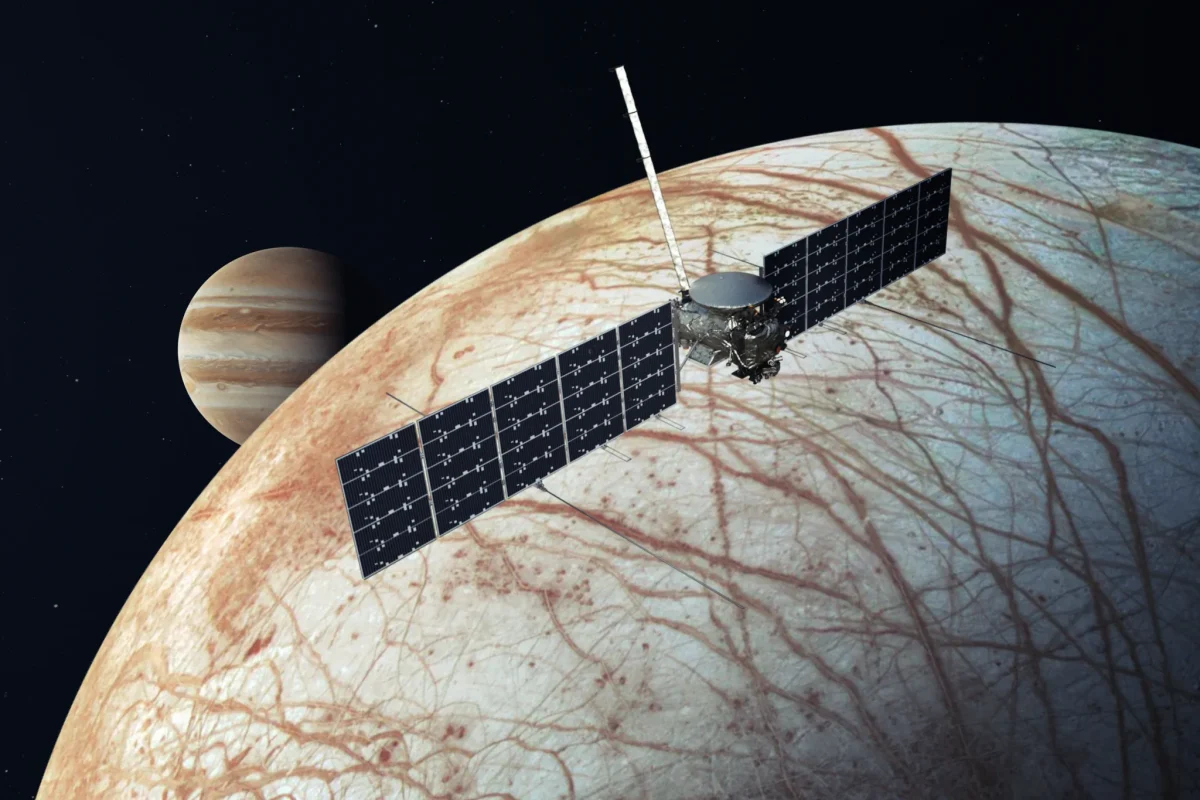
Once it reaches its destination, Europa Clipper will make 49 flybys of Europa, some at an altitude of about 25 km. The ESA JUICE mission will also reach Jupiter in 2031. Its main target is Ganymede, and the JUICE spacecraft will fly past Europa only twice, allowing scientists to compare data from the two missions.
Europa was discovered by Galileo Galilei back in 1610. The first detailed images of the moon were obtained during the Voyager 1 flyby in 1979. Data collected by the Galileo spacecraft in the 1990s provided grounds for the hypothesis that a hidden saltwater ocean lies beneath Europa’s icy surface. Kurt Niebuhr, program scientist at NASA Headquarters, is convinced that the lessons learned from Europa Clipper will be “so sensational, so fantastic, that everyone will be demanding a follow-up mission.”
The next stage of the journey is already approaching. In early December 2026, the spacecraft will fly past Earth and receive an additional boost from its gravity. After this maneuver, the probe will enter its trajectory toward Jupiter, where it will arrive in April 2030.
