
Europa, one of Jupiter’s icy moons, has long fascinated scientists because of what may lie beneath its frozen shell—a global ocean of liquid water. However, a new study suggests that reaching it may be more difficult than previously believed.
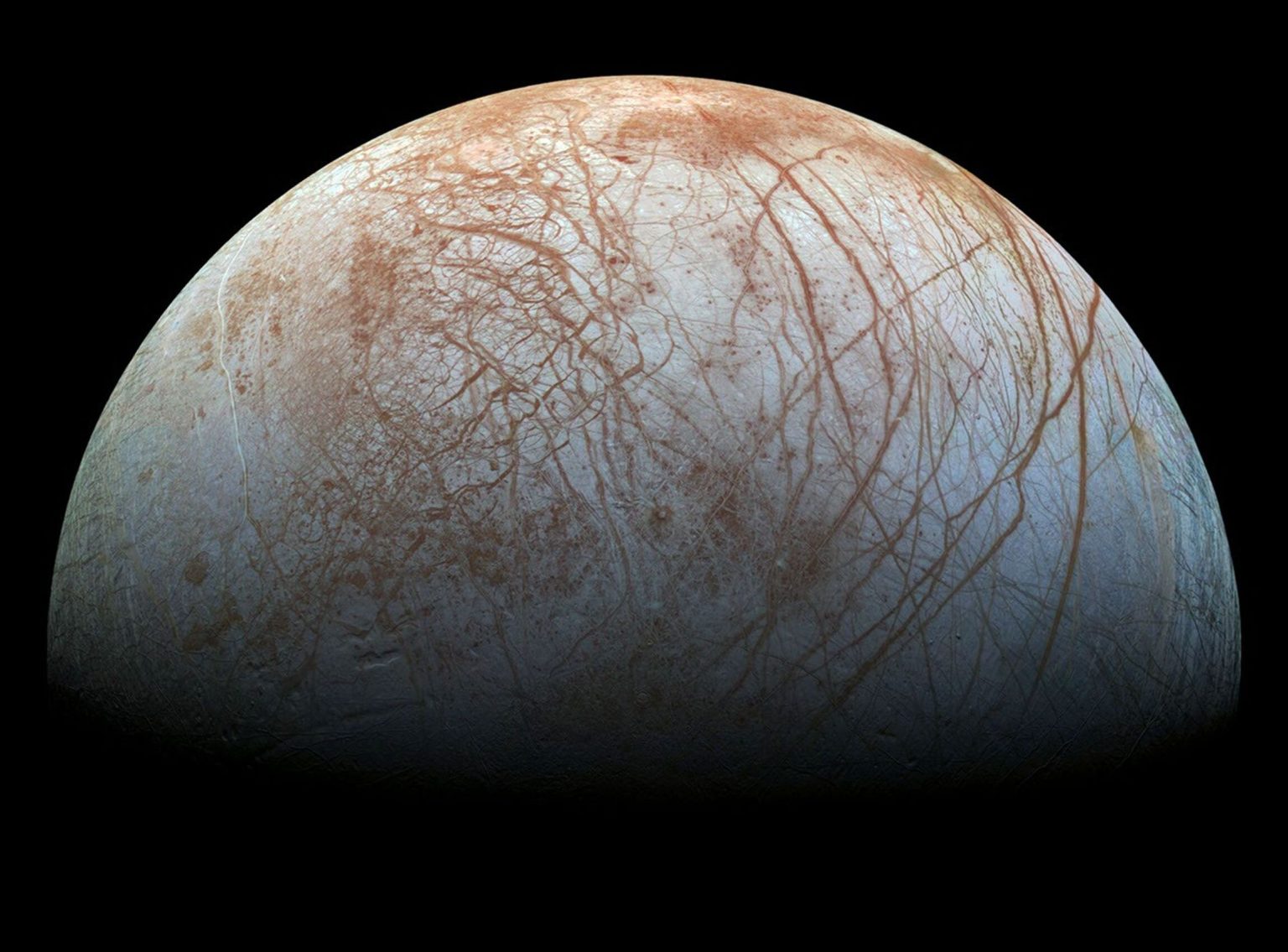
Can Water Rise Through Cracks?
Europa’s hidden ocean has made it one of the most intriguing places in the Solar System for studying conditions that could support life. However, according to phys.org, a new study led by Rutgers University scientist Lujendra Ojha suggests that one of the most promising pathways to Europa’s ocean may be far more complicated than previously thought.
In the study, published in Nature Astronomy, Ojha and his colleagues used computer simulations to test whether liquid water from Europa’s deep ocean could rise through cracks in the ice shell and accumulate in shallow reservoirs closer to the surface. Such reservoirs, if they exist, could be easier for future missions to detect or sample than the ocean lying deep underground.
“The mystery we wanted to solve was whether this journey is possible at all,” said Ojha, an associate professor in the Department of Earth and Planetary Sciences at Rutgers University’s School of Arts and Sciences. “Can liquid water rise from Europa’s deep ocean to the surface without freezing along the way?”
Their conclusion was that the journey from the deep ocean to the shallow ice is probably far more difficult than scientists had believed.
Shallow Water Reservoirs May Be Misleading
This discovery has important implications for future exploration of Europa. If shallow pockets of liquid are discovered beneath the moon’s surface, this would not necessarily mean that they contain water from Europa’s deep ocean. They may have formed locally through the melting of ice within the shell itself.
This is an important distinction. Scientists are interested in Europa because liquid water, chemistry, and energy are all essential ingredients in the search for habitable environments beyond Earth. A shallow reservoir would be easier to reach than the deep ocean. However, if the reservoir is not connected to the ocean, it may not reveal what is happening in Europa’s most intriguing environment.
The study comes as two major space missions are heading toward the Jupiter system. NASA’s Europa Clipper mission launched in October 2024 and is expected to arrive at Jupiter in April 2030, where it will orbit the planet and conduct 49 close flybys of Europa.
The European Space Agency’s Jupiter Icy Moons Explorer mission, known as JUICE, launched in April 2023 and is expected to arrive at Jupiter in July 2031.
Together, the missions are expected to provide scientists with a much more detailed view of Europa’s ice shell, the composition of its surface, and possible subsurface water. Europa Clipper’s radio instrument may help scientists determine whether shallow reservoirs exist and how they are structured.
Water Turbulence and Freezing in Europa’s Cracks
Beneath Europa’s extremely cold surface, a global ocean may remain liquid because Jupiter’s powerful gravity continuously compresses and stretches the moon, generating internal heat that is trapped by the ice shell above.
The study focuses on dikes—narrow cracks or fractures through which water from the ocean could theoretically rise through the ice. The concept is somewhat similar to the way molten rock can move through cracks on Earth before fueling volcanic activity. On icy worlds, this process is known as cryovolcanism, or volcanism involving ice and water rather than molten rock.
According to Ojha, turbulence is an important element in the physics of cryovolcanism. Earlier models often assumed that water rising through Europa’s ice moved in a relatively orderly manner. However, simulations led by Rutgers University indicate that the water would probably move rapidly and turbulently through the cracks, mixing with their cold walls and quickly losing heat to the surrounding ice.
“This water rising upward will be turbulent,” Ojha said. “It will move left and right, up and down, and it will have a swirling motion. When that happens, the liquid water will cool very quickly as it approaches the surface.”
As the water cools, it may become supercooled, meaning that it remains liquid even after its temperature falls below the normal freezing point. Under these conditions, tiny ice crystals known as frazil ice may form and gather together, blocking the pathway.
The simulations show that narrow cracks may freeze within only a few hours. Wider cracks could theoretically allow more water to pass through, but turbulence makes such scenarios much less likely. The researchers found that, to deliver enough water to form some of Europa’s surface features, the cracks would need to be unrealistically long or appear in large numbers.
The Ice Shell Is a Stronger Barrier Than Expected
The result presents a picture of Europa in which shallow water, if it exists at all, may have a different origin than many scientists had hoped. Instead of rising directly from the ocean, the water may form through localized heating and melting within the ice shell.
“Our work shows that Europa’s ice shell may be a stronger barrier between the ocean and the surface than previously believed,” Ojha said. “This helps future missions interpret what they find and better understand where to search for signs of habitability.”
