

Scientists in the United States are investigating how heavy particles move through quark–gluon plasma. This will help them understand the behavior of this extremely unusual substance, which filled our entire Universe during the first microseconds of its existence.
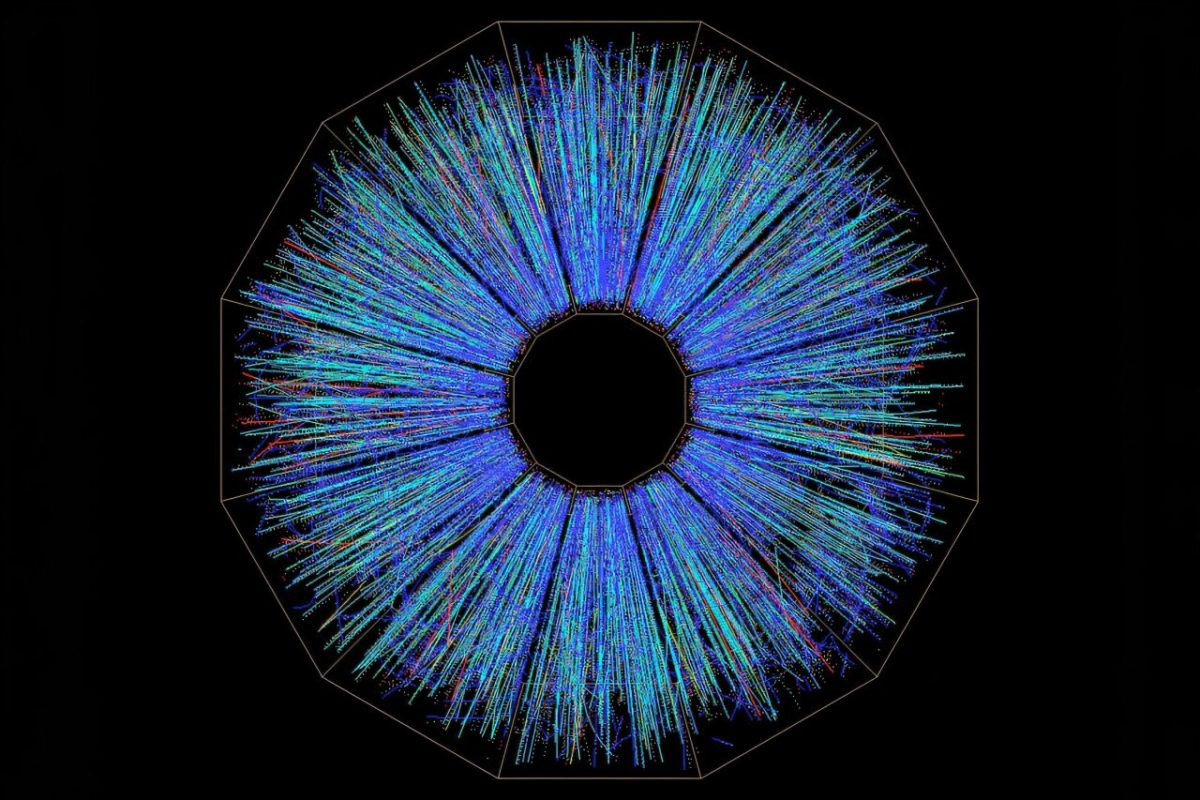
Quark–Gluon Plasma
According to phys.org, scientists at the Massachusetts Institute of Technology and the University of California, Santa Barbara, recently investigated one of the strangest substances in the Universe: quark–gluon plasma. The findings of the study, which applied Albert Einstein’s theory, were published in Physical Review Letters.
A few milliseconds after the Universe formed, all its matter consisted solely of individual quarks of six different types and gluons—tiny particles that normally bind quarks into larger particles but were then racing around at tremendous speeds, creating chaos. As the energy density fell, gluons “glued” quarks into protons and neutrons through the strong interaction, which they mediate.
Since then, quark–gluon plasma has mostly been encountered in laboratories on Earth, where it can be maintained for only an extraordinarily brief time. Studying it is extremely difficult, much to scientists’ frustration, because processes can sometimes occur within it that quantum mechanics cannot explain.
In the new study, scientists attempted to consider quark–gluon plasma as the oldest liquid in the Universe. Strictly speaking, it is not a liquid, since it does not consist of molecules and therefore does not even flow in the conventional sense. However, certain analogies do apply, prompting the researchers to use an intriguing theory developed by Albert Einstein.
Brownian Motion in Quark–Gluon Plasma
In 1905, Albert Einstein proposed a theoretical explanation for Brownian motion—a phenomenon discovered a century earlier. It describes the spontaneous movement of tiny solid particles suspended in a liquid. Einstein offered the now-familiar explanation that these particles are buffeted by the thermal motion of molecules.
The researchers decided to apply the same principle to quark–gluon plasma by introducing heavy quarks into it. In theory, these should behave like particles in water. Plotting the strength of the kicks they receive should produce the familiar bell curve of a normal distribution.
However, things work somewhat differently when a particle travels at a relativistic speed, and this was the case that interested the scientists. The team began with a scenario in which a relativistic heavy quark moves through a gas of weakly interacting quarks and gluons. This provided the starting point for their calculations.
For this initial scenario, they calculated the strong nuclear force acting on the heavy quark and the probabilities of different changes in its momentum as it traveled through the gas of quarks and gluons. This calculation produced a curve representing the probability distribution of changes in the quark’s momentum. The same curve can represent the probability of the quark experiencing different forces: stronger kicks cause larger changes in its momentum.
The Findings
The curve calculated by the researchers was bell-shaped, similar to the one Einstein found for other liquids, but only for small kicks. Unlike Einstein’s bell curve, the team’s result showed a skew for heavy quarks moving at relativistic speeds. The tails at the two ends of the curve were unequal, revealing a surprising imbalance in the types of kicks a heavy quark would experience.
The team then performed the same calculation for plasmas composed of different particles. They found that the same skewed curve applied regardless of the plasma’s composition. They also discovered that this same structure was already hidden in previous calculations for strongly coupled plasma, despite differences in the microscopic physics. According to the researchers, this means that interactions in the primordial plasma were already strong enough for it to behave more like a liquid than a gas.
