

A new study suggests that immediately after the giant impact that formed the Moon, Earth may have been strongly flattened at the poles and rotating extremely rapidly. This process shaped its geological structure and surface features at the time.
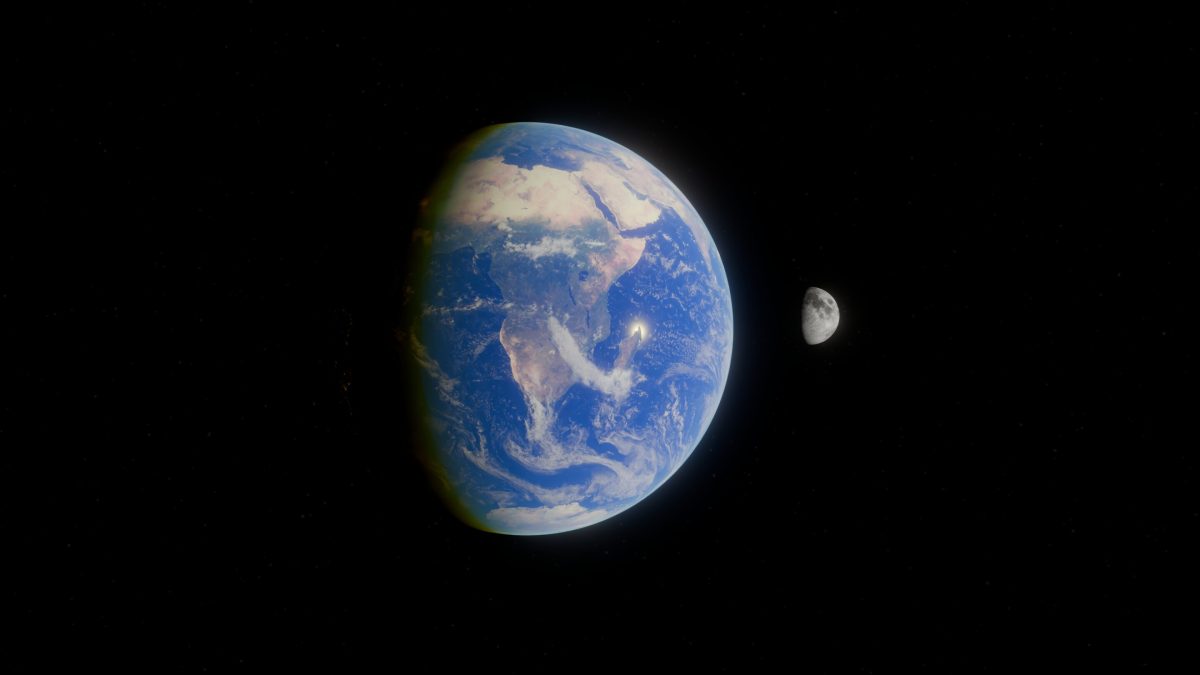
Earth After the Giant Impact
The leading theory of the Moon’s formation involves a large body colliding with Earth at the very beginning of our planet’s history. Debris from the impact gathered in orbit to form our satellite, while Earth itself began spinning extremely rapidly. Now, according to Phys.org, researchers have considered what shape the planet had and how this affected the formation of its crust.
Simon Lock of the University of Bristol investigated this question. He recently published his research in Journal of Geophysical Research: Solid Earth. Lock proposed a somewhat innovative model that remains consistent with existing scientific knowledge: immediately after its formation, the Moon orbited practically just above Earth’s surface, while the planet itself resembled a pumpkin.
Scientists already knew the first part. Direct observations show that our satellite has been slowly moving away from Earth for billions of years and will continue to do so. The second follows from the fact that Earth’s rotation period at the time was only two to five hours.
Under these conditions, even after the crust cooled, centrifugal forces would have caused the planet to bulge along the equator and flatten at the poles. Something similar happens today, but on a much smaller scale. Back then, the “pumpkin-like” shape would have been far more pronounced. In some models, the equatorial radius is twice the polar radius.
The Ancient Crust
Everything described above is based entirely on simulations rather than samples of the ancient crust. That crust once covered the entire surface of our planet but was later completely remelted by geological processes. This is the new study’s main weakness.
This is unfortunate, since fascinating processes must have been taking place in Earth’s primordial crust. Most likely, it was not divided into separate moving blocks like today’s crust. Nevertheless, Earth’s compression and stretching forced it to deform. The new simulations show that the resulting stresses could have been comparable to those that formed the Himalayas.
The oldest regions of today’s crust can still reveal a great deal about the primordial crust. They display a wide variety of rock types. Researchers link this both to the remelting of the oldest rocks—which would already have undergone chemical changes through contact with air and water—and to asteroid impacts.
As the planet later became rounder, its crust stretched near the poles and compressed around the equator, generating movements that could have rivaled those at modern plate boundaries over tens of millions of years. In his study, Lock emphasizes rotation as a key but underestimated component of Earth’s earliest geology. He now hopes that incorporating it into future models will give researchers a much clearer picture of how our planet’s surface formed and how its first continents emerged.
