

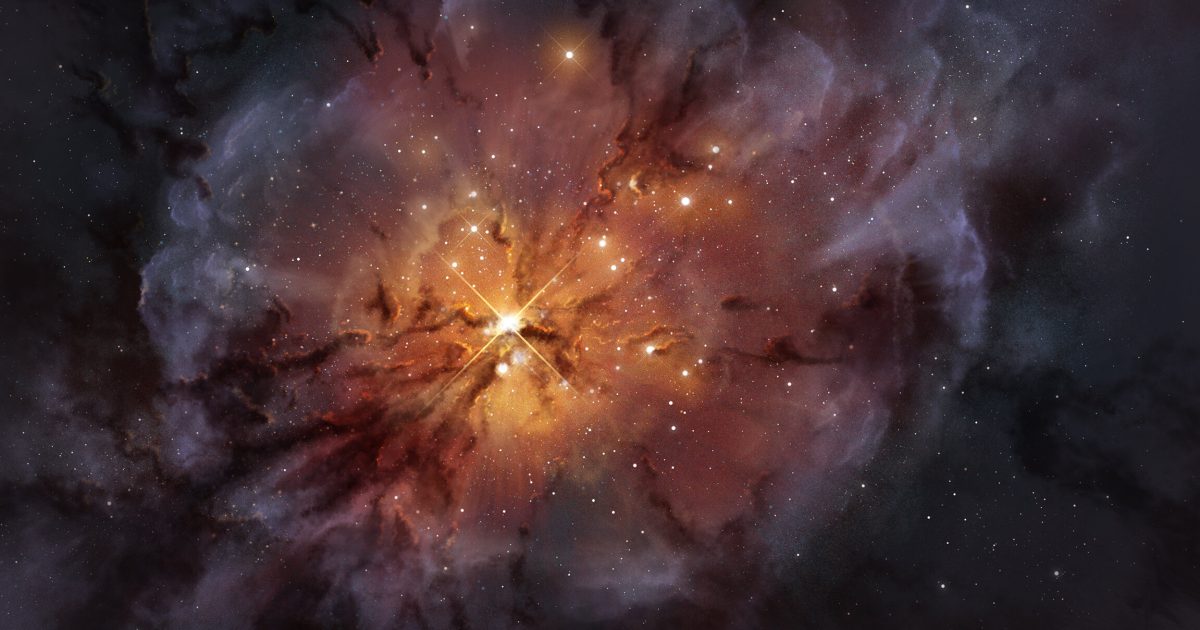
Images of the young Universe from the James Webb Space Telescope revealed more bright galaxies than models had predicted. New computer calculations suggest that ultraviolet radiation from young star clusters may have driven diffuse gas and dust out of galaxies, allowing more of their starlight to reach us. This barely interfered with star formation in dense clouds.
Repeated Pushes
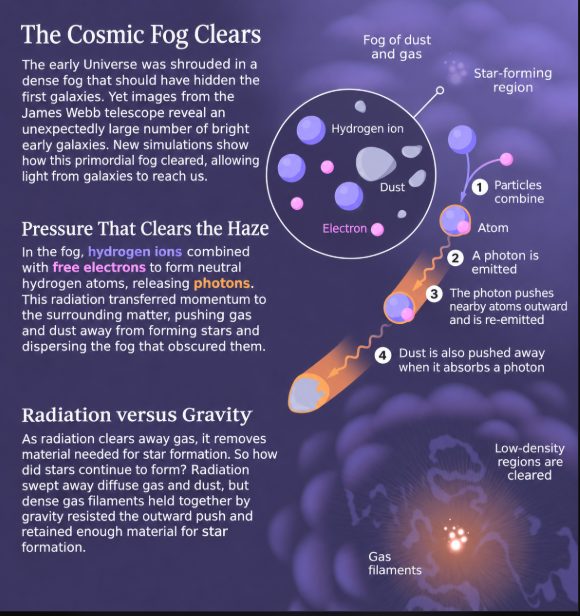
Ultraviolet radiation from young stars ionizes the hydrogen around them. When an electron recombines with a hydrogen ion or collides with a hydrogen atom, the gas emits Lyman-alpha photons—ultraviolet light at hydrogen’s strongest spectral line, with a wavelength of approximately 122 nanometers.
After absorbing most types of radiation, an atom or dust grain releases the energy at a different wavelength, allowing it to escape with little further obstruction. A hydrogen atom, however, almost immediately reemits a Lyman-alpha photon at the same wavelength, so a neighboring atom can absorb it again. As a result, the photon remains trapped in the gas for a long time.
Each absorption gives the gas a small push, and together these pushes create strong pressure. According to Shyam Menon, quoted by Phys.org, scientists have long known that this pressure could be important, but they could not determine its strength in a realistic environment. Modeling it is difficult because every interaction between a photon and an atom must be calculated individually.
The Mystery of Bright Galaxies in the Early Universe
Models developed before the launch of James Webb predicted that such galaxies would be much rarer during the first few hundred million years after the Big Bang. Two proposed explanations are that gas in the early Universe’s dense clusters may have formed stars more efficiently than it does today, and that there was little dust surrounding them.
However, simplified models cast doubt on the first idea. Their calculations suggested that Lyman-alpha pressure should disperse gas in these clusters, preventing it from collapsing into stars.
Gravity Versus Pressure
Shyam Menon of the Flatiron Institute’s Center for Computational Astrophysics and Aaron Smith of the University of Texas at Dallas calculated this pressure at selected snapshots of a simulation in which a gas cloud with a mass of one million Suns collapses. Their findings were published in the peer-reviewed journal The Astrophysical Journal.
Lyman-alpha pressure proved to be 3–500 times stronger than the pressure from the remaining ultraviolet and infrared radiation. Unlike the simplified models, however, the simulation showed that gravity remained stronger in the dense gas filaments where most stars form, keeping the gas bound to the cluster despite the outward push.
The authors estimate that even with Lyman-alpha pressure, between 25% and 60% of the cloud’s gas could likely have formed stars. This is several times higher than in present-day star-forming regions, where the fraction typically does not exceed 10%. The less dust there is, the lower this fraction becomes, because dust absorbs Lyman-alpha photons and weakens their pressure.
In the diffuse gas between stars, where gravity is weaker, pressure prevailed. Lyman-alpha radiation therefore likely did little to slow star formation in dense clusters, while driving away the gas and dust obscuring the stars and making early galaxies appear brighter. This makes the two explanations for the mystery compatible. “It can clear the fog to some extent,” Menon says.
In the authors’ model, the gas shrouding a cluster disperses up to twice as quickly with Lyman-alpha pressure as without it—in less than 4 million years. The cluster therefore becomes visible before supernova explosions occur, while its most massive stars are still shining. This may have allowed their ionizing radiation to escape and strengthen the ionization of hydrogen between galaxies during the first billion years.
Limits of the Calculations
The pressure was calculated for individual snapshots of the simulation, so the calculations do not show how radiation changes the cloud itself over time. The strength of the effect also depends on the amount of dust, which remains uncertain for early galaxies.
Olof Nebrin of Stockholm University and Aaron Smith have already modeled Lyman-alpha radiation together with gas motion in two dimensions. Shyam Menon hopes that extending this work to three dimensions will become possible in the coming years.
