

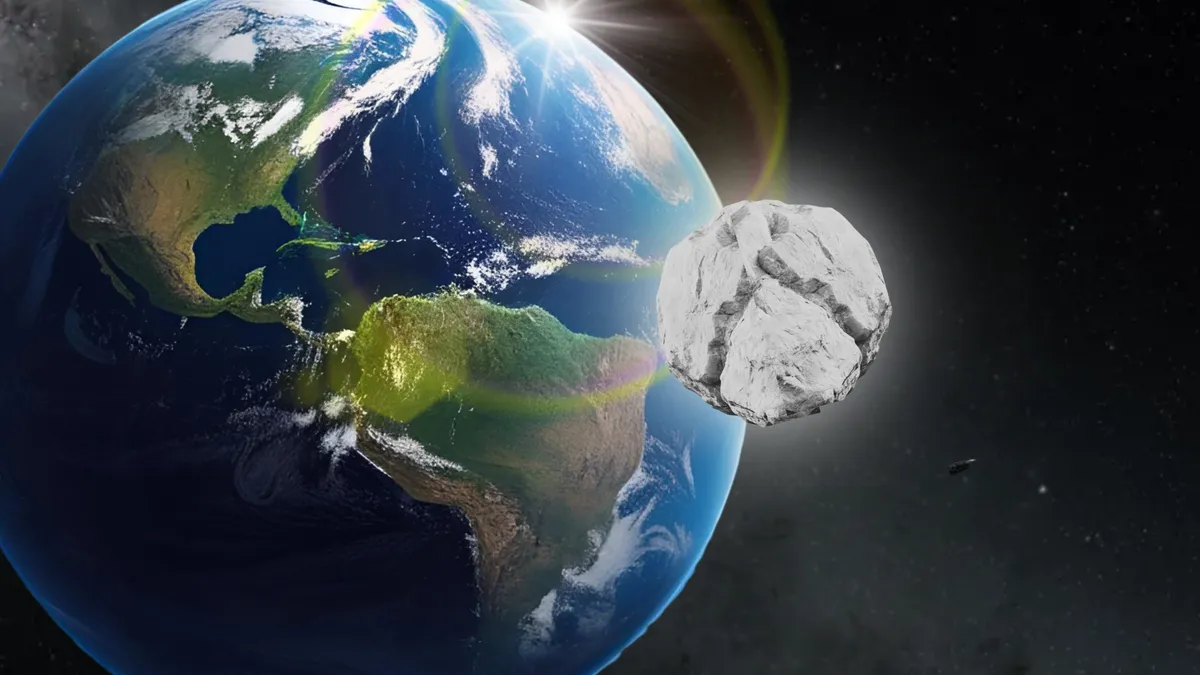
Another moon has been orbiting Earth for several months—a temporary and exceptionally tiny one. Designated 2026 QQ8, the object could fit in the bed of a truck. Early next year, it will leave our planet’s vicinity and continue along its own orbit around the Sun. It was only spotted in August, although it had already been under Earth’s gravitational influence for some time.
Discovery in Hungary
Hungarian astronomer Krisztián Sárneczky first detected 2026 QQ8 on the night of August 19–20 at Piszkéstető Station. Over the following three days, astronomers at observatories in Croatia, Italy, Namibia, Spain, and the United States confirmed the discovery.
The official announcement appeared on October 29 in a Minor Planet Center circular. Orbital calculations showed that the body is temporarily bound to Earth. Its size is estimated at one to two meters.
Why the Object Stayed
The orbit of 2026 QQ8 around the Sun nearly matches Earth’s. It completes one revolution in 359 days, and its orbital plane is tilted by only half a degree relative to Earth’s. The object and our planet therefore travel almost parallel to one another at similar speeds. During a close approach, Earth’s gravity is strong enough to bend its path into loops around the planet.
Such visitors near Earth are not unusual. According to Space.com, previous studies suggest that up to six similar bodies could be orbiting the planet at any given time. Simulations of the overall population showed that a typical temporary moon measures about 75 centimeters across and remains nearby for approximately nine months. At one to two meters in size, 2026 QQ8 is noticeably larger than this average. Earth cannot hold onto it for long because the Sun’s gravity continually perturbs its motion, and sooner or later such objects return to independent orbits.
Rock or Rocket?
But is it really a rock? In 2020, astronomers tracked an object designated 2020 SO that was expected to become a temporary moon of Earth. It turned out to be the Centaur upper stage of a rocket launched in 1966 with the Surveyor 2 spacecraft.
The rocket fragment’s true nature was revealed by its spectrum, which resembled painted stainless steel, and by the effects of solar radiation pressure. A hollow metal casing has a large surface area relative to its mass, so radiation pushes it much more strongly than it would a solid rock.
The Minor Planet Center also accounted for this effect when studying 2026 QQ8, obtaining an area-to-mass ratio of approximately 8 square centimeters per kilogram. No connection to any known artificial object was found. Calculations show that this value is entirely plausible for a solid rocky body about a meter across, whereas the estimate for 2020 SO was approximately 60–70 square centimeters per kilogram. The uncertainty remains large, so the center’s specialists are calling for further observations and calculations of its motion.
Farther Away Than the Moon
2026 QQ8 is currently approximately 1.9 million kilometers from Earth—five times farther away than the Moon, at 384,000 kilometers. Its apparent brightness is around magnitude 25, making it 40 million times fainter than the dimmest stars visible to the naked eye. The object was last observed on October 9 by David Tholen using the University of Hawaiʻi’s 2.2-meter telescope on Maunakea.
An estimate based on the average duration of such captures suggests that the object will escape Earth’s gravitational hold around January 2027. Until then, large telescopes can further refine its motion, and those measurements will determine whether astronomers can conclusively distinguish a natural body from a piece of spacecraft debris.
