
The idea of traveling back in time is one of the most popular themes in science fiction. Yet the absence of visitors from the future has long suggested that the real Universe follows much stricter rules. A new study by physicist Hongsheng Zhang of Jinan University in China, published on the preprint server arXiv, proposes a concise mathematical barrier that rules out any hope of closed time loops in most types of universe.
Instead of complex calculations involving quantum effects, infinite amounts of energy, or gravitational singularities, Zhang used the long-established null eikonal equation, normally employed to describe the propagation of light waves.
The result proved strikingly simple. The proof takes just three lines and rests on a single geometric fact: a lightlike direction can never be perpendicular, or orthogonal, to a traveler’s timelike path. It follows that a certain mathematical quantity must increase continuously along the entire trajectory. Consequently, no object can return to its starting point in its own past.
This can be compared to driving down a one-way street with no U-turns, exits, or even a shoulder where a car could turn around.
Four Locks on the Door to the Past
Theoretical physics already had three main families of criteria that prohibit closed timelike curves:
- Temporal criteria: these assume the existence of a single cosmic clock that always ticks forward.
- Energy criteria: these require positive energy and gravity, ruling out the use of “exotic matter” with negative mass.
- Topological criteria: these describe the shape and connectedness of spacetime itself.
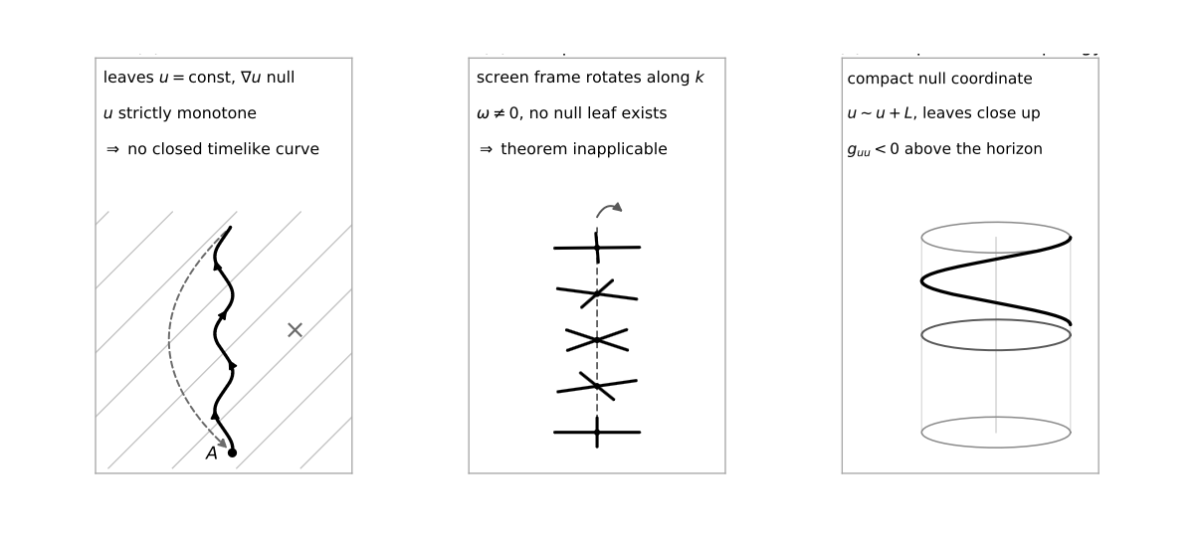
Zhang’s work adds a fourth tool. It allows mathematical models of the Universe to be quickly tested for the possibility of time travel without solving the extraordinarily complex equations of general relativity.
Light Instead of a Clock
The main innovation lies in how the researcher proposes slicing spacetime. Traditional models require selecting a specific moment of “now,” which calls for an observer and a clock.
Zhang instead slices spacetime using surfaces on which light itself exists. This geometry is entirely objective and does not depend on who performs the measurements.
Are There Exceptions?
Mathematical proofs are also useful because they clearly define their own limits. According to the author, there are only two theoretical ways to circumvent this prohibition:
- Local twisting: extreme curvature of spacetime around objects with immense gravity, such as rapidly rotating black holes.
- Global topology: a situation in which the Universe loops back on itself on a large scale and has a doughnut-like shape.
Whether such conditions exist in our Universe remains an open question. Physicists now, however, have a precise algebraic guide to which geometric laws would have to be broken to build a real time machine.
Previously, we reported on how a mathematician confirmed the possibility of time travel.
Based on material from sciencealert.com
