

Supermassive black holes at the centers of galaxies already existed in the very early Universe. They grew by merging, but before doing so, they spent some time in pairs. A recent study of pulsars offers a way to constrain how massive those pairs were.
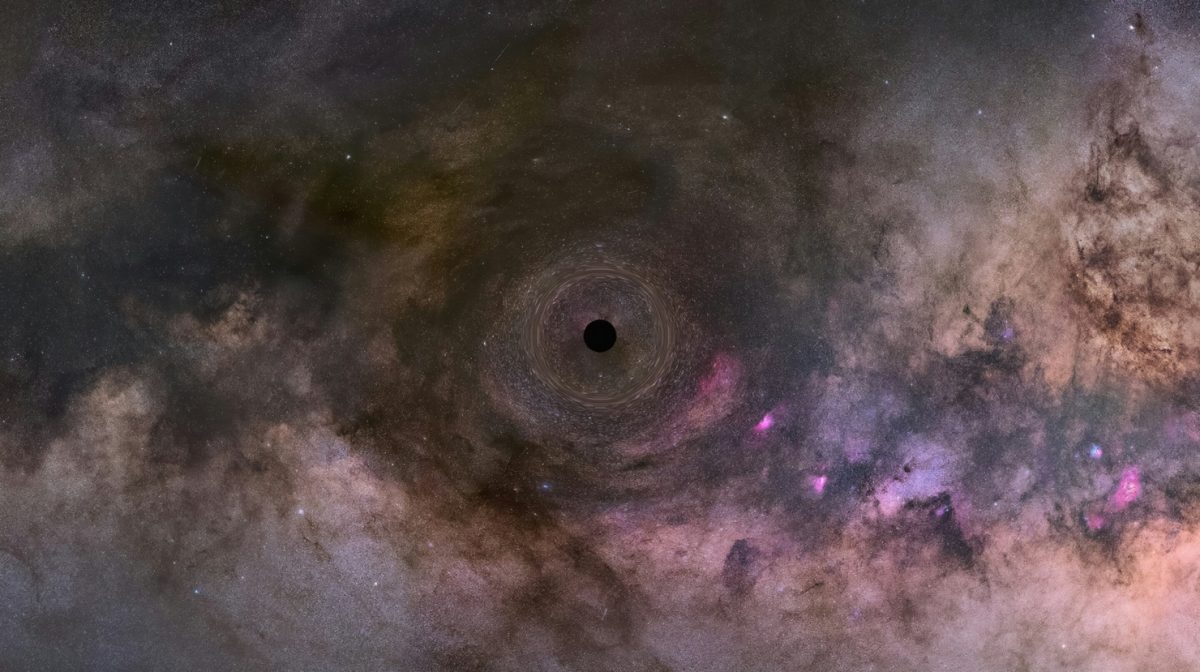
Pulsars Help Detect Gravitational Signals from Black Hole Pairs
Observations using instruments such as the James Webb Space Telescope have revealed surprisingly massive black holes in the early Universe. Even less than a billion years after the Big Bang, some of these objects already had masses billions of times greater than the Sun’s. Astronomers still do not understand how they reached such enormous sizes so quickly, according to phys.org.
In a new study, a team led by Yiqin Chen of Beijing Normal University used a pulsar timing array to place the first direct constraints on the existence of supermassive black hole pairs during this early period, known as “cosmic dawn.”
When two supermassive black holes orbit one another, they slowly disturb the surrounding spacetime, sending gravitational waves across the Universe. For pairs of this mass, a single orbit can take about a year, producing waves at frequencies too low for ground-based detectors to register.
Instead, astronomers search for them using pulsar timing arrays: networks of rapidly rotating neutron stars scattered throughout our Galaxy that flash with the regularity of cosmic clocks. A passing gravitational wave subtly shifts the timing of these flashes, producing a pattern across the array.
By isolating signals from individual pairs at enormous distances, astronomers could determine how much the earliest supermassive black holes grew through mergers. However, standard search methods do not account for the expansion of the Universe, which stretches gravitational waves as they travel. Ignoring the resulting redshift can lead to incorrect mass estimates for distant pairs. Consequently, such searches have so far been restricted to the nearby Universe.
Accounting for Redshift in Signals from Distant Objects
To address this problem, Chen’s team developed a new approach that accounts for the strong redshift of signals originating in the distant early Universe. A redshifted wave reaching Earth was originally emitted at a higher frequency, when the black holes were orbiting more closely and generating stronger waves. Surprisingly, this increase in brightness can outweigh the weakening caused by distance.
To apply this idea, the researchers analyzed 18 years of observations of 30 pulsars collected by the Parkes Pulsar Timing Array in Australia. They then combined their search results with the known coordinates and redshifts of two objects.
The first was an exceptionally bright quasar observed less than 900 million years after the Big Bang. The second was one of the most distant galaxies ever discovered by James Webb, observed less than 300 million years after the Big Bang. Together, these sources allowed the team to calculate limits on the true masses of any black hole pairs in these systems.
Mass Limits and Future Searches
For both objects, the team ruled out pairs with masses of approximately 10 billion solar masses or more. This marks the first direct gravitational-wave constraint on black hole pairs during cosmic dawn.
As Parkes combines its data with those from other radio observatories, and future facilities such as the Square Kilometre Array improve pulsar timing precision, Chen’s team hopes these limits will soon become tighter. Combined with dedicated searches for short gravitational-wave bursts, this research could bring less extreme pairs within astronomers’ observational reach.
Overall, the findings show that greater distances do not necessarily make black hole pairs harder to detect. This could open up a new way to search for them and help explain how such massive black holes appeared so early in the Universe’s history.
