

Imagine a spacecraft that takes almost two days to receive a question from Earth and send back an answer. It predates personal computers, the internet and smartphones, yet it is still operating in a region of space no other human-made object has ever reached. On 18 November 2026, Voyager 1 set a historic record, reaching a distance of one light-day from Earth. How has a spacecraft designed to operate for only a few years survived for almost half a century? What has it discovered along the way, and how much longer will its extraordinary journey continue?
One light-day from Earth: How far is that?
On 18 November 2026, at 12:16 Kyiv time, Voyager 1 reached a distance of approximately 25.9 billion km (16.1 billion miles) from Earth. It is the first human-made spacecraft to travel so far. But why does NASA measure this distance in light-days rather than kilometres?
Light travels at nearly 300,000 km/s (186,000 miles/s). In a single second, it could circle Earth more than seven times. Light takes approximately 1.3 seconds to reach the Moon and 8 minutes 20 seconds to travel from the Sun to Earth. Yet even at this incredible speed, a signal now takes 24 hours to reach Voyager 1.
For comparison, the spacecraft is approximately 67,000 times farther away than the average distance between Earth and the Moon. If it were possible to drive to Voyager 1 at 100 km/h (62 miles/h) without stopping, the journey would take almost 30,000 years.
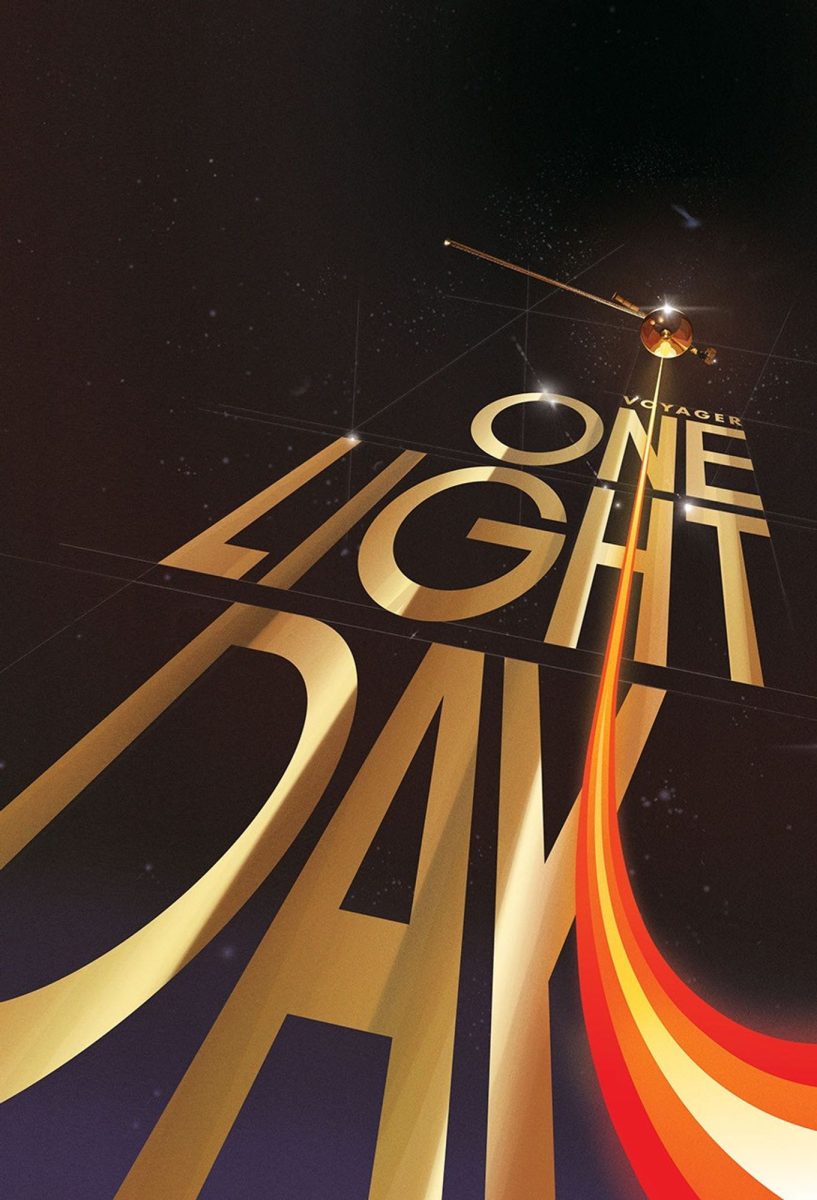
Voyager 1 itself is travelling at approximately 61,000 km/h (38,000 miles/h) relative to the Sun – almost 70 times faster than a typical passenger aircraft. Yet on interstellar scales, even that speed seems modest.
Most interestingly, reaching the one-light-day mark did not mean that the spacecraft crossed any new physical boundary. Nothing changed in its surroundings. The date matters primarily to us, because it shows just how far humanity has managed to send its technology. To understand how Voyager 1 reached such a great distance, however, we need to go back almost half a century.
How did a five-year mission become a 49-year journey?
In 1977, NASA took advantage of an exceptionally rare opportunity. Jupiter, Saturn, Uranus and Neptune were positioned in such a way that spacecraft could fly past them in succession, using their gravity to change speed and direction. A similar alignment of the outer planets occurs approximately once every 175 years.
For engineers, this was a remarkable opportunity. Instead of carrying enormous quantities of fuel for acceleration, a spacecraft could make use of the planets’ own motion around the Sun. This technique is known as a gravity-assist manoeuvre. A spacecraft passes close to a planet in such a way that it gains some of the planet’s orbital energy. As a result, it changes trajectory and can accelerate relative to the Sun while using almost none of its own fuel.
This principle allowed the two Voyager spacecraft to explore the distant planets in a relatively short time. Voyager 2 launched first, on 20 August 1977. Voyager 1 followed on 5 September. Despite their numbering, the second spacecraft launched earlier, but the first took a faster trajectory and overtook its twin in December of the same year.
Both spacecraft were designed for a service life of approximately five years. Their original objective was to study Jupiter, Saturn and their moons. In March 1979, Voyager 1 reached Jupiter. Its photographs revealed the giant planet’s atmosphere in unprecedented detail and helped scientists discover Jupiter’s faint rings and two new moons.
But the greatest surprise lay elsewhere.
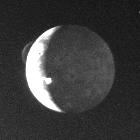
In images of Io, scientists noticed enormous plumes of material rising above the surface. These were active volcanoes – the first time humanity had directly observed active volcanism beyond Earth. Some volcanic plumes on Io rise hundreds of kilometres into space. By comparison, ordinary volcanic clouds on Earth generally do not reach even one-tenth of that height.
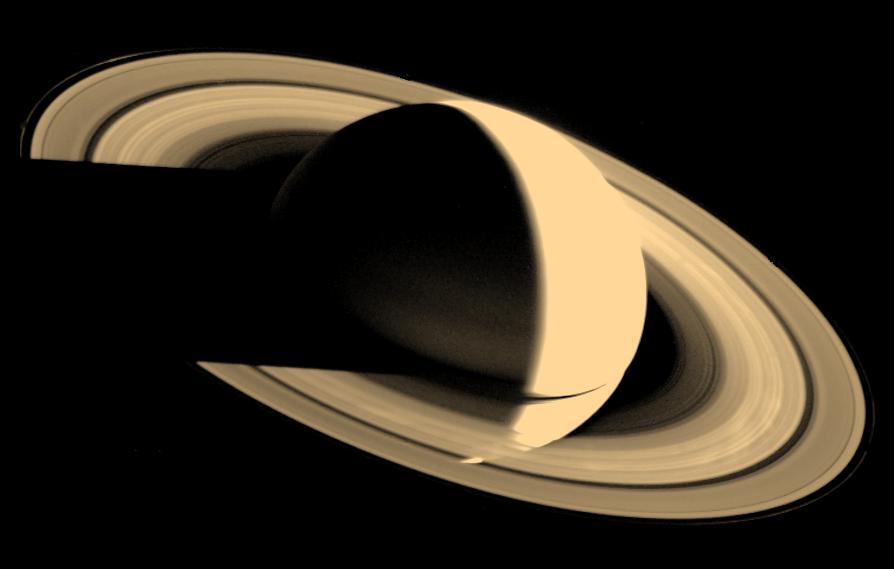
The discovery transformed our understanding of the moons of giant planets. They were not merely cold, rocky or icy bodies, but entire worlds with geological activity of their own. In November 1980, Voyager 1 flew past Saturn, discovering new moons and complex structures within its rings. Scientists were particularly interested in Titan – the planet’s largest moon, enveloped in an exceptionally dense atmosphere.
The need to fly close to Titan determined the spacecraft’s subsequent fate. The gravity-assist manoeuvre altered its trajectory, sending Voyager 1 far from the plane of the planetary orbits. It could no longer continue to Uranus and Neptune. That task fell to Voyager 2, which later became the first, and remains the only, spacecraft to visit both planets. For Voyager 1, the planetary phase of the mission was effectively over. But an entirely different exploration lay ahead.
What did humanity leave aboard a spacecraft that may outlive our civilisation?
Even before Voyager 1 launched, engineers knew that it would continue travelling through space after completing its exploration of the planets. One day, it might travel so far that Earth would lose contact with it forever.
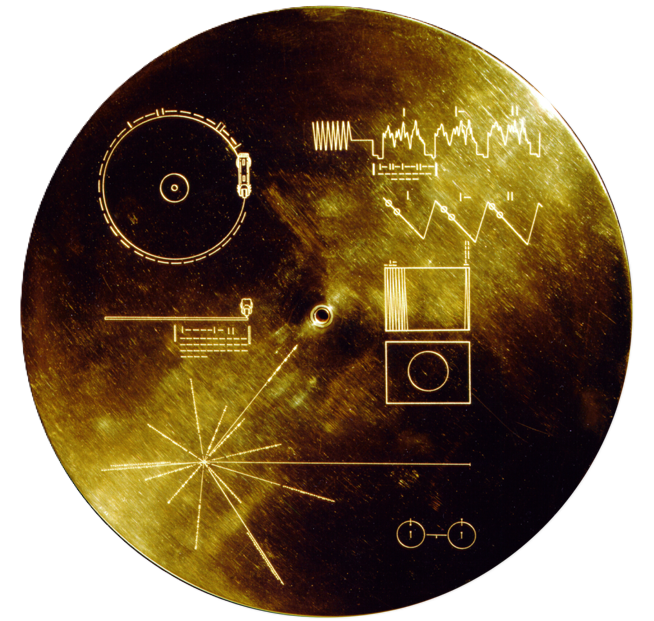
NASA therefore decided to send something special aboard the spacecraft. Both Voyager 1 and Voyager 2 carried a Golden Record – a gold-plated copper disk measuring 30 cm (12 inches) in diameter, intended as a message from humanity. Its contents were assembled by a team led by astronomer Carl Sagan. The record includes 115 images depicting life on Earth, greetings in 55 languages, sounds of nature, and 90 minutes of music from different cultures and eras. Among the recordings are whale song, the sound of wind, human laughter, works by Bach and Mozart, and rock and roll by Chuck Berry.
The protective cover bears symbolic instructions explaining how to play the recording, along with a diagram showing the Sun’s position relative to pulsars – a kind of cosmic address for Earth. Of course, the likelihood that an extraterrestrial civilisation will ever find a small spacecraft in the vastness of space is extremely low. But the idea was not solely about possible contact. The Golden Record became a time capsule capable of preserving evidence of humanity’s existence long after the spacecraft themselves have ceased operating.
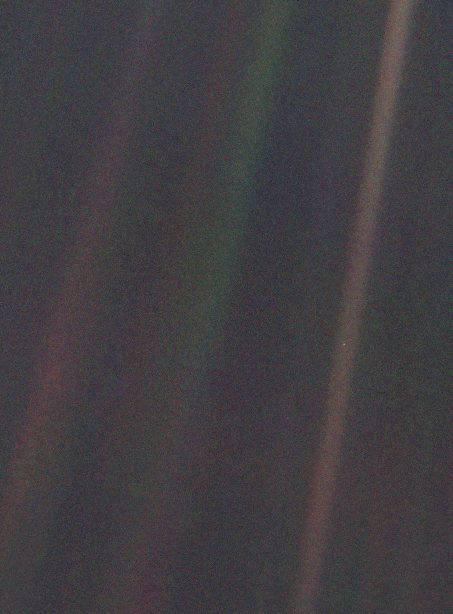
Yet Voyager 1 left its most famous message not on the Golden Record, but through its own camera. On 14 February 1990, when the spacecraft was approximately 6.4 billion km (4 billion miles) from Earth, NASA turned its cameras towards the Solar System for the last time. The result was the famous image known as the Pale Blue Dot.
In the photograph, Earth appears as a tiny point of light lost among rays of sunlight. No continents, oceans or human cities are visible – just a few pixels containing the entire history of our civilisation. After this series of photographs, Voyager 1’s cameras were switched off to conserve energy for the next stage of exploration. The spacecraft never photographed the planets again. It travelled onwards to a place where ordinary images could no longer tell the most important part of the story.
How did Voyager 1 become the first spacecraft to reach interstellar space?
The Sun does more than emit light and heat. It constantly releases streams of charged particles known as the solar wind. Together with magnetic fields, these particles create an enormous region around the Sun called the heliosphere. It can be imagined as a kind of bubble within which the solar wind pushes against the surrounding interstellar medium.
But this bubble is not infinite. At great distances, the pressure of the solar wind is gradually balanced by that of the interstellar medium. The boundary between them is called the heliopause. On 25 August 2012, Voyager 1 crossed this boundary and became the first human-made spacecraft to enter interstellar space. Scientists established this from changes in the properties of charged particles and plasma around the spacecraft. In particular, they found evidence of a much higher plasma density, characteristic of the interstellar medium.
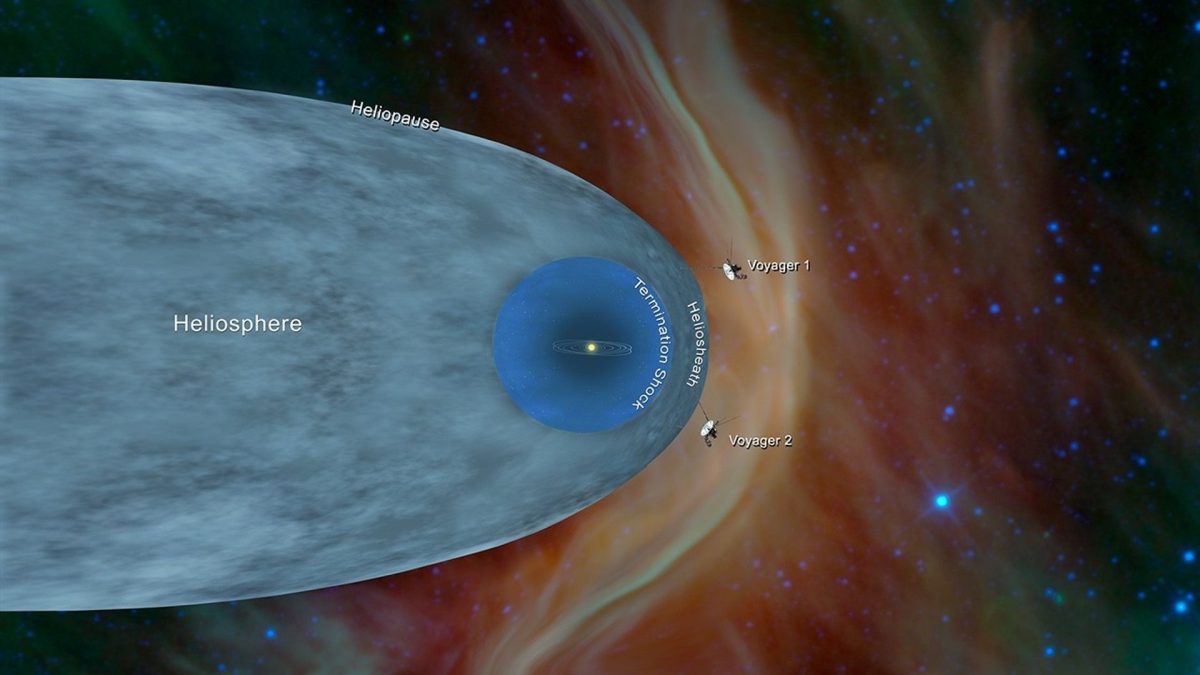
There is, however, an important distinction: leaving the heliosphere does not mean leaving the Solar System altogether. The Sun’s gravitational influence extends much farther. Ahead lies the hypothetical Oort Cloud – an enormous, distant region of icy bodies. According to NASA estimates, Voyager 1 will take approximately 300 years merely to reach its inner edge and perhaps around 30,000 years to pass through the entire region.
The spacecraft has therefore already become an interstellar traveller, but its journey beyond the Solar System in the broader sense is still far from complete.
How can you control a spacecraft when a signal takes a whole day to reach it?
Over almost half a century, Voyager 1 has outlasted several generations of computer technology. Its onboard systems were developed at a time when home computers were only beginning to become popular. Today, an ordinary smartphone has incomparably greater computing power. But Voyager 1’s strength does not lie in its processing performance.
Its defining feature is its ability to operate autonomously for decades, withstand extreme conditions, and maintain contact with Earth. To communicate with it, NASA uses the Deep Space Network – an international network of large radio antennas located in the United States, Spain and Australia. Some antennas are 70 m (230 ft) in diameter, roughly two-thirds the length of a football pitch. Their geographical distribution allows communication with distant spacecraft as Earth rotates.
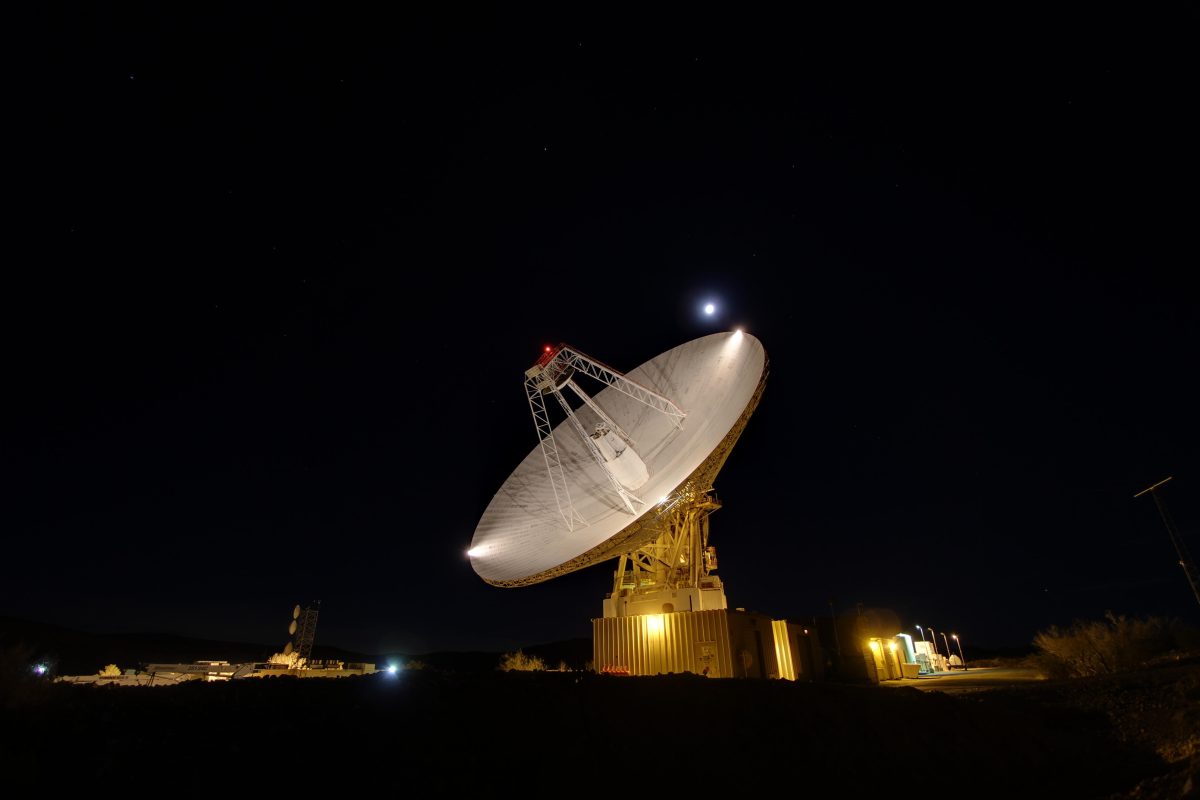
Yet even the largest antenna cannot overcome a fundamental limitation – the speed of light. If engineers send a command to Voyager 1 today, it will not arrive until the following day. They must then wait approximately another day to learn the result. In effect, every decision becomes an experiment lasting at least 48 hours. This is particularly challenging when faults develop aboard the spacecraft.
In November 2023, Voyager 1 stopped transmitting intelligible scientific and engineering data. For almost five months, engineers worked to identify the cause. They eventually discovered that part of the memory in one of its onboard computers had been damaged. Replacing the chip was impossible, so they had to divide the software code into sections and move them to other areas of memory. In April 2024, the spacecraft resumed sending accurate information about its condition and later restored scientific observations.
And that was not the last challenge. In October 2026, contact with Voyager 1 was unexpectedly lost for approximately two days before being restored. Engineers determined that one set of attitude-control thrusters had shut down, after which the backup set was activated. However, the mission’s principal problem is becoming increasingly serious – a shortage of electrical power.
What will happen when Voyager 1 finally falls silent?
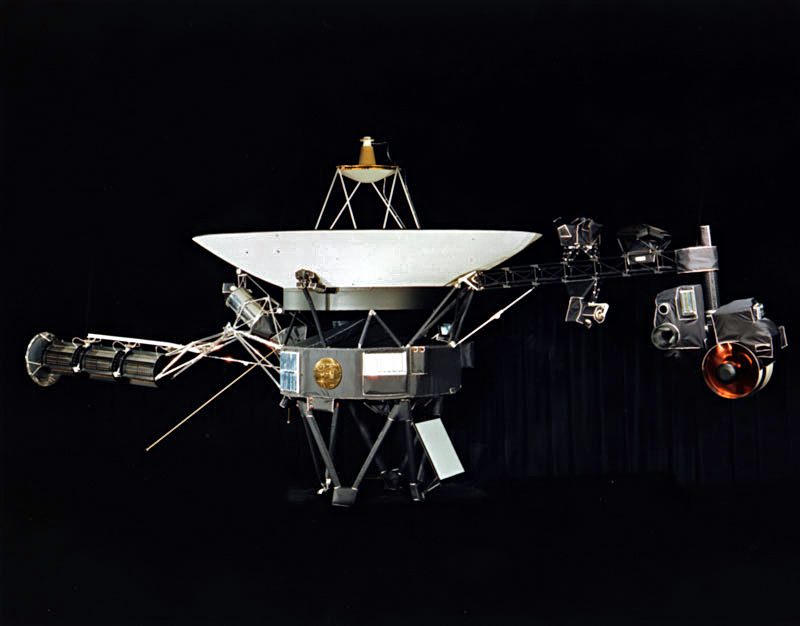
At such a distance, solar panels cannot realistically provide the electricity the spacecraft needs. Voyager 1 therefore uses three radioisotope thermoelectric generators, which convert heat from the radioactive decay of plutonium into electricity. These are not nuclear reactors. They contain no controlled chain reaction – only the natural release of heat, some of which is converted into electrical energy. Over time, however, their power output decreases by approximately 4 W each year. At first glance, that may not seem much – roughly the power consumed by a small LED lamp.
For a spacecraft with a limited power budget, however, every watt matters. Engineers are gradually switching off equipment that is not essential for continued operation. In April 2026, NASA switched off the instrument used to measure low-energy charged particles. As a result, Voyager 1 was left with only two active scientific instruments: the magnetometer and the plasma wave detector.
In September 2026, engineers also completed a complex operation to transfer several systems to more energy-efficient equipment. This allowed them to postpone the next shutdown of a scientific instrument. Nevertheless, the gradual depletion of the power supply cannot be stopped. Sooner or later, Voyager 1 will cease transmitting scientific data and eventually lose contact with Earth altogether. The precise date will depend on the remaining electrical power and the condition of its equipment.
Even then, its journey will not end. Without the need to operate its thrusters continuously, the spacecraft will continue moving through space under its own momentum. In approximately 40,000 years, Voyager 1 will pass within about 1.7 light-years of the star Gliese 445. And this will be just one of countless stages in its journey around the centre of our Galaxy.
And aboard it, the Golden Record will remain, carrying human voices, music and the sounds of Earth.
Voyager 1 was designed for a few years of planetary exploration, but it became humanity’s longest-running space expedition. It discovered new worlds, became the first spacecraft to reach interstellar space, and showed us Earth as a tiny blue dot in the vastness of the Universe.
One light-day is not the end of its journey. It is a reminder of just how far human curiosity and engineering ingenuity can take us.
And one day, when Voyager 1’s final signal disappears into the noise of space forever, the spacecraft will continue on its way – without us.
To explore this extraordinary story in detail, from the first discoveries near Jupiter to the milestone of 18 November 2026, watch our video ‘Voyager 1 – One Light-Day from Earth’ on the Universe Space Tech YouTube channel.
