

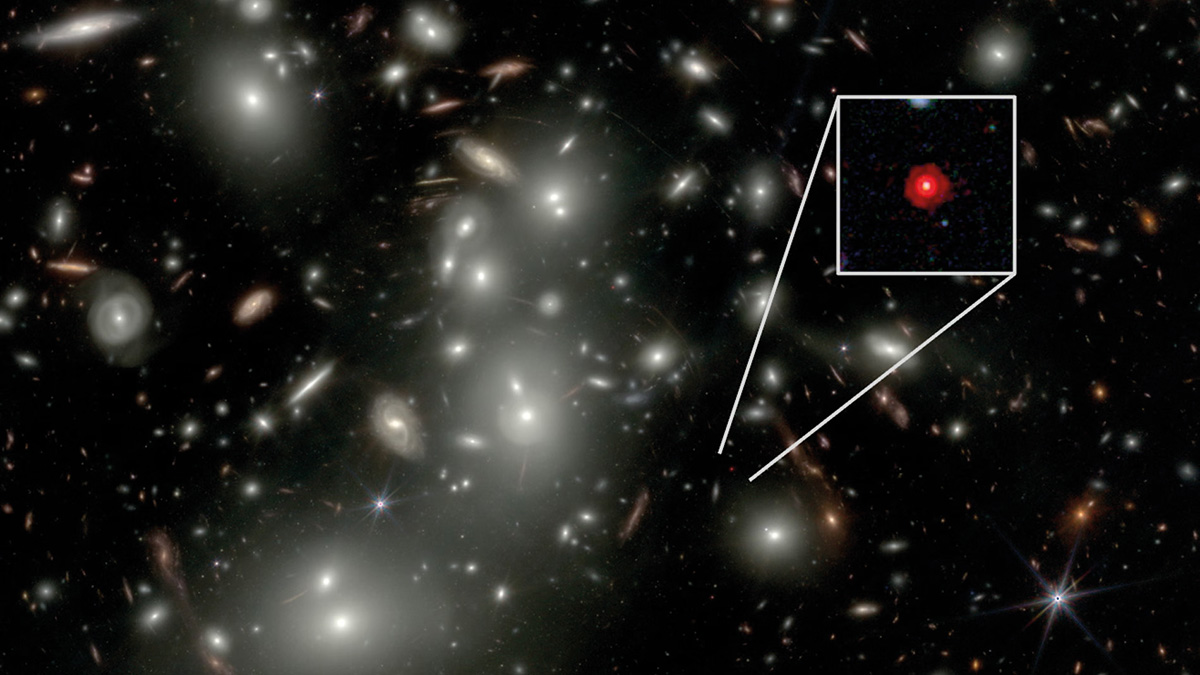
The little red dots in James Webb images may be galaxies in which the first supermassive black holes are forming at their centers. Each such black hole forms from the collapse of a supermassive star and remains hidden inside a dense gas disk from which the star originally formed. According to new simulations, this explains both the dots’ unusual spectra and their disappearance.
A trap for X-ray radiation
A team led by Daniel Whalen of the University of Portsmouth simulated how, in the early Universe, a cloud of gas flows into a disk and forms a single supermassive star instead of numerous smaller stars. After one or two million years, this star collapses, producing a direct-collapse black hole with a mass of about 100,000 solar masses. The study was published in the peer-reviewed journal The Astrophysical Journal Letters.
At the center of the disk, the density exceeds 10 billion particles per cubic centimeter, trapping the black hole’s X-ray radiation in the gas. The researchers even increased its intensity to the level expected from a black hole with a mass of 10 million solar masses, but it still could not escape. Other radiation partially gets out, making the object bright but without an X-ray signal.
An overview of the mysterious Little Red Dots detected in the early Universe. Source: Astrum YouTube channel.
What these dots actually are determines how we explain the black holes that appear too massive for their age in images from James Webb. Remnants of the first stars had masses of tens or hundreds of solar masses, while direct-collapse black holes start at around 100,000 solar masses, giving them a head start in their growth.
Two sources of the same light
The dots appear red in images because they emit most of their energy in the red and infrared ranges. However, they are also bright in ultraviolet light, while appearing fainter in the intermediate range between them. As a result, their brightness plotted against wavelength has two peaks with a dip in between, resembling the letter V. Neither an ordinary dusty galaxy nor a known type of active galactic nucleus produces this combination, so for a long time it was unclear where the two peaks came from.
According to the model, there are two sources. The red peak comes from gas surrounding the hidden black hole, while the ultraviolet peak comes from stars in a nearby dense cluster. These stars have a combined mass of 120 million solar masses and are packed into a region about 1,000 light-years across. The cluster is so dense because gas in the galaxy accumulates toward the center, where stars form.
In the model, the center of the cluster is displaced from the black hole by approximately 250 light-years. In gravitationally lensed dots, the red and ultraviolet components are also separated by between 160 and 330 light-years, which supports the model.
Agreement with observations
The researchers compared their calculations with the spectra of five real dots and found a good match. The black hole in the most distant of them had previously been estimated to have a mass of 300 million solar masses, while its stars were estimated at one billion solar masses. Such masses are difficult to explain because star formation should somehow have slowed down while the black hole was growing. The spectrum of this dot could be reproduced using a black hole with a mass of 10 million solar masses and stars with a combined mass of 120 million solar masses.
Previous explanations, ranging from supermassive stars to compact star clusters, explained only part of the observations. Therefore, Universe Today calls the new model the best explanation of the dots to date.
Why the dots disappeared
The dots were numerous about 600 million years after the Big Bang, but by 1.5 billion years after it, their numbers had decreased significantly. Other simulations suggest that direct-collapse black holes formed most frequently between 500 and 650 million years after the Big Bang, before the gas became enriched with heavier elements. Heavy elements cooled the gas more efficiently, causing clouds to fragment into numerous smaller clumps from which much lower-mass stars formed. As a result, new direct-collapse black holes no longer appeared.
The black holes that had already formed continued to grow until their X-ray radiation broke through the disk and the characteristic spectrum of the dots disappeared. “Perhaps we are witnessing the birth of the first supermassive black holes,” says Daniel Whalen.
In some of the first observing programs of the Roman Space Telescope, researchers will search for red dots at later cosmic epochs, closer to our own time. A team led by Vasily Kokorev of the University of Texas at Austin will investigate whether their numbers really decrease over time. A sharp decline would support the black hole growth phase scenario.
