

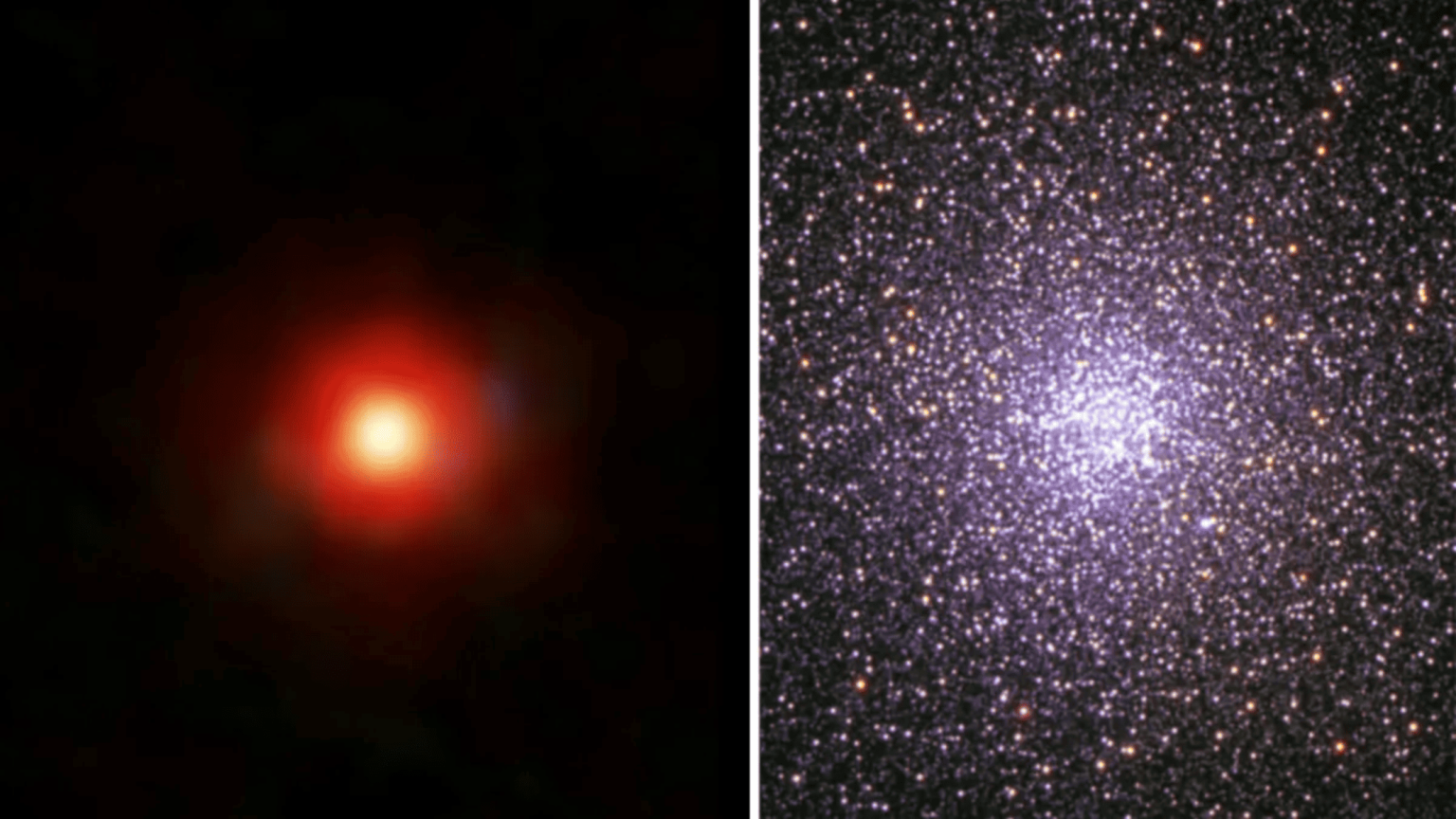
Small red dots are visible only in the distant past of the Universe. The closer observations come to the present day, the fewer of them appear in the data, until they disappear entirely. These objects may not have been destroyed but may instead have gradually changed their appearance. A new study suggests that they eventually evolved into dense concentrations of stars.
A Vanished Population
Objects known as Little Red Dots have been detected by the James Webb Space Telescope since 2022. The earliest examples date to an epoch approximately 600 million years after the Big Bang.
Then something unusual happens. Once the Universe reaches an age of about two billion years, every trace of these objects disappears.
Many explanations have been proposed. One suggests that they are black holes concealed within enormous envelopes of gas and dust. A team from the University of Texas at Austin has offered an alternative in a preprint that has not yet undergone formal peer review and is available on arXiv.
Overview of the mysterious red dots observed in the early Universe. Source: Astrum YouTube channel
Familiar but Still Mysterious
Globular clusters are found mainly in large galaxies and contain up to several million ancient stars packed into a relatively small volume. The Milky Way alone contains at least 150 of them, Space.com notes. Despite their long history of study, the mechanism by which such systems form remains unclear.
The difficulty is that observations show these clusters only after billions of years of evolution. Their massive stars have already disappeared, the gas has dispersed, and dynamical processes have altered their mass and structure. Reconstructing the initial conditions from such a picture is almost impossible, explained Danielle Berg of the University of Texas.
Traces of Extremely High Temperatures
According to the classical model, a cluster formed during a single episode of star formation, when cosmic matter consisted primarily of the two lightest elements and contained only tiny amounts of everything else. Observations contradict this picture. Many stars in such clusters show excesses of helium, nitrogen, sodium, and aluminum, while carbon, oxygen, and magnesium are noticeably less abundant than theory predicts.
The chemical inhomogeneity of these systems has remained unresolved for more than half a century. As early as the 1970s, spectroscopy revealed that stars within the same system could have significantly different proportions of heavy elements, even though the prevailing view held that they should all have originated from a single gas cloud.
This combination points to thermonuclear fusion at temperatures far higher than those found even in the interiors of ordinary massive stars, said Mike Boylan-Kolchin of the University of Texas. According to him, the necessary conditions could be created inside an extraordinarily massive star.
A Supermassive Star as the Solution
In the model, the source of such heat is a supermassive star, a hypothetical object with a mass between one thousand and ten thousand times that of the Sun. It may have formed in the extremely dense environment of a young cluster, where stellar collisions and mergers occurred repeatedly.
Such an object may have existed for approximately one million years, an extremely brief period by cosmic standards. By comparison, the Sun, at 4.6 billion years old, is roughly halfway through its evolution. Nevertheless, this interval would have been sufficient to produce the required elements in the necessary proportions. A supernova explosion would then scatter this material into the surrounding region, where it could become the building material for the next generation of stars.
Similarities in Mass and Timing
Chemistry is not the only argument supporting this connection. According to the team’s calculations, the spatial distribution of Little Red Dots in the early Universe corresponds to the distribution of globular clusters today. Models of the evolution of these objects also indicate a similarity in mass, since their estimated values could plausibly evolve into those measured in the modern Universe.
Chronology provides another clue. The mysterious objects appear at approximately the same time that such systems are believed to have begun forming. There is still no single decisive piece of evidence, Mike Boylan-Kolchin acknowledges, but this explanation accounts for many otherwise unrelated observations at once.