

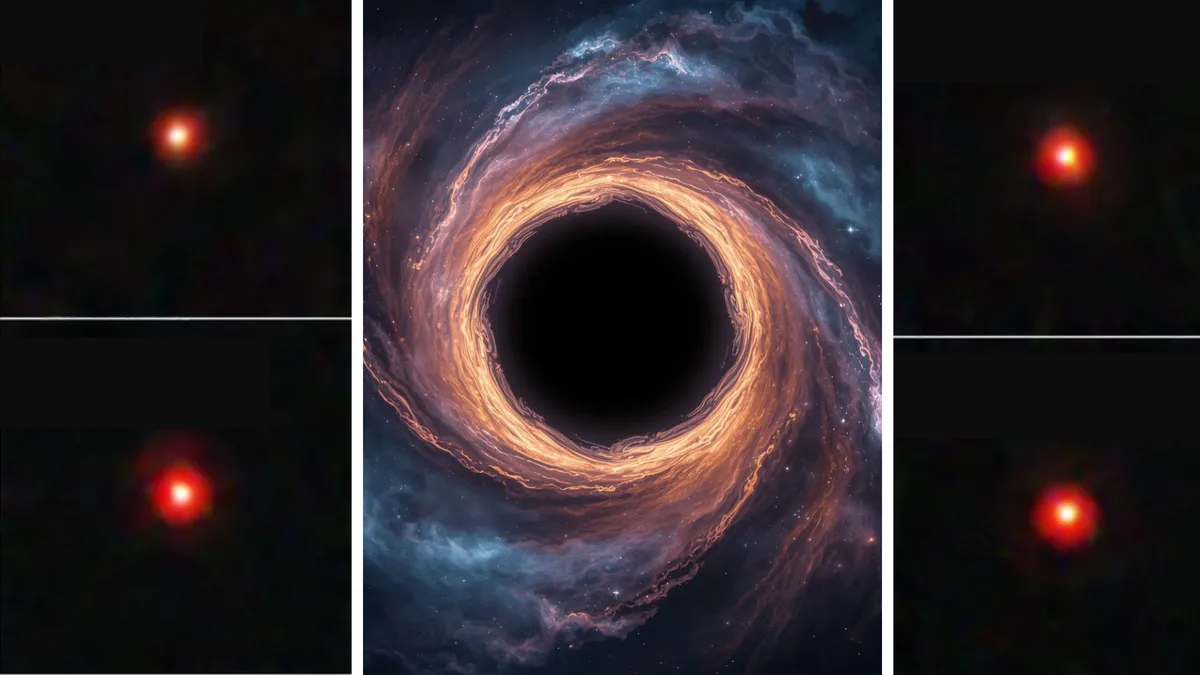
The mysterious little red dots seen in images from the James Webb Space Telescope may turn out to be black holes around which gas accumulates faster than it falls inward. This conclusion follows from a computer simulation of the early Universe that was created for an entirely different purpose, yet these objects appeared in it on their own, without adjusting the parameters to fit them. The same mechanism also explains how the first supermassive black holes managed to gain enormous mass in a short period of time.
An Unusually Massive Start
Observations with the James Webb Space Telescope have presented astronomers with two problems that have no obvious solution. The first concerns supermassive black holes, billions of times heavier than the Sun, which already existed when the Universe was less than one-tenth of its current age. A black hole left behind by the collapse of a single star would not have had enough time to grow that large even through gas accretion and mergers, so the usual scenarios do not work here. No less puzzling are the little red dots — compact sources with spectra strongly dominated by long red wavelengths — seen during the period from 600 million to one billion years of cosmic history.
In the simulation, whose results were published in the peer-reviewed journal Nature, black holes began their growth with much greater masses. The work was carried out by a team led by Sunmyon Chon of the Max Planck Institute for Astrophysics together with colleagues from the University of Tokyo and the universities of Kanagawa and Chiba. Ultraviolet radiation from a neighboring galaxy undergoing intense star formation prevented a nearby cloud from fragmenting into smaller clumps. The gas was able to accumulate in large quantities and eventually collapsed into supermassive stars of several hundred thousand solar masses.
About two million years later, the giants left behind black holes of around one million solar masses each. Black holes formed from the remnants of the first generation of stars in the same model started with only 800 solar masses.
By 650 million years after the Big Bang, these objects already weighed about 30 million solar masses. That is seven times more than Sagittarius A*, the central black hole of the Milky Way, which is about four million times more massive than our star.
An Excess of Gas
Young galaxies received enormous streams of dense gas, much of which moved toward the center. When matter reaches a black hole too quickly, it does not have time to fall through the event horizon and instead begins to swirl around it because it retains its rotational motion. This creates a massive opaque envelope through which light cannot pass directly.
Normally, the growth rate of a black hole is limited by its own radiation, which pushes away the surrounding medium. Inside the envelope, some photons become trapped and move inward together with the infalling matter. As a result, in less than a million years, the mass increased several times or even several dozen times faster than the so-called Eddington limit.
Theorists call such a configuration — a black hole inside a giant cocoon of gas — a quasi-star. According to Sunmyon Chon, this is the first time such a structure has formed naturally in a cosmological simulation. The scientist also told Space.com that the simulation had been created to study the origin of the first massive black holes, and no one expected the red dots to emerge from it.
Why the Dots Are Red
The color and broad hydrogen lines characteristic of these compact sources have a simple explanation in the model. Radiation produced near the black hole must pass through the envelope, so its wavelengths are altered along the way. Scattering by free electrons makes these spectral features even broader, just as in real observations.
The phase when the envelope is densest and almost completely blocks the light lasts from one hundred thousand to one million years. It then becomes more diffuse, and the black hole appears as a more conventional active galactic nucleus — a compact central source that shines because matter is falling into it.
Questions for Theorists
The simulation does not explain why the little red dots disappear at later epochs. The calculation covers only one region of the early Universe and does not include plasma jets or winds through which a black hole ejects some matter outward, so the resulting growth rate should be regarded more as an upper limit of what is possible.
Next, the team plans to test whether the scenario is reproduced under different initial conditions and to prepare predictions for comparison with new James Webb data. Observations of little red dots are accumulating so quickly that theorists now have to keep up with them by producing new predictions.
