

A scientific mystery is unfolding around the small space object 1998 KY26, towards which Japan’s Hayabusa2 spacecraft is currently travelling. The small body, approximately 11 metres in diameter, rotates on its axis every five and a half minutes and is about 299 million kilometres from Earth. It is displaying unusual behaviour: it is accelerating.
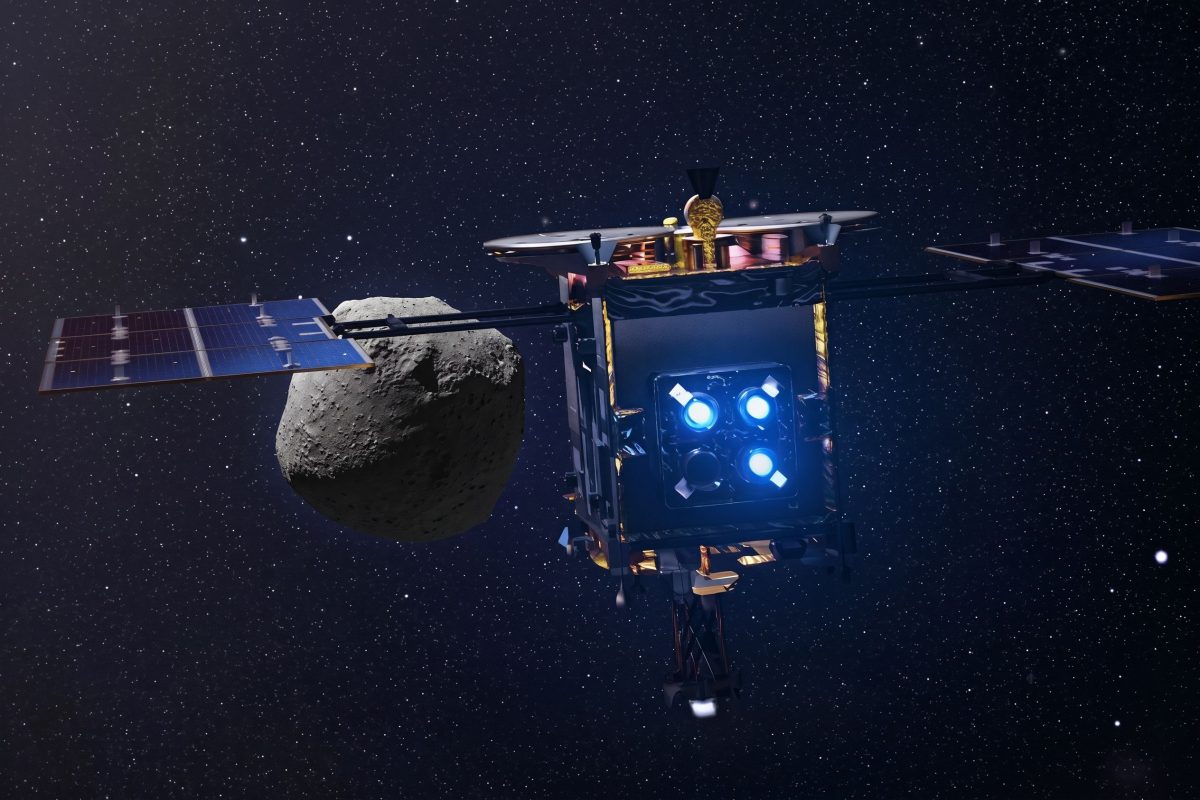
The acceleration of asteroids or comets is not unusual in itself. In this case, however, the motion is clearly being driven by a source of thrust that scientists cannot yet explain.
The situation has prompted several hypotheses. Harvard astronomer Avi Loeb has put forward the unconventional suggestion that 1998 KY26 may not be a natural body at all, but an abandoned Soviet spacecraft launched almost 40 years ago.
A more conservative theory classified the object as a so-called “dark comet”—a rocky asteroid that accelerates through the undetectable evaporation of its internal ice reserves.
Too Hot for Ice
However, a new study published in the scientific journal Icarus rules out the “dark comet” explanation. Aerospace engineers Corbin Hansen and Masatoshi Hirabayashi of the Georgia Institute of Technology carried out detailed thermal modelling of the object using available observational data.
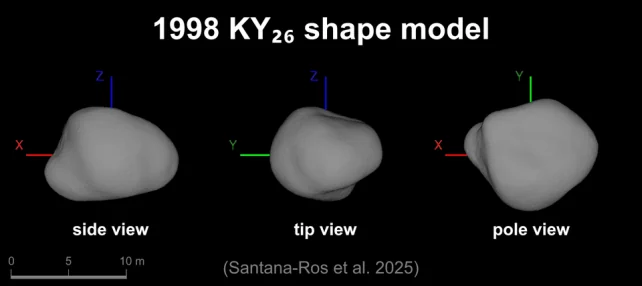
The findings showed that 1998 KY26 is too warm to retain frozen water. Even in its coldest and most heavily shaded regions, temperatures rise above −60 °C. By cosmic standards, this may seem cold, but in the vacuum of space, that temperature is too high: water vapour would escape too rapidly. At this temperature, the object would exhaust its entire ice supply in just 62 years—a mere instant compared with the billions of years that make up the lifetimes of typical asteroids.
An Artificial Origin?
The study’s authors concluded that 1998 KY26 is a “dehydrated asteroid” that lost all its water in the distant past. This means that thrust from sublimating ice cannot be responsible for its acceleration.
Among the possible natural explanations, scientists are now considering solar radiation pressure or so-called “thermal radiation forces”—the Yarkovsky effect, in which an unevenly heated asteroid re-emits heat and receives a small but steady push.
Japan’s Hayabusa2 probe is expected to provide a definitive answer. In July 2031, the spacecraft will reach the object and examine it at close range, allowing researchers to see for themselves what is accelerating this mysterious celestial body.
We previously reported on how an interstellar meteorite fell to Earth.
Based on reporting by Science Alert.
