

Japan’s Subaru Telescope has studied the nucleus of the short-period comet Encke. The research has helped scientists understand the factors that cause its orbit to change.
The Hidden Nuclei of Comets
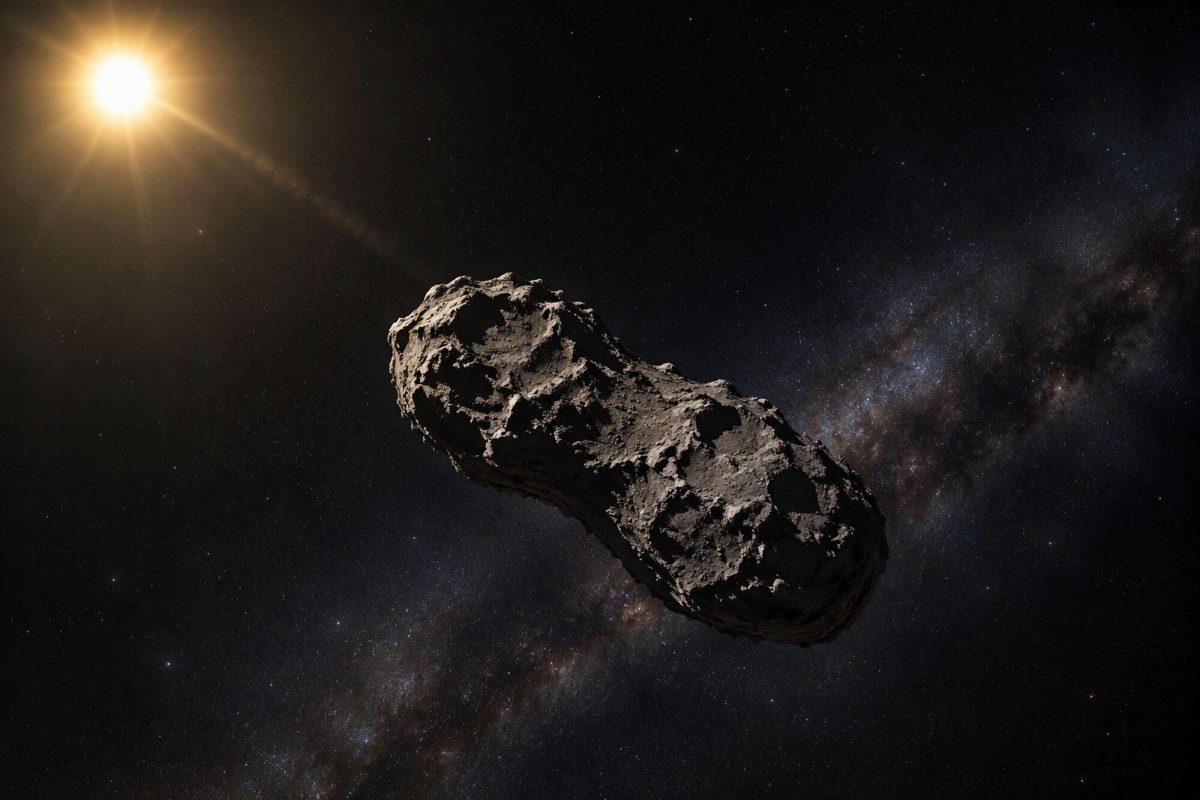
Mid-infrared observations made with the Subaru Telescope have revealed the shape and surface temperature of the nucleus of comet 2P/Encke. By analysing how the nucleus’s thermal emission changed as it rotated, researchers found that it is elongated, with a long axis of approximately 7 km and a short axis of about 3 km.
They also determined that its surface temperature at the time of observation was 328 ± 7 kelvin, or approximately 55 °C. According to Phys.org, the findings, published in The Astronomical Journal, offer new clues to understanding changes in cometary activity and orbits, as well as the early history of the Solar System.
Comet Encke (2P/Encke) is named after the nineteenth-century German astronomer Johann Encke, who studied its orbit in detail and demonstrated that it is a periodic comet passing the Sun approximately once every 3.3 years. Encke also discovered that the comet’s orbital period was gradually shortening, but the reason remained unknown. A clue to this mystery lay in its nucleus.
In the mid-twentieth century, American astronomer Fred Whipple proposed that when a comet releases gas and dust as it approaches the Sun, the resulting recoil force changes its orbit. He also proposed the “dirty snowball” model, in which the nucleus consists of ice mixed with dust. This model remains the foundation of our understanding of comets.
Cometary nuclei preserve material from the birth of the Solar System 4.6 billion years ago, making them important objects of study. However, when a comet approaches the Sun, gas and dust released from its nucleus spread out around it, forming a cloud-like structure called a coma. This makes it difficult for ground-based observatories to observe the small nucleus at its centre directly.
Comet Encke’s Elongated, Warm Nucleus
A research team from the University of Occupational and Environmental Health, Kyoto Sangyo University and Photocross Co., Ltd. analysed mid-infrared data on comet Encke, at wavelengths of approximately 10 micrometres, obtained with the Subaru Telescope in November 2003. The observations were carried out using the Cooled Mid-Infrared Camera and Spectrometer (COMICS).
Mid-infrared observations can detect thermal emission from the nucleus itself. Thanks to the Subaru Telescope’s high spatial resolution, comet Encke appeared as a point source, indicating that emission from the coma made only a small contribution to the observed signal.
The analysis showed that the comet’s brightness varied during the observations. This is thought to result from the rotation of an elongated nucleus, which changes the apparent area of its surface as seen from Earth. From this variation in brightness, the team estimated that the nucleus is an elongated ellipsoid measuring approximately 7 kilometres (4.3 miles) along its long axis and about 3 kilometres (1.9 miles) along its short axis.
Previous visible-light and radar observations had also suggested that Encke’s nucleus might be elongated, while spacecraft observations have revealed cometary nuclei with complex, distinctly non-spherical shapes. This study provides an independent estimate of Encke’s shape based on thermal emission from the nucleus itself.
By analysing thermal emission recorded at different wavelengths, the team found that the nucleus’s surface temperature was 328 ± 7 kelvin, or approximately 55 °C, when the comet was about 1.1 astronomical units (AU) from the Sun. This agrees well with the temperature of approximately 327 kelvin predicted by an empirical model based on earlier observations. The nucleus’s surface temperature reveals how it absorbs sunlight and radiates heat into space, providing insight into its thermal properties and helping scientists understand its activity.
A “Non-Gravitational” Change in Orbit
Comet Encke holds a special place in the history of cometary research. It was one of the cases that led scientists to the concept of a “non-gravitational effect,” in which a jet of gas from the nucleus acts like a rocket engine, pushing the nucleus and changing its orbit.
The magnitude and direction of this effect depend on the nucleus’s shape and rotation, as well as where gas is released and in which direction. The shape identified in this study cannot be directly established as the cause of the change in Encke’s orbital period. Nevertheless, the shape and dimensions determined here provide fundamental information for understanding the comet’s activity and the long-term evolution of its orbit.
The Observatory on Maunakea: A Window into Cometary Nuclei
In 2021, the same team also succeeded in detecting the nucleus of another comet in the mid-infrared. Together with the current findings, ground-based observations are gradually revealing the nature of cometary nuclei.
The mid-infrared range is well suited to detecting thermal emission from a nucleus, but it is challenging for ground-based observations: mid-infrared radiation is readily absorbed by water vapour in Earth’s atmosphere, while both the telescope and the atmosphere emit strong thermal radiation of their own.
At an altitude of approximately 4,200 metres (13,800 feet), the summit of Maunakea is dry and has little water vapour, making it well suited to mid-infrared observations. Taking advantage of this excellent location and the Subaru Telescope’s large 8.2-metre aperture, COMICS was a world-class instrument capable of both imaging and spectroscopy at high spatial resolution.
COMICS concluded its observations on the Subaru Telescope in 2020. At present, no instrument on Maunakea can routinely conduct mid-infrared observations. A plan to bring COMICS back into operation is now being developed under the leadership of Dr Takafumi Ootsubo of the University of Occupational and Environmental Health, who led this study.
